
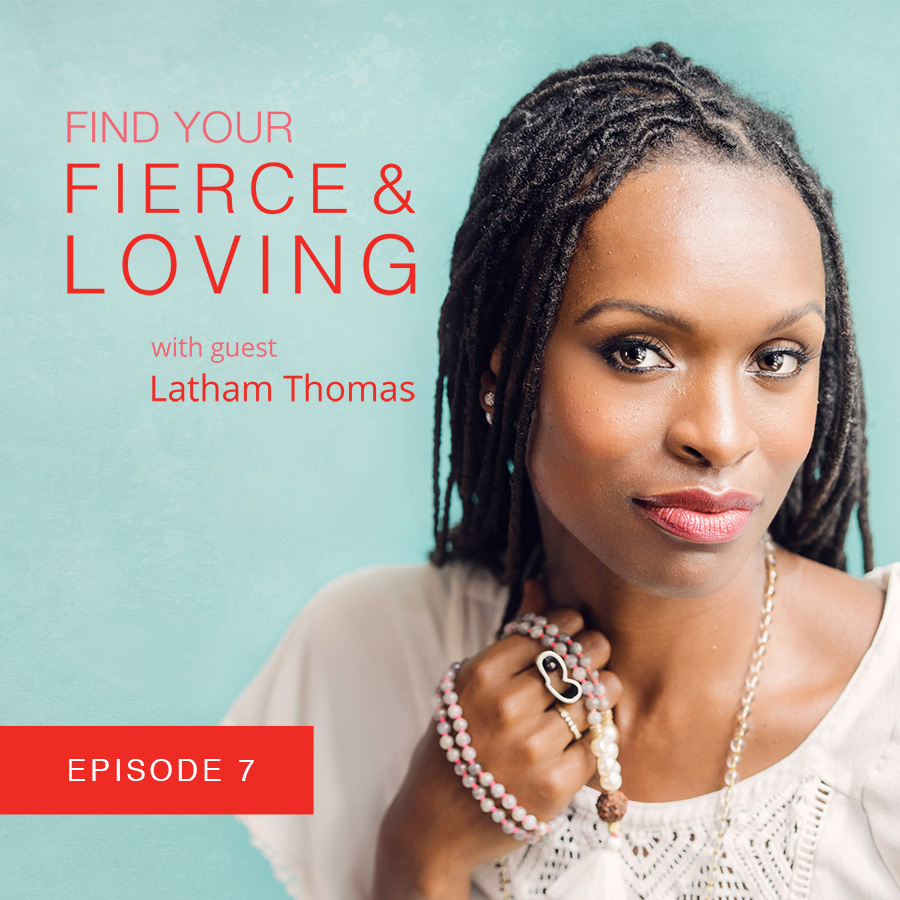
“Beautiful things can be born out of crises if we move in the energy of gratitude and possibility.” – Latham Thomas
As humanity births a new paradigm of existence we are confronted with the realities of systemic dysfunction and called to deliver a new world that works sustainably, holistically, and generously. Latham Thomas has devoted her life’s work as a doula, educator, and founder of Mama Glow to the optimal wellness, spiritual growth, and radical self-care of people around the globe. Take a listen as we unpack owning your glow, the Black maternal health crisis, and the necessary shift we are in the midst of.
Show Notes
What makes Latham Thomas so extraordinary and her work so critical is the lens of liberation that she brings to birth work in this country. All of her training is with Black maternal health in mind and serves as a demand to bring attention to the crises that we tolerate, that we endorse, that we remain asleep to around Black women and the birthing process in this country.
Listen in to this episode of Find Your Fierce & Loving to hear from Latham, a maternity lifestyle maven, world renowned wellness leader, and master birth doula as she talks with Lola about how the birth of her son ignited a calling she could no longer ignore and why it’s well past time to take a critical look at the state of Black maternal health in this country.
- (04:32) – Nudge into initiation
- (11:15) – Who are you really?
- (16:46) – Femme force
- (27:26) – Doula immersion
- (32:07) – Calling forward truth
- (38:36) – Crisis and gratitude
After giving birth to her son Fulano in 2003, Latham Thomas set out on a mission to help women reclaim birth. A graduate of Columbia University & The Institute for Integrative Nutrition, Latham is a maternity lifestyle maven, world renown wellness leader and master birth doula on the vanguard of transforming the wellness movement. Named one of Oprah Winfrey’s Super Soul 100, Latham is bridging the gap between optimal wellness, spiritual growth, and radical self care and is the go-to-guru for modern holistic lifestyle for women. She authored the bestselling book titled, “Mama Glow: A Hip Guide to a Fabulous and Abundant Pregnancy”, foreword by Dr. Christiane Northrup in 2012 and most recently published bestseller OWN YOUR GLOW: A Soulful Guide to Luminous Living and Crowning the Queen Within.
Do you want to unleash your inherent love and goodness, liberate yourself, and free humanity from the oppressive systems and structures we have created? We are here to support you in finding your fierce and loving life. Join us in Our Circle, a vibrant membership community rich in opportunities for personal transformation and our collective awakening. Find out more at lolawright.com/our-circle. This winter consider joining us for the Set On Fire Virtual Retreat from December 30 to January 2 – end 2020 powerfully and enter 2021 creatively, lolawright.com/set-on-fire-retreat.
You can follow Lola Wright, on Instagram, Facebook, LinkedIn, and Twitter and learn more about my work at lolawright.com.
Chicago born and built, Lola grew up in wealth and privilege, yet always sensed something was missing. She sought out aliveness and freedom in music, immersing herself in the hip hop and house music scenes of 90s Chicago. After finding herself on her own at 23, as the mother of two young children, she became determined to create a new experience.
Lola is an ordained minister with a gift for weaving together the mystical and material, she served for many years as the CEO of Bodhi Center, an organization committed to personal transformation, collective awakening, conscious activism, and community-building.
Theme music by independent producer Trey Royal.
If you’d like to receive new episodes as they’re published, please subscribe to Find Your Fierce & Loving in Apple Podcasts, Google Podcasts, Spotify, or wherever you get your podcasts. If you enjoyed this episode, please consider leaving a review in Apple Podcasts. Your reviews help others find the show.
Transcript
Latham Thomas: Sometimes you’re not there yet, and so it’s almost that cheerleading into becoming and that belief into becoming and that prayer and that affirmation and that showing up and handholding that also leads people to becoming who they are.
Lola Wright: Personal transformation and collective awakening involve being the most alive, brilliant, inspired, creative, on fire version of yourself, a version that is not consistent with the status quo. My name is Lola Wright and this is Find Your Fierce & Loving. This podcast is a wake up call, a roadmap back to your holy purpose, an invitation to set fire to the box you’ve been living in and watch it burn.
Lola Wright: Today’s episode is a real treat. We have the opportunity to hear from one of my very good friends, the brilliant Lathan Thomas. Latham Thomas is a graduate of Columbia University and the Institute for Integrative Nutrition. Latham is a maternity lifestyle maven. She is a world renowned wellness leader and master birth doula, really on the vanguard of transforming the wellness movement. Latham has been named one of Oprah Winfrey’s Super Soul 100, and Latham is bridging the gap between optimal wellness, spiritual growth, and radical self care. She is the go to guru for modern holistic lifestyle for women. She is also the author of best selling book titled “Mama Glow: A Hip Guide to a Fabulous and Abundant Pregnancy” and most recently published bestseller OWN YOUR GLOW. A Soulful Guide to Luminous Living and Crowning the Queen Within. Latham is also one of my best friends from high school. And during this pandemic, I have attended two of her extraordinary doula certification trainings. It is my deep, deep pleasure to share her brilliance with you on the Find Your Fierce & Loving podcast. Enjoy.
Lola Wright: I am so happy to have you on this podcast, brilliant woman. And before we dive in, I just want to start with an excerpt from your book Own Your Glow. And I think this is really the gift that you are to so many that interact with you. You start by saying, “I’m inviting you to your initiation. There is an ethereal glow that is maintained when we are in constant reverence of the divine source of creative energy flowing through us. That is the glow I am talking about. That light inside of you is relentless. Everything it touches in its path is graced. Here we will explore key lifestyle practices to ignite that inner light and keep it sparked. Glow to me is an actual vibration that you emanate. This guide is about finding your own creative edge, your sexy sauce, unabashedly crowning yourself, blossoming into leadership, nurturing your own nebula, and moving from the darkness into your explosive glow power that will light up the universe. If we can connect to that creative center, listen to it, feed it, nurture it, we can grow in ourselves something much bigger than our own journeys, and offer it up to the world. When you transform, everything around you will too.” And that is absolutely what I have witnessed in you. This transformative presence that is constantly recreating yourself into this bolder and bolder light. And I just am so happy you’re here. Thank you.
Latham Thomas: Wow Lola, thank you for having me. Thank you so much. It’s been a journey. It’s been years of knowing you and being in friendship, and I’m just grateful to be here.
Lola Wright: What is it like to be someone who really does evoke, invoke, invite people into their own initiation? Like you do that quite literally as a world renowned doula, but it’s really more than that. It’s the spirit of who you are, constantly nudging people into their own initiation.
Latham Thomas: You know, I think it’s like a calling, you know. So for me, this idea of, you know, the gentle nudge, the sort of handholding, the witnessing is so important for evolution. If you think about, like anything that people have journeyed towards in their lives, it’s always been about this idea of making space for what’s to come and designing for that. And as I think about, you know, ushering folks to a new place in their lives and sort of my role in that, it’s really one of witnessing. It’s really one of seeing them in their vulnerability. It’s really one of sort of protecting and holding space. And so it’s often just about, you know, supporting and allowing them to show up for themselves. And I think you know this too in the work that you do, often people just need to be seen and they also need the ability to see themselves in a way that they couldn’t before. And oftentimes it’s other people outside who offer that as an opportunity for growth. Right. Who offer up to them, this is who I see you as. Right. And sometimes you’re not there yet. And so it’s almost that cheerleading into becoming and that belief into becoming and that prayer and that affirmation and that showing up and handholding that also leads people to becoming who they are.
Latham Thomas: And so in the work, whether it’s doula work, whether it’s, you know, supporting, you know, women who are on the path to become birth workers and doulas, Like it’s me seeing not just the potentiality, because I think this idea of potential has been really reduced to like, you know, the pinnacle of some of what somebody might be if they had the right circumstances. But I see it as like not potential. I see it as potency, you know, like I see the fullness of who you are when you walk through the door. Right. And who you are becoming, not who you’re, you know, if only this and only that circumstance. No, there are certain things that are put into our lives that unfold a certain way, and I believe that with that we’re allowed or offered an opportunity to step into the nature of who we are in that moment and meet that circumstance or meet that challenge and triumph over it. And so that’s sort of where I like to play, I think. And space is really, like in that, in that space of seeing people cross this threshold and become something that they didn’t know they could become and to come on the other side with something they didn’t have before they started.
Lola Wright: It’s so interesting that you say that, and I’ve shared this story with you a number of times. But I think it was probably about nine or ten years ago, and I was, you know, working in corporate America at the time, doing so much of my own, like soul work and had been for a long time but had not quite figured out how to pivot out of banking. Like I was just like, I cannot imagine this is what I’m on the planet for. Nothing wrong with banking for those who are called to it. Like, there you go.
Latham Thomas: God bless.
Lola Wright: Right. It wasn’t mine. And I remember being on the phone with you, and I was sitting at the edge of my bed. And I was just like, oh, and you were like, Lola, just start by offering a circle in your house. Start where you are. Do not allow the bigness of your desires to hold you back from moving something forward right now. And it was this like loving nudge. Exactly. It wasn’t like, what’s your problem? It was really just like, hey, you can do this. Start where you are. And I never could have imagined from that conversation very shortly thereafter would I have found myself leading this really dynamic community that transformed thousands of lives. So, I mean, I just think that is precisely.. I was birthing a new iteration of self, and you held space in that process.
Lola Wright: So I just I love that you.. because we can all find ourselves there. Right. It’s like a crossroads. You know, you talk about this in your book like whether it’s the time, you know. You know it’s time to leave your partner. You know it’s time to leave a job. You know it’s time to do something differently. And then, you know, how have you organized your environment, your support system, your circumstances to really allow you to step into this next iteration?
Latham Thomas: Right. Yeah, I think that’s what it’s all about. I think it’s being really aware of this time that we have precious little of and using it and expanding it and making it your own, like only you can do what you’re here to do. Like I can’t do it. And I think it’s so interesting how, you know, parents talk to their children about, like, things that they want them to do. And, yes, there’s like something really powerfully potent about, you know, the guiding that kids get and certain people who become masterful and savants. And, you know, it’s incredible to see that. But also there’s like everybody has their time. Everybody has their awakening. And we just have to be really mindful of the way that we deliver support, that it’s not judgmental, that’s not, you know, shrinking people deeper into themselves, but having them, you know, expand beyond themselves.
Lola Wright: One of the things that you write in your book is who are you really? What are you passionate about? What is missing that keeps you from living your best life? The first step to embracing your glow lies in answering those questions. And I’m curious for you, like, how did that unfold for you? I mean, I seem to remember pretty early you were like, I’m going to New York and, you know, you went to New York and you never left. And I’m imagining, like along the way, you know, you didn’t start out as a doula. You started out, you know, like in integrative nutrition and a whole variety of things preceded the work you’re doing now. So have there been moments that got you closer to who you know yourself to be or what have been those, like, break points?
Latham Thomas: You know, for me, it was really the birth of my son that made it apparent that I would do work in women’s health. It was a really beautiful and powerful experience. It was transformative. I share this story with the doulas all the time because I want people to know what’s possible, and but also, you know, celebrate the magic and the ethereal and the ancestral divine and all the things that happen when a woman or birthing person is allowed to instinctively move in the way that they desire through a process like that. And I was held in that way by my midwife and my best friend who had showed up at the time and my son’s father. And it transformed me. It taught me so much about myself but also about the process. And I was still really young. And so, you know, at twenty three, it transformed me for forever. But at the same time, it also like ignited in me a calling, although I resisted the work for a long time. And so yeah, I was hearing for years to be a doula. It was years and years and years of messaging. And so I think, you know, it was my son’s birth. And then after that it was me becoming a single mother and really having a desire for a more entrepreneurial path. But, I would definitely say that like that moment for me was his birth.
Latham Thomas: And then it was sort of was a tug and pull between me being open to and also resistant to a calling that I knew was going to consume my life. Like I just knew it. But it came to a point where I couldn’t stop. And I had actually celebrated my birthday, and I was at an ashram teaching. And they had a puja ceremony, and after the puja, there was a Vedic astrologer and he said, I want to give you a reading. And so the first and most powerful thing he said was you’re supposed to mother the mother. And I was like, OK, that’s wild because he doesn’t know anything about me. But also I was like, I’m kind of already doing that. He’s like, no, no, no. It’s supposed to be big. I was like, OK. And then of course, I go back to my life and everything is in New York City at the pace that it is – accelerated. And one day I remember checking my email and getting a acceptance to a fellowship program for doulas, and I don’t even remember applying. And I think that, like, that’s part of the process of like sort of being led someplace sometimes. Like, you know, you’re guided in a way where it’s just your higher self who’s doing all the work sometimes. And so that’s how it was for me. You know, like I had to be pulled. I had to be pulled spiritually to even fill out that application, you know, in a consciousness that would allow me to to be open to the possibility of what that would bring into my life in terms of change. And so and it did. It changed my life.
Latham Thomas: Of course, later it became apparent that this has to be a journey where I initiate others, where I support others on their quest, where I teach everything that I know because I’m not as effective as one person. But there’s a thousand people, you know, or two thousand or three thousand or ten thousand of us that have the same sort of mission and the same seed planted, we can make a difference, and I can do that much more effectively if it’s just not myself. And so that’s where the idea in 2018, you know, the idea was stewing, but the sort of pushing the button and committing in 2018 was when we launched the first doula immersion in June and that forever changed my life too. So I think it always starts with colano. It always starts with that pregnancy and that experience of joy and knowing that twenty minutes later I wanted to protect the experience for other women, but also to know that from that stemmed like all these other, like, beautiful tentacles or beautiful branches you know that have been able to bear many fruits for so many other people. So I feel grateful for that.
Lola Wright: You know, when I hear you share that, thinking about this antiquated idea of femininity, which is like sort of docile, nice, pleasing, acceptable. And when I think about you as this very fierce and loving presence on the planet, I think you transcend this very antiquated, oppressive narrative of femininity because you have this incredible capacity to claim your power, your fire, and your tenderness, which I think is something that like, you know, we’ve really segmented. Like we.. I think human beings have not, by and large, figured out how to live an integrated existence. And you’re someone who I think really demonstrates this capacity to integrate the self. And for those of us that identify as women to transcend this very narrow narrative of what it means to be feminine. Can you talk a little bit about how this idea of femininity or you know, like the femme force occurs for you?
Latham Thomas: Yeah, you know, I think that so much of our experience is like binary, right. And so I think it’s become so normalized for people to think about the archetypes that have been set forth culturally. But, you know, I always see these aspects of not necessarily gender oriented, but like energy oriented. Like dominant energy is not necessarily forceful. But I think that there can be a dominant energy that is vulnerable and that is soft. If you think about like water that runs over rocks. It completely wears it down, but it’s soft. Right. And but it’s just in constant relationship with something that’s hard and it wears it down. Or if you think about like birds, there’s actually this guy who practices like falconry. And so he has all these different types of birds and he gets them to fly in formation. But it’s not through like force, but it is like a dominant energy that sort of helps all of the birds entrain to the same rhythm that allows them to fly in formation. Right. It’s not like one of them is like, let’s go this way. There’s like a dominant energy that guides all of them and then they entrain to that energy. And so it’s the same when you’re in a choir and you hear there’s a voice that is dominant, not stronger, but just dominant and that dominant voice then brings other voices and then there’s a leveling right of sound that creates harmony. And so for me, there are parts of me that move through the world really vulnerably, really soft, and then parts of me that move through the world more protected or armed. Right. I see it as like a dance between those energies and how to, like, activate them. And also, we have so many archetypes that we can look to from different world cultures that show the film for us being just like sleighing and slow roasting people along the way.
Latham Thomas: And then you see, like, you know, also very like soft and girly types of archetypes as well. And I think that there’s a place for like all of these, just like I think that there’s a place for, you know, all of them in when like men move through the world or folks that identify as men and when they move through the world, there’s a place for, you know, not just being and leaning into toxic toxic masculinity, but like kind of leaning into what have been traditionally celebrated as femme qualities, which just mean like, you know, a way of anointing yourself with the soft that’s inside of you and covering yourself with that, blanking yourself with that. Right.
Lola Wright: I’m so excited. We have kicked off Our Circle, this dynamic membership community that gathers each and every week live and on demand. If you’re looking for a way to take this conversation into deeper practice, consider checking out Our Circle. All the information is on my website, lolawright.com. This December, at the end of the month, as a way to end 2020 powerfully and enter 2021 creatively, I am inviting you into the Set On Fire Virtual Retreat. It’s 99 dollars, and it’s going to be an immersive experience with a little bit of community gathering on December 30 from 7-9p Central Time. Then we will have two days of self guided practice, which we will provide you with all of the instructions and lovingly nudge you on. And then we’ll reconvene on Saturday, January 2, from 1-3:30p Central Time. If you are looking for a way to end 2020 powerfully and enter 2021 creatively, I would love to have you join me for the Set On Fire Retreat. Find the link in today’s show notes and get registered. Invite your friends. Join me. It will be powerful, mystical, magical. And I want you there with me.
Latham Thomas: I think that because we as women in the world have been forced to adapt to male work patterns and have been forced to adapt ourselves to sort of thrive in spaces that aren’t designed for our success, that aren’t designed for our us to thrive in mentally, emotionally, spiritually, that we sometimes wear that armor too long. And when we come home and other places, we’re still wearing those aspects. Right. That we’re still dripped in these parts of ourselves that we’ve actually created to sort of move through the world. And so I’m just really keenly aware of that energy and always trying to, like, uncloak myself. So if I do have to move into a space where I’m sort of outnumbered, then I’m aware of that energy. I’m not going to shrink into myself and be quieter or whatever. No, I’m going to be still my strong self. But it means that in some spaces you might be like, oh, I could dial up a little bit here than normal or I might have dial down a little bit here, more than normal. Like you just figure out how to be in certain spaces. And you also as a woman, you learn very early on whether or not you’re safe in a situation. And that’s something that I’ve also seen as a huge attribute, that if you hear people talk about oh you’re too emotional and you’re too this. No, I’m actually heightened. I have heightened emotional awareness which is actually a superpower. I can walk into a room and tell that somebody was crying in here. That’s a superpower. That’s not a flaw. And so I think that, again, we’ve been so indoctrinated that these things that make us uniquely ourselves and uniquely powerful have been pushed to the side. These are not valued by Capitalism because they’re not valued by Feminism. And so because they’re not valued by these systems, these people who move in this way become marginal in terms of how they relate to the world and how you’re seen. And so you end up in spaces like the Healing Arts. You end up in spaces where you’re in these smaller communities because your gifts are not celebrated in spaces where.. you know like the mainstream spaces. Right. And so and so I think that for me, it’s just like a subtle awareness that we all should have and connect to and really appreciate.
Latham Thomas: Like, there are a lot of things that I understand that are sort of classified as masculine qualities that I embrace. And there’s also a lot of feminine ones that I embrace. But I’m not all one or the other. I think I’m definitely both, and I think all of us are. I think it could be liberating, which I’ve seen for so many young people that I talked to who some days are like, yeah, like I’m gender nonconforming. Like some days I feel this more this way or more that way. That’s awesome. Right. To be able to lean into what you feel and also operate from that energy. And I feel like at my core, I just so feel wrapped in being like a woman, and I feel really thankful to have been born. And in a time where we are not getting burned on stakes and things like that that used to happen to us. But we are still under attack and our bodies are still under attack in so many ways. I also feel aligned with the struggle for those who walk outside their homes, who identify as women or identify as femme and are not safe because they may be trans, or like I feel that we have to recognize that all of us have the right and have the power to and should be sort of allowed to move freely and safely as a people who we are. Right. And be able to express that. And I feel that it’s obviously a privilege to be able to express that and not be ridiculed and not be under attack for like living in this body.
Lola Wright: So, you know, a lot of people, I think, are familiar with your work for having participated in the birth of DJ Khalid’s baby and Alicia Keys baby. And like that’s obviously very fun to talk about. But you also become really one of the most influential voices around Black maternal health. And I feel like the work that you’re creating in your doula immersion program is very, very specific. And, you know, I’m participating in it. I’m so excited. I’m very, very particular about who I am facilitated by and have often had a desire to do a doula program but knew I was only willing to do it with you. So can you just talk a little bit about, like, the particular lens through which your doula program is oriented and then specifically the importance of it, given the state of Black maternal health in this country?
Latham Thomas: Sure. You know, I think that for so long there have been programs that have centered whiteness and this experience of birth being for people of color, really being forced to the margins. And so when I did my training, there was a lot of education around what was happening in marginalized communities, but there was also not a lot of action at that time. And so when I started, I was working in one of the places that had the highest level of maternal mortality morbidity at the time, which was Hudson County in New Jersey and was doing community doula work there, which entailed servicing young women, immigrant women that were pregnant. And that was also doing at least three births for free for those communities. And what I saw at the time, you know, we thought like.. I was early on, so I was thinking that, like, is this isolated? Like, is this something that is like.. Why is this happening and how come like, it’s just so rampant right now? But what I came to learn was that this was not something isolated and that we’ve been on the twenty five year increase in Black maternal deaths in this country. There hasn’t been a lot of attention except for in the past two and a half years. There’s been a real focus on sharing and shedding light on the issue. Currently, Black women and Native women are at nearly now 4 to 5 times more likely to die during childbirth or due to childbirth related causes than white women in this country.
Latham Thomas: The number is also the same in the UK, which really shows us that like anti blackness is a global phenomenon. It’s not just something that happens here and what that looks like on a sort of global scale. If you want to think about the U.S., we are last out of all developed countries in terms of maternal health outcomes, but we spend the most on health care per capita. So this is a huge issue. We should not see women falling through the cracks like this. And obviously a crisis like Covid-19 exacerbates this for communities of color. And so what we see is critical to our program and critical to sort of the future of this work is that we center the needs of marginalized people in the program and that activism and advocacy is at the core of the work that we do and that understanding that there is magic and there is ancestral wisdom and traditions that weave through this work and that there is a, you know, evidence based research, but also ethereal things that occur in this process. Like, to me, it’s just like a dance, you know, to learn all these things, but also couch them in a way that really grounds us, but also sends us into the world with tools that we need to fortify ourselves to do this work and also to protect the communities that we serve.
Lola Wright: As long as I have known Latham, she has devoted herself, her life, and her work to exposing inequity, injustice, and calling forward truth.
Latham Thomas: If you think about the differences between working with folks who have access and who have, you know, everything they need and folks that don’t, that are on the margins. There’s a difference, a huge difference that it makes in one’s life when they have access to all that they need. And so what that could look like, for instance, would be like the Disability Act. When you think about folks who might have been in wheelchairs or on crutches or had, you know, just go to the corner. Right walk, go to the corner, wheel yourself to the corner, and you get to the curb and you can’t get off the sidewalk to cross the street. Like, that’s a huge, like you have to think about like, OK, somebody has to help me now or how do I get across the street? Like, there’s it’s like a life decision that has to be made just to figure out how to navigate your day. When they decided to cut curbs, put curb cuts and sidewalks, people were up in arms. This a huge waste of money, like why would we do this? And it was like an infrastructure nightmare. The idea was that it wasn’t something that should be done. And then it was passed. And now when you walk down any street corner anywhere in the United States, there’s curb cuts at each corner.
Latham Thomas: And who benefits? Not just the people who are in a wheelchair or who may need the assistance getting off the curb. But elderly people, children in strollers, people on bicycles, people pushing their groceries across the street, all those people benefit. Right? And they and it’s not designed for them, but they benefit. So and it makes their life easier too. So if you think about designing for the one who really needed it, if you design for that person, that community that really needs the change, everybody benefits. So we have to be thinking about that. We look at Black maternal health. We have to design for this community first. It’s not about that it’s not.. white women are dying, too, by the way, like about 12.7 per every 100,000 live births. It’s not good of a statistic either, but it’s that we are dying at such an alarming rate. You know, in New York City, that number jumps from 4 to 5 times to 8 to 12 times. Right. And so what that means is we really need to be right now in these places where the numbers are high and the population is dense. We need to be thinking about solutions, and we need to be activating them. And for folks who are trying to figure out like what is it and why is it? And what generally happens is that Black people get blamed for the things that happen in terms of dysfunction in our communities. We get blamed for things that happen in terms of health outcomes. We get blame for everything. Instead of saying, look, why is it happening to them? It’s like, what are they doing that or what’s wrong with them that this is happening?
Latham Thomas: And so it’s nothing that’s wrong with Black women. But what it is, is that there are systems that we enter into that are racist, where there’s also all types of bias that people experience, whether you’re Black, whether you’re LGBTQ, whether you’re single, whether you’re young, whether you’re older, like you, you experience bias. But what disproportionately happens to Black women is that they’re not heard. They are neglected. They are.. Their pain is not perceived. They do not get the medication that they need. They are underdiagnosed usually. And there’s also this sort of mistrust from that stems back to the days of chattel slavery, really, that is rampant. We don’t trust the medical system. We were experimented upon without our consent. Like a lot of horrifying things that happened at the hands of medicine and medical racism is huge. And so, yeah, there’s a mistrust as well. Right. But we know that Economics do not protect us from dying in childbirth. We know that Education doesn’t protect us where these factors protect white women and actually increase their chances of better birth outcomes. Someone like Serena Williams could be, you know, in a position where she almost died and somebody down the street from you. Like it doesn’t matter. Right. And so you would think that, like, economics play a factor and education will pay a factor, but they don’t. And so we also know that the lived experience, like we just talked about, of being Black in America, being somebody who’s worrying about your son walking down the street, that type of chronic stress actually makes impact on your health. Right. And so acute stress is different. Episodic stress is different. But chronic stress, chronic stress is what leads to actual devastating health outcomes. Right. And that could increase your blood pressure, can create hypertension, can exacerbate diabetes, can also lead to obesity. And so all these things are comorbidities that we find in the Black and Brown communities, along with asthma as well, which makes it so. And sometimes blood disorders and placental disorders that also can challenge, make it challenging for Black women when they enter into pregnancy. And so we have to look at those factors. We also have to look at the system and then we have to figure out, like, do these people matter enough to make a change? And I can tell you that if this was happening at this rate for white men, it would not even be an issue because we would have solved it. If it was happening at this rate for white women, we would have also solved it. Right. So the fact that it’s hitting Black women in this way, really, and that not everybody is up in arms about it really speaks to sort of the apathy that exists around these issues that face us, that this should be seen as a human rights issue. Right. And it’s not a Black issue. It’s an issue for all of us.
Lola Wright: What makes Latham so extraordinary and her work so critical is the lens of liberation that she brings to birth work in this country. I have nothing but deep reverence and appreciation. And I think you’ll enjoy her perspective on crisis and the energy of gratitude that is necessary in this moment to move us towards possibility.
Latham Thomas: That’s what we’re really looking at in this training, you know, we seek to make sure people understand the origins of birth work in this country. We seek to make sure people understand the legacy of chattel slavery and how that has affected you know our current medical model. And also, we seek for people to understand and come in to right relationship with their bodies around their own birth experiences, around their breastfeeding experiences, whether or not they’ve had children, but like how they show up to this program in sort of looking at their own history and moving into a place of healing. And so that’s what the program’s deeply about. It’s not just for you to get information so that you can go out into the world. It’s for you to really, yeah, like transform in your own self. Right.
Latham Thomas: And come onto the side into this space of healing, of dialog, of support, and of sisterhood, and it’s really about connecting with other folks who can support you and that you can be supported by, but that you can also impact so greatly with your own support. And so it is a deep community. It’s a global community. We’re in like six continents and all over the US with the program in terms of student body. But then, you know, now we’re online and so people can join the program digitally, which we didn’t offer before Covid-19. And that was, again, something that came that was born out of the crisis. And I think so many beautiful things can be born out of crises if we really move in the energy of gratitude and move in the energy of possibility. And that’s where we’re at I think right now. This apex is about what’s possible. I want us to reclaim joy in the birth process for Black women. I want us to protect this experience because the experience that I had should be available to everyone. It should not be, you know, economically driven. It should not be driven by race. And it shouldn’t be something that, you know, that women feel is unattainable. Right now, we need to get to a place where women feel safe in their bodies, that they feel safe in this process, and that they feel like they have access to people who can guide them. And that’s what we’re trying to do, is just educate the next generation of birth workers who can support in that way.
Lola Wright: Latham Thomas, thank you so much for the work you do on the planet. Thank you for the deep reminder of possibility that you have been for me. I’m grateful for the fierce and loving presence that you have. I know that thousands of people are impacted by you saying yes to your calling. I love you, and I am so grateful for you.
Latham Thomas: I love you. Thank you, Lola. Thank you.
Lola Wright: If you enjoyed this show and would like to receive new episodes as they’re published, subscribe wherever you get your podcasts and consider leaving a review in Apple podcasts. Your reviews help others find this show. You can follow me @lolapwright on Instagram, Facebook, Linked In, and Twitter and learn more about my work at lolawright.com. This episode was produced by Dante 32 with theme music from independent music producer Trey Royal.
Latham Thomas: I was like, I’m kind of already doing that. He’s like, no, no, no, it’s supposed to be big.



Leave A Comment