
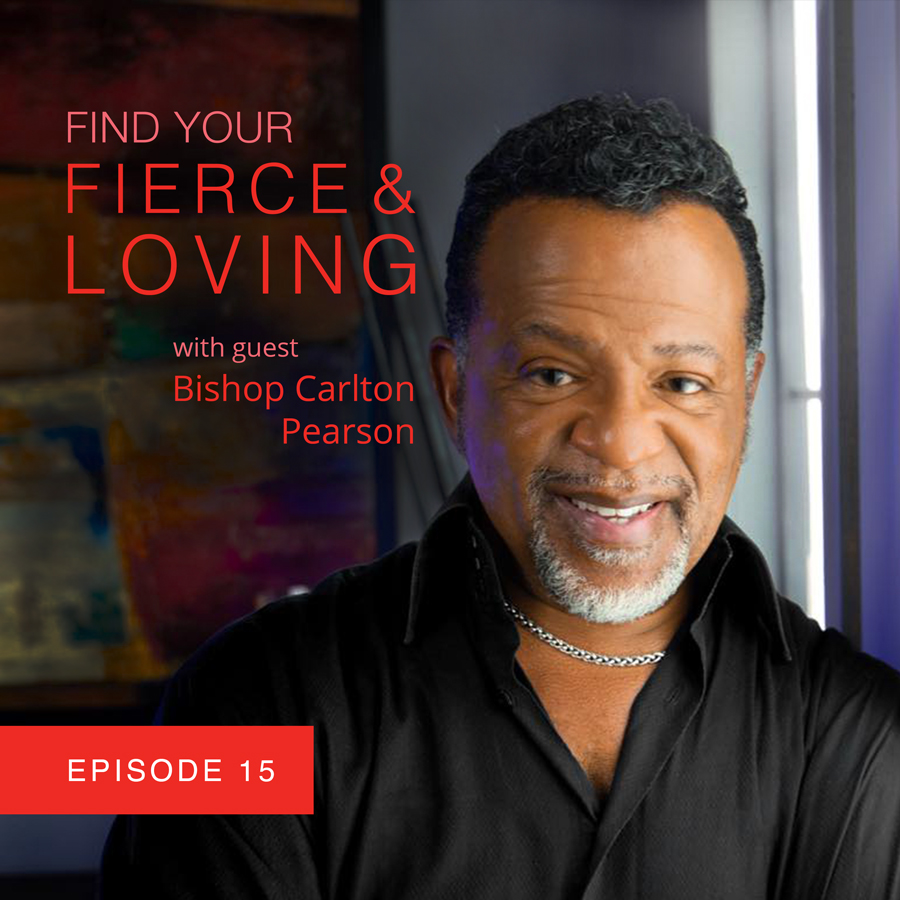
“We know how to heal ourselves. Even in the midst of trauma, and drama, and excitement, we know what to do if we just follow the instincts of our nurtured and nature self.” – Carlton Pearson
As humanity experiences a rebirth of our existence, we are suffering the discomfort and pain that comes with transition. Bishop Carlton Pearson, who experienced his own painful transitions and losses because of his faith and convictions, believes that life’s breakdowns can be turned into breakthroughs. Now he’s looking back on the thousands of years that brought us to this moment and providing his counsel on where we must go next.
Show Notes
There are so many mistruths and half-truths in this world about what faith and love actually mean, and what the history of faith actually teaches us about those concepts. Bishop Carlton Pearson reaches beyond these obfuscations and sees us turning to recognize and fight for our shared humanity.
Listen in to this episode of Find Your Fierce & Loving to hear a renowned heretic talk with Lola about what made him break with his Pentecostal dogma, the messy truths of that church, and the radical change that is happening all around us.
- (04:24) – Questioning dogma
- (12:44) – Accepting reality
- (20:02) – A post-Christian world
- (28:23) – A great awakening
Carlton Pearson was one of the most beloved Pentecostal Christian personalities of his generation. Thousands would fill arenas and churches to hear him sing, preach and inspire. Things changed quite dramatically when he stood in his mega church pulpit to proclaim a new doctrine, one that declared that because of Christ, no soul will spend eternity in hell. His controversial doctrine polarized faith communities literally all over the world. He lost his influence, his church, his friends, his finances in a very short period of time, one of the church’s most beloved went from hero to zero, seemingly overnight, and became the most prominently titled heretic of his generation. After spending the last two decades rebuilding and rebooting his life and ministry, Carlton Pearson has emerged with a new purpose aimed to help others examine and reconsider what they believe, why they believe it, and how those beliefs add to or subtract from the quality of their lives. He is developing a multicultural and radically inclusive Metacostal online community reaching thousands that emphasizes expanded consciousness, radically inclusive love and self actualization. His books The Gospel of Inclusion and God Is Not a Christian, Nor a Jew, Muslim, Hindu… are available on Amazon and his CD Reflections After the Rain is available on iTunes. You can find his movie Come Sunday on Netflix.
Do you want to unleash your inherent love and goodness, liberate yourself, and free humanity from the oppressive systems and structures we have created? We are here to support you in finding your fierce and loving life. Join us in Our Circle, a vibrant membership community rich in opportunities for engagement and transformation. Find out more at lolawright.com/our-circle.
You can follow Lola Wright, on Instagram, Facebook, LinkedIn, and Twitter and learn more about my work at lolawright.com.
Chicago born and built, Lola grew up in wealth and privilege, yet always sensed something was missing. She sought out aliveness and freedom in music, immersing herself in the hip hop and house music scenes of 90s Chicago. After finding herself on her own at 23, as the mother of two young children, she became determined to create a new experience.
Lola is an ordained minister with a gift for weaving together the mystical and material, she served for many years as the CEO of Bodhi Center, an organization committed to personal transformation, collective awakening, conscious activism, and community-building.
This podcast is produced by Quinn Rose with theme music by independent producer Trey Royal.
If you’d like to receive new episodes as they’re published, please subscribe to Find Your Fierce & Loving in Apple Podcasts, Google Podcasts, Spotify, or wherever you get your podcasts. If you enjoyed this episode, please consider leaving a review in Apple Podcasts. Your reviews help others find the show.
Transcript
Lola Wright [00:00:01] Personal transformation and collective awakening involve being the most alive, brilliant, inspired, creative, on fire version of yourself. A version that is not consistent with the status quo. My name is Lola Wright and this is Find Your Fierce & Loving. This podcast is a wake up call, a roadmap back to your holy purpose, an invitation to set fire to the box you’ve been living in and watch it burn.
Lola Wright [00:00:40] Oh, I’m so, so excited to welcome the brilliant Bishop Carlton Pearson on today’s episode of Find Your Fierce & Loving. I want to tell you a little bit about this brilliant man. He’s had an incredible impact on my life and on thousands of lives around the world, hundreds of thousands, arguably millions. So let me just jump in and get you familiar with who this human is. Carlton Pearson was one of the most beloved Pentecostal Christian personalities of his generation. Thousands would fill arenas and churches to hear him sing, preach, and inspire. Things changed quite dramatically when he stood in his mega church pulpit to proclaim a new doctrine, one that declared that because of Christ, no soul will spend eternity in hell. We’re going to talk a little bit about what he means by that in a moment. His controversial doctrine polarized faith communities literally all over the world. Bishop Pearson wasn’t prepared for the rejection and stones aimed at him. He lost everything. He lost his influence, his church, his friends, his finances in a very short period of time, one of the church’s most beloved went from hero to zero, seemingly overnight, and became the most prominently titled heretic of his generation. After spending the last two decades rebuilding and rebooting his life and ministry, Carlton Pearson has emerged with a new purpose aimed to help others examine and reconsider what they believe, why they believe it, and how those beliefs add to or subtract from the quality of their lives. To the greatest kind of heretic in my eyes, one who stands up for the freedom, liberation, and celebration of all human beings, I welcome you, Bishop Carlton Pearson. It is my great honor.
Lola Wright [00:02:59] It is my great privilege to have you with us today. And I’m so grateful you’re here with me. Welcome.
Carlton Pearson [00:03:08] You’re one of my favorite people on the whole planet. You’re so bright, so brilliant, so insightful, so spiritual, so creative. An amazing leader. You just have a good sense. And you’re balanced and I just always when I grow up, I’m going to be just like you.
Lola Wright [00:03:27] Well, here’s what’s true. It is because of human beings like you that I get to be the way I am. And I think it’s really, really important to honor and acknowledge that, you know, this podcast is called Find Your Fierce & Loving. And really what that means is that I believe we’ve been raised with a kind of adolescent, westernized, sanitized definition of love. You know, we love, we love the scripture: Love is patient. Love is kind. It does not boast, you know. And while sure love can be all of those things, I actually think the kind of love that’s needed on the planet right now is the love that you embody, which is a fierce love, a willingness to stand for something. And it’s Semitic root. The word is hooba, which actually means to set on fire. That is actually what the word in Aramaic and Semitic linguistics means. So I just want to ask you a little bit about what that means for you. You know, what is it that had you step into a kind of radical love and lose everything for what felt true for you?
Carlton Pearson [00:04:42] Well, love like life is one of the sexually transmitted diseases that all the things have. You don’t create love, you come here, you don’t learn to love, you learn to hate. But love is not just patient. Love is a patient in need of health care, constant health care. It’s like a disease, a dis-ease. It has tension and stress. And I feel love to the point that it’s painful. I have children, my wife, my mother and father, my siblings, I’ve had all kinds of love relationships and all of them are sensitive and sensitizing, you feel the pain or the pathos, pathology, if you will. And so I’m learning how, that, beyond that word, in addition to the word, is the word compassion, which means to to feel for someone. I don’t you just tell me you love me, I want you to tell me that you feel me. Do you get me? Do you feel my pain? Cause there’s a lot… and you don’t just marry people you love you try to marry people, if you’re going to get married, you like because there’s a lot of people you love that you want to live with. Sometimes it’s your parents or your siblings, sometimes their own kids or your own spouse. You love them, but you… somebody say, I want a loving, close knit, fun loving, devoted family that lives in another state. So… that just comes a few times a year. Cause it’s it’s… nobody can hurt you or harm you or even hate you like somebody you love or who love you. I see that in divorce court. I’ve seen that at funerals. I’ve seen that at burials. I’ve seen that in rooms where people are listening to the will read. And people who really dearly, nearly love each other die hating the one they love. You think you can’t do both but people do it all the time. Some people live in marriages for fifty years. They can’t stand each other. But they can’t live with them, they can’t live without them, so they just tolerate and rarely celebrate and they get so used to it, it doesn’t hurt anymore.
Lola Wright [00:07:03] Yeah, I oftentimes say we need a kind of spiritual maturation of these qualities. We have a very adolescent relationship to them. So I’m curious, like I imagine when you…so what year was it? When you stepped out and you said, I cannot subscribe to this dogma and doctrine that, essentially, at least from the movie “Come Sunday,” the implication is that, you know, you were surrounded by gay people in the church and specifically the choir director, the music director, right? And you were having to navigate the tension between this Pentecostal worldview and someone whom you deeply loved and cherished and regarded, and that that dissonance in your being demanded a kind of spiritual awakening. Is that a fair articulation?
Carlton Pearson [00:08:02] Well, my religion, my dogmas and my doctrines, demanded that I cannot accept this person as a gay person or at least an outed gay person. It’s like don’t ask, don’t tell. Well, I say don’t ask, don’t tell doesn’t mean no ass, no tell. They doing stuff. Not just homosexually, but heterosexually. There were a lot of preachers and Christians that were sleeping around and doing things that… we were extreme… The Pentecostals are extremely edgy, exotic forms of Christianity. Like Kabbalah for Judaism and Sufism for Islam. We’re the more mystical aspect with harsh fasting and praying and holiness. We used to say no sipping, no dipping, no tipping. No sipping drink, besides water and milk, not even coffee is holy. And no dipping the snuff, you know, and no tipping out on your spouse. It’s holiness or hell. We came up around that, a lot of restrictive, suppressive sexuality. Even in heterosexuality meaning sex is not something you deal with. You stay away from it. It’s for procreation and not recreation. They don’t know that recreation and re-creation is the same thing as procreation and co-creation but anyway. Those are just semantics. So we wrestle with that all our lives. And I saw these very powerful, mostly musicians, keyboards, singers, songwriters, worship leaders who live between the worlds. Most musicians don’t live on the note, they live between the notes. They don’t live on the words or lyrics, they live in the space between. They’re really mystical people, and they can usher in what we call the presence of God, profoundly. We’d all be weeping, hands uplifted, people on their face before God and then we found that same person was gay. And that wasn’t bad enough, they were active gay. And so when that became, we became aware of it… sometimes preachers wouldn’t say anything because nobody in the congregation, to take the service, could take the service where our services were always crescendo-ed. They were always spiritually orgasmic by the terminology. The song, the sermon, the service itself had to reach a climax to where people would fall off in the spirit or shout or cry or jump, run. And now I’m hanging out with Unitarians and Unity folks, and they, they’ll clap and they’ll do a little something. They all don’t do much, but they’ll do a little something. So there was nothing looking…. We didn’t have anything to look forward to. But in the Black Pentecostal, particularly Black Pentecostal church you don’t just preach the sermon you perform it. So these musicians, and not only, not exclusively them, but particularly, they could just take us there. They could close their eyes and sit at those keyboards, I’m about to cry now just thinking… They could take us places. Everybody would close their eyes and leave that person at that instrument, and they would become one with the instrument, whether it was an organ or a piano or even a guitar, and then somehow lead us to wherever they went. It was hard to reconcile that God would use a person like that so powerfully and they weren’t “holy.” I wrestled with that my entire religious life. I knew preachers who were sleeping around and were closeted alcoholics but when they got in that pulpit they could bring the house down. Yet… I don’t mind that but the teaching was God does not dwell in an unclean vessel. But if a person comes to me, one of my most esteemed mentors, died when he was eighty one, a bishop, he was a womanizer. And we didn’t find that out till the very end. But when he was in his 20s, he had an affair and he went to his bishop and confessed it. The whole story, weeping and repenting, this was a Pentecostal holiness church where their rules were strict as ours, and when he finished the conversation, the bishop who knew exactly what the man was going through, said “Son, the best thing I could do for you is ignore this conversation. I have to act like it didn’t happen, because if I, if I acknowledge it, I have to de-credentialize you. I’ve got to take your papers. You have to step down from the ministry for at least two years. And it’s worse if you divorce and it’s even worse if you remarry after divorce. So let’s act like we didn’t have this conversation.” The indication was that Bishop had those same proclivities, if not actualities, in his life and if anybody knew he was that way, he couldn’t be a bishop, be a pastor. They wouldn’t even consider him a Christian if you, “sleep around.” So our religion is a harsh religion and our God is a judgmental God with terrible anger management issues. He flies off the handle. He throws tantrums and earthquakes and tsunamis and volcanoes and cancer and AIDS and COVID. We blame all the horrible things on God. We thank him for the good. We say the devil did it, but God sent it. There’s so much psychosis in in most fundamental religions, whether that’s Judaism, Islam or Christianity. The fundamentalists in those religions are bitter, angry…. So we’re dealing with ,one of the things I’m doing right now, I consider myself an apostate. You people talks about the apostate church. The word apostate literally means runaway slaves. People thinks it means you’re you’re a heretic and you’re you’re you’re a demon. I consider you a runaway slave. Now, you were never a slave to the degree that we are, but you’re a free spirit. I started moving among New Thought people. I thought these people don’t have the shame and guilt. I don’t even know life without that. There are elements of it, but not near like us. You don’t judge people. You would sit, I mean, it does, homosexual conversations don’t even come up. You can have gay people, out gay couples working on your staff and it is not an issue.
Lola Wright [00:14:18] Yeah, I would actually say for many of us it’s a requirement. Like I required my staff to be reflective of the community I serve. So like, if if my staff does not reflect the community I serve then what in the world are we actually doing right now?
Carlton Pearson [00:14:33] I have never heard that even in New Thought. That has, that really moved me.
Lola Wright [00:14:38] I mean, it’s true. You know, you and I, I’m from Chicago, born and raised, you spent a number of years in Chicago, and as one of, if not the most racially segregated cities in the country, that has always been true for me also. Like if this geography is thirty three percent Black and two percent Jewish and bla bla bla bla bla, then my community, if we’re going to say we’re the beloved community, then my community needs to reflect the city of Chicago because that’s where we say we are. You know what I mean? Which, by the way, as you know, is like that does not happen by accident. That requires an, I mean just an incredible amount of an intensity of intentionality. One of the things that strikes me and what I hear you saying is this tendency to pretend like something isn’t happening. This tendency in the church to sort of like, “Hey, I’m just going to pretend we didn’t have this conversation.” I feel like that is the season that we’re living in in this country politically. And so we have spent hundreds of years and I want to say we, by that I mean like white America, being like, “No, no, no, no, no, no.
Lola Wright [00:15:53] Come on, everybody. Let’s just, like, move it along, keep it going, you know?” And now it’s like, oh, no, no, no.
Lola Wright [00:16:00] We are actually unable to have forward moving progress. We are delaying the evolution of humanity by our unwillingness to have the necessary conversations. And I know you’ve been very comfortable speaking out on that.
Carlton Pearson [00:16:15] It’s part of my therapy. It’s part of my liberation. I mean, I knew all this was around us and, but I don’t know how to address it. I didn’t give myself permission because no one was really stopping me. Then I lost the church, and you’re talking about property and real estate and prestige and then your, your income as well as your reputation. So I’m free now and I don’t have to impersonate that person, pointing that finger. It’s pharisaic and the word “pharisee” means separatist, and I’m an inclusionist. And so I couldn’t be pharisaic anymore. And when I see or sense pharisees, the reason people pretend is because they’re trying to protect something. And when you get to the place where all you protect is virtue rather than vice, you’re comfortable in that flow. My religion. I have so many, I know so many older, “saints” I mean they’re in their 80s though, and 90s. And they were bitter and angry and hurt and disappointed, even with God, but they would never say with God. One of the last conversations I had with Oral Roberts was that God didn’t heal all the people he prayed for. And he said he had a big ten thousand seat tent, it was packed every night. Then we had what we call the invalid tent and if you drove up to it, it looked like a disaster place. You’d see ambulances and oxygen tanks and people on stretchers and some regurgitating and defecating or urinating and it was a foul smelling place but they, they were in the worst state and they come to the miracle worker. But we didn’t let them in, he didn’t let them come into the main auditorium, because some of their diseases were contagious. And he didn’t want to ever pray for them publicly because they rarely got healed. And if you, if you bring somebody to the platform that’s badly deformed or deficient and they don’t get healed or touched, then it drops the faith, in the energy in the room.
Lola Wright [00:18:24] Wow. That’s like a lot of pressure. Oh, my gosh.
Carlton Pearson [00:18:28] We didn’t bring wheelchairs up on the stage unless we knew the person could already walk. They just needed the wheelchair to help them. And then the crowd was so gullible. So soon as you say, “Stand up, sister,” well she stands up. She walked in there and we gave her, like the many hand crusades, we have hundreds of wheelchairs. We want a few people to get on they legs and walk, so that when you come up on the stage, they bring the wheelchair on the stage, the workers do, and you say, “what’s what’s your problem? How long have you been in a wheelchair?” We don’t let them say, “I’ve been in here bout 30 minutes.” The impression is they’ve been in there 30 years. “That’s all right, darling we don’t want to talk about the past. Get up in Jesus name.” And they would get up and the crowd would go nuts. Then people really in wheelchairs who couldn’t get up often did, because that act of faith stimulated theirs. And they thought “If I can…” because the energy and the atmosphere was so charged with positive faith.
Lola Wright [00:19:26] So how do you, how do you reconcile that? Because that’s an ecstatic experience. Right? Which, you know, obviously we could make a lot of critique around the, you know, fallacy and, you know, like the challenging aspects of that. And yet there’s great value in creating ecstatic experiences in the human dimension because we are so trapped in this material realm, we can’t seem to get out of our psychosis. So do you get to do that in a way that feels in alignment with you now?
Carlton Pearson [00:20:04] Well, yes, because it’s like what they call “hidden persuaders” when you go to the grocery store and you hear that happy music, you spend an extra $25 or $30 or $50 because the music just… you know? That stuff is all around us. It’s the power of persuasion, which faith is all about, faith actually means firmly convinced based on the conviction of what you’ve heard. Or firmly persuaded, based on the conviction of what you’ve heard, not just what your outer ear, but with your inner ear. So you’re creating with people of that like, televangelists and healing evangelists, and miracle workers, with them, the end justifies the means. If I say I’ve anointed this with oil, I was on my face before God for 21 days fasting and praying, I have all these cards and the Holy Ghost told me, God said, “if I put this in your hands every time you touch it, the same anointing that’s on me will be on you.” Now I’m feeling that right now. I’m saying it because I always said it with conviction and convincibility, not invincibility. I was convincing you because you came to me hoping for help. So I say, “this is holy water, sweetheart,” but you don’t know what it is, I just got it out of the thing. But “I prayed for this water or I had a crucifix in it all last night. And I mixed it with oil, oil that I bought in Jerusalem,” because I have some in the garage. Well my voice and my power of persuasion is working. But you’re the one crippled or you’re the one depressed or you’re the one suicidal, you’re the one with a tumor or a cyst or growth or a cancer. You’re the one depressed. You come to me for help. And so I give you my tools.
Lola Wright [00:21:58] You want to be more alive. You want to unleash your inherent love and goodness, liberate yourself and free humanity from the oppressive systems and structures we have created. We are here to support you in finding your fierce and loving life. Join us in Our Circle. This is an affirming and radical space that will gather weekly on demand or live whatever works best for your life. For more information on how you can engage in our circle, visit lolawright.com/our-circle. I’d love to have you with us.
Carlton Pearson [00:22:42] So there’s a lot of church hurt out there with this present election and how the evangelicals have gotten King James mixed up with King Jesus. They think, they think going into all the world and preach the gospel to all the creatures. They’re not thinking about Anglos, they’re thinking about Africans and Asians and Indians. They think that came from King James in London, not Jesus in Jerusalem. Both of their mother’s names, Mary, one’s the Virgin Mary the other one is Mary Queen of Scots. So the confusion is there and evangelicals are really frustrated because they’re still prophesying this man is going to win. In fact, I think, that at some point Trump’s going to turn on the Christians and say, “Why didn’t you fill the streets with guns? Why don’t you protect your leader?” He might, because he turns on everybody, it’s simple. Even his cabinet members. He’s going to blame them and never himself. So I think that’s the beginning of us entering into an official post Christian era, not post Christ but post Christianity. Because the most fundamentalist Christians I know are suffering from psychosis. They’re out of touch with reality. They’ve chosen a leader who creates his own reality differently than they do. At least he got to the White House. He may be in the jailhouse in the year, but that’s where he is right now in the White House. And so they are, I have friends Lola, that I grew up with, with whom I’ve worked and walked for 30, 40, 50 years who are staunch Trump supporters and are now so confused and so depressed. They don’t and they won’t even admit they were ever, there was ever any error. And the ones who do admit error say “I’m done with it. I’m done with God, with faith, with the Bible, with the whole BS.” Yeah and they’re leaving and they’ll be at your church next week or some less fundamentalist church. Trump will go down in history as the worst president in recent history, maybe ever history and he’s only there because my brethren and sisters put him there. My fundamentalist evangelical, Bible toting, Bible quoting, biblical literalist, put him there.
Lola Wright [00:24:57] Can you explain the distinction from your perspective of…because you said, you believe we’re moving into a post Christian world as being distinct from post Christ? And I think I think very, I think that’s an important distinction and I want to make sure people understand.
Carlton Pearson [00:25:13] Well Christ consciousness existed before Jesus. The spirit of Christ, which means anointed one, and the word “anoint” means to smear or rub or even fling, sling oil. The Hebrew word for oil is “shemen,” the English word is “semen,” that’s where we get it from. So it’s a fertility sound. That’s, the spirit of the Christ or the anointed Meshach and Mashiach is Messiah. But Meshach?, that has existed before Jesus of Nazareth ever existed and has existed since Jesus of Nazareth. So when I say the Christ, like Mahatma Gandhi said, were not for Christians and I may have become. So Christianity, the institution which is Christianity Incorporated, started in Rome. Jews didn’t kill Jesus, Italians did, the Romans did. And so we’ve gotten all this mixed up. But the way back in the days of Moses and really to the Sumerians and the Acadians that preceded the Egyptian civilization that we know of, there was always a connection with the ether or ethereal, with the esoteric, with the otherworldliness. When Jesus said “you must be born again,” Nicodemus comes to him by night, says, “Master, we know you are a teacher sent from God because nobody could do these miracles.” And Jesus says “you must be born again dude.” Again, the Greek word “again” is anothen, A-N-O-T-H-E-N what we’re getting is an ether, ether, you must be born an ether, ether, you’ve had a spiritual awakening, a transition. “If you awaken to who I was, my divinity, which put you in touch with your divinity, Nicodemus,” and Nicodemus “So what? I don’t even know what you’re talking about. I mean, what do you mean born again?” And Jesus said “That you’ve had this awakening.” That’s what that means. So being born again is not responding to some Christian altar call, confessing a few words, shaking the preacher’s hand, and being baptized in water. Being born again is awakening to who you are, your connection to divinity, that you are a divine expression in the universe. Whether you’re Christian, Jewish, atheists wake up to that in my opinion. In the next few weeks, the energy in this planet, as we go on, the 21st of December, that said one of the new moon eclipses, that’s going to be pretty powerful. I think that’s shifting us. I’m told that the one that we experience on the 21st, even though we’re now in January, hadn’t occurred since, in 400 years. So 2020 and the next 400 years, the next several years in this country and culture is going to be very profoundly different. It’s going to shift the energy much more powerful. We’re going to relate to each other differently. I call it a new Pentecost. Pentecost is not about speaking in tongues. It’s understanding tongues. That could be your husband or wife or boyfriend or girlfriend or child. You could finally hear what they’re saying. You read the scripture. They were astounded that they could understand. They’d been going to Jerusalem for years for the Feast of Pentecost. But they never understood the feast or the fast. They just did it. So now when I saw these white kids walking the streets of America with Black Lives Matter signs and I stopped and said, “What are you all doing?” They said, “Black Lives Matter. And I’d say, well, that all lives matter yes?” And they said, “Of course. But if Black lives don’t matter, then all lives don’t matter.” I just want to get the conversation up. I underst- I said I said, “y’all get it, don’t you?” They said, “we finally, we do. Our parents don’t. And our grandparents don’t approve.” Because I said, “Do your parents know you’re out here?” “They don’t get it,” they said.
Carlton Pearson [00:29:11] “We get it.”
Carlton Pearson [00:29:13] And there’s a Black and Hispanic and Asian and a gay person, somebody with a with a skateboard and somebody with a fro and somebody with dreadlocks, and they’re all there beautifully together. I started weeping. Because we’re for the first time, we’re going to relate to each other well, we’re going to understand each other, we’re going to not be afraid of a conversation like we’re having. I said to my son one time we were in Chicago, “There’s a lot of panhandling downtown.” My kids have always seen me give, I wanted them to believe in benevolence. But when I give the man something, they would do too, usually they were men, I said to them, “Always make eye contact when you give to a panhandler. That honors the dignity of their humanity, don’t just throw something. I don’t care how big or small the bill is. Don’t just throw something at them like they’re an animal. Smile. ‘Hello, sir.’ I always call them sir. Put the money in their thing,” I said, “but when you’re comfortable, I want you to sit down and talk to the man. Ask him something about his life, make him the feature, who is he? What’s his name? Where does he live? Does he have any family?” And my son did it probably for like two weeks. And he came home crying, he was so moved. I said, “Tell me about it.” The man who had been in the army. He had been married, he had a master’s degree, fell on hard times. He has the post-traumatic, PTSD, separated from his family, didn’t want to be around his family, didn’t want his family to see him like that. I’m not going to say perfect explanations, but but rationalize, rational explanation of why he’s in defeat. Everybody counts and there is a story in every tear. And we need to find out what’s being flushed out of the system, even our own tears.
Lola Wright [00:31:02] So what I hear you saying is, this is my interpretation of what I hear you saying: We are in the midst of a great awakening, that the human experience is in the midst of a great awakening and that the opportunity exists to have a perceived sense of oneness or unity, to become awake and aware to the fact that we are not these individualized entities that are automatons, that need to be operating from survival and perceiving everyone out there as a threat. It sounds like that’s what I hear you saying.
Carlton Pearson [00:31:36] I could have just stayed at home. And you have, all you folks who listen to this lady. That’s how she is. She gets it. She can say it with precision and concision. She gets it. And that’s what I love the most.
Lola Wright [00:31:52] So do you sense that the discomfort that we are living in the midst of is what is required for us to cross the threshold?
Carlton Pearson [00:32:03] Yes, and that’s why I say we’re not in trouble, we’re in transition and we’re in the narrowest part of the birth canal. That’s the most traumatic for the mother and the child being born. It’s dying is normal. Death is quiet and we get emotional but the dying person itself, it just kind of go to sleep even if they’re killed tragically. Birthing, though, by nature, it’s loud and messy. They are pushed out of their mother’s womb suddenly and abruptly and it’s violent and popped out on a table. There’s a big bright light that they’re not used to. That’s why they quickly wrap them in swaddling clothes to give them a sense of security. But that’s trauma that we carry the rest of our lives and we work and walk through it. Some people get great help. Some people become alcoholics and drug addicts and wife beaters and children molesters because they were traumatized. And that’s the Greek word for wound. They get wounded and then the wounds, wounds intensify and repeat themselves. There’s a lot of crippled people on the planet. So we have to help people remember why they came here. And not feel like they offended the universe by coming. And that they belong here, that they have not broken some rules or violated some chaste responsibility by coming out of a screaming vagina. That sounds gross but they came out of that down that vaginal passageway and came to the world, took the first milk from their mother’s breast. Whoever teaches a kid to pull their thumb to their mouth while they’re still in their mother’s womb. They didn’t go to school for… that’s not a learned response. But somehow that kid knew that something goes into their mouth to nourish them. We know how to heal ourselves. We really know how to help ourselves, even in the midst of trauma and drama and excitement. We know what to do if we just follow the instincts of our nurtured and natural self, we can, we can handle anything. The transition we’re going through right now is loud and messy and violent. But it’s good. I say to my friends and to all the viewers now, just pause, you have a natural, in born, we’re coming up to to Christmas, the Virgin’s name was Mary. That’s in the scripture. Virgin’s name was Mary. The word Mary comes from the Hebrew word mr yam, which comes from the Hebrew word myrrh, which means bitterness. So you could say the Virgin’s name was bitterness. But out of that, bitterness came an anointing or an anointed one. We’ve had a bitter taste the last four years, really, some people all their lives, but in the midst of all of this bitterness can be betterness. And I think 2021, this year is going to be a astoundingly glorious time for us. If we can get past the nausea, which is the noise, terms are related, to the sound of the age. I’m ready for the healing to begin.
Lola Wright [00:35:27] Hmm, well, so one of the things that’s coming through for me as you speak of this and you speak of the word the name Mary and it’s origin of bitterness, it is the first time I have ever drawn a correlation between Mary and the goddess Kali, who is the goddess that kills and births new life out of a kind of violence. And I’m going to look into that, because if you think about the way Mary Magdalene and the Virgin Mary have been portrayed, they are, they are well, certainly the Virgin Mary is portrayed as the sort of innocent, soft, meek figure but I am curious to know, you know because I relate to to scripture as mythology, and I relate to of all of all religious texts as just a metaphor for our learning and our growth and our awareness.
Lola Wright [00:36:33] So if, in fact, Mary means bitter, what does bitter mean?
Lola Wright [00:36:37] It means intoler- It could mean, intolerant of what is. Well, given the climate that Mary was living in it would make perfect sense that she would be intolerant.
Carlton Pearson [00:36:47] She was engaged to a man she probably didn’t love. You know the Jews, that’s why Paul later said “Young… older women teach the young women to love their husbands.” Because you know “matchmaker, matchmaker, make me a match. Find me a find. Catch me a catch.” We can presume that this young girl, probably 12 or 13 years old, when she was impregnated by the “Holy Ghost,” according to scripture, whether you’re a little lost or not, even the whole idea of Holy Ghost will be arrested for statutory rape. Wouldn’t he? Because she’s underage. But in those days, the Jewish women often were impregnated 12 or 13 years old. So she’s just a kid. And I… she could have been bitter or unhappy or intolerant. You know of the fact that she’s… and why would God find, could he not find some young Jewish girl in Israel who wasn’t betrothed, whose husband wouldn’t be embarrassed and tempted to put her away privately or divorced or secretly? That’s what the scripture says.
Lola Wright [00:37:48] Or intolerant of the Roman Empire, which was an oppressive regime. Right? Like there was lots of material to be intolerant of.
Carlton Pearson [00:37:56] She if she was aware of that, I know Joseph might happen, but I think she represents the whole culture, Jewish culture at that time. And Jewish, Jerusalem is an occupied city you’re right. The Roman Empire, which we’re still living under somewhat. Roman Empire is what turned Christianity or made it into a corporation. You know? So there’s so many mistruths and and half truths and untruths out there, this post Christian era, and mark my word, there’s going to be some revelations this year: 2021, older generation like me, particularly my generation, is going to say, “well, that’s just the devil. That’s the entire false prophet, that’s the Antichrist.” Younger people are going to say, “Whoa, whoa, back up. What are you saying? When did that? Who did that? Are you kidding me? I knew I didn’t feel comfortable with this. I love my parents, I love my grandparents, but I’m not going for that B.S. anymore.” Preachers are calling me saying, “I can’t get my kids to stay in church. I can’t even get them to come. And I buried their grandparents. I married their grade friends.” They get Black Lives Matter and say it is all lies. They’re into justice and peace and equity as opposed to inequity. I think the most blatant form of iniquity is inequity. These kids get it. I mean, they’ve got my computer, my iPad, my laptop, my iPhone, all have a picture of an Apple with a bite out on the back of it. The tree or truth of the knowledge, which means science, of good and evil. There is a science to good and evil. And I think these young kids are scientists and technologists.
Lola Wright [00:39:45] What I hear you saying is that there’s a liberation happening in human consciousness and progress is possible when consciousness is liberated and not thwarted. And so, yeah, I’m with you. I’m encouraged by the time we’re living in. Bishop Carlton Pearson, I’m deeply, deeply grateful for the influence that you’ve had on my life. Thank you for letting me into your world. Thank you for someone who has been a teacher for me, now for eight years. Who did my installation, who literally birthed a new version of me. You were my own midwife and I’m very, very grateful for you. Thank you for being on this podcast.
Carlton Pearson [00:40:25] Thank you so much. I have such respect, and yours wasn’t very violent or wild at all. It was a very, that was the classiest, coolest, calmest, sweetest, anointed consecration and installation I’ve been in in a while. We’ve yet to see who, who you are. You are so full of hope for the rest of the world. And 2021 will manifest things to you, but it’s not so much this time about manifestation, it’s going to be about creation. You will create what you want to manifest. Nothing has been stopped. You have not been in trouble. You are in a powerful transition. And we need you. We need your intelligence. We need your spirit. We need your vocality. We need your verbosity. We need everything you are. And I salute that. Don’t you forget me when you’re rich and famous. Because I’m gon come with a shoe and throw it at you.
Lola Wright [00:41:21] I won’t forget you. I got you.
Carlton Pearson [00:41:22] I love you. I love you so much.
Lola Wright [00:41:26] If you enjoyed this show and would like to receive new episodes as they’re published, subscribe wherever you get your podcasts and consider leaving a review in Apple Podcasts. Your review helps others find this show. You can follow me at Lola P. Wright on Instagram, Facebook,LinkedIn, and Twitter and learn more about my work at lolawright.com. This episode was produced by Quinn Rose with theme music from independent music producer Trey Royal.
Carlton Pearson [00:42:11] And they’re not used to that. We brought all these Pentecostal people in who I call the Metacostals, and I said, “Now, Marlon, there may be somebody that comes with my group or the group that we will attract to your Unitarian church. We’re going to ask you to lay hands on them.” He said, “What does that mean? Where do I lay the hands?” I said, “From the neck up son. From the neck up.”




Leave A Comment