
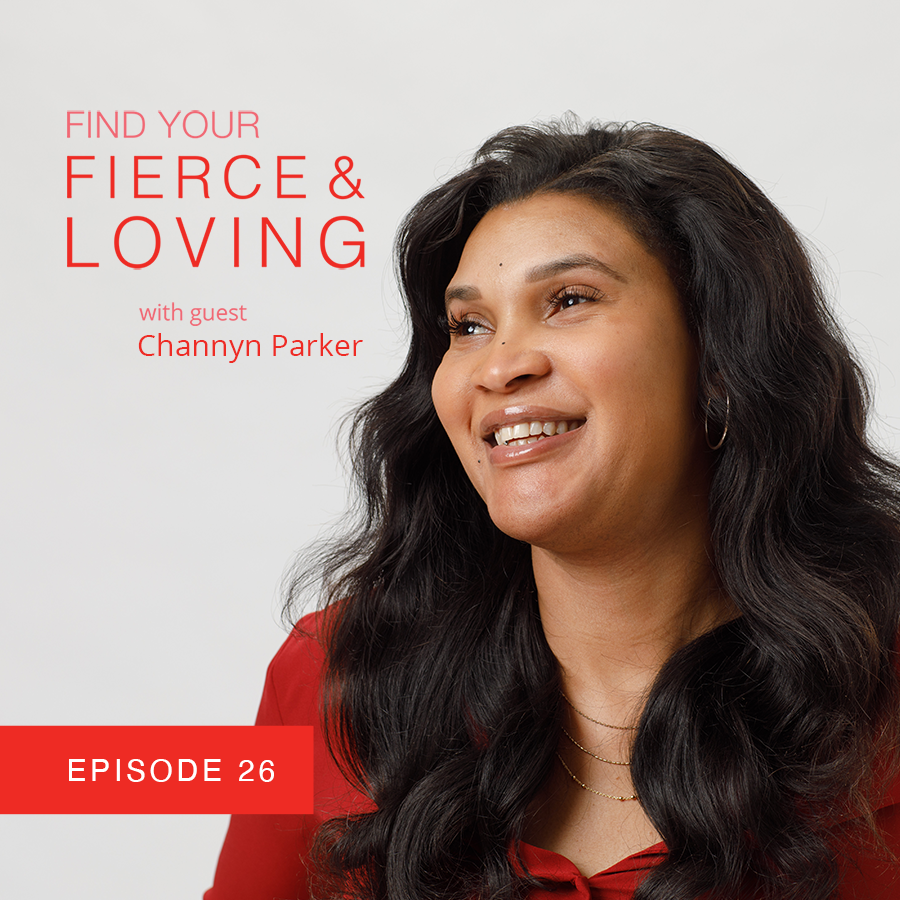
“Are we seeking the gift that this person is, and the gift that this person brought out in us?” – Channyn Parker
We all struggle with defining ourselves and how we fit into this world. During her continual journey to figure it out, Channyn Lynne Parker refuses to absorb the limitations that other people try to place on her. As a human rights advocate and Director of Strategic Partnerships for Howard Brown Health Center, Channyn fights for the equality and dignity of everyone, while protecting her own health and happiness.
Show Notes
One of the greatest pieces of wisdom that Channyn has learned is that everyone on this earth has their part to play. You may not enjoy their effect on your life, but they are on your path for a reason, whether that reason is to nourish you or to teach you valuable lessons.
This week on Find Your Fierce & Loving, we invite you to consider the humanity of every person who exists alongside you. Each one of us is full of contradictions and history that we cannot judge as good or evil. We can only recognize ourselves as partners in humanity and accept our responsibility to work on it together.
- (04:03) – Identities
- (11:20) – Choosing a narrative
- (20:46) – Contradictions
- (31:55) – Partner in humanity
- (41:12) – Good and evil
Channyn Lynne Parker is a Human Rights advocate, public speaker, community-centric leader and Director of Strategic Partnerships for Howard Brown Health Center and serves on the board at Equality Illinois. Prior to her current role, Channyn served as manager of The Broadway Youth Center, Youth Development Program, and manager of Chicago House Social Service Agency’s TransLife Project (2017). Channyn is the first openly transgender woman to work in the Cook County Dept. of Corrections, working with populations in protective custody. Inaugural Trans100 awardee (2013). White House speaker, National HIV/AIDS Strategy (2015), Chicago Women’s March speaker (2017, 2018). Recipient of the Henrietta Lacks award, Women in Health in Chicago (2018) and Equality Illinois prestigious, Humanitarian, Freedom Award (2019).
Do you want to unleash your inherent love and goodness, liberate yourself, and free humanity from the oppressive systems and structures we have created? We are here to support you in finding your fierce and loving life. Join us in Our Circle, a vibrant membership community rich in opportunities for engagement and transformation. Find out more at lolawright.com/our-circle.
You can follow Lola Wright, on Instagram, Facebook, LinkedIn, and Twitter and learn more about my work at lolawright.com.
Chicago born and built, Lola grew up in wealth and privilege, yet always sensed something was missing. She sought out aliveness and freedom in music, immersing herself in the hip hop and house music scenes of 90s Chicago. After finding herself on her own at 23, as the mother of two young children, she became determined to create a new experience.
Lola is an ordained minister with a gift for weaving together the mystical and material, she served for many years as the CEO of Bodhi Center, an organization committed to personal transformation, collective awakening, conscious activism, and community-building.
This podcast is produced by Quinn Rose with theme music by independent producer Trey Royal.
If you’d like to receive new episodes as they’re published, please subscribe to Find Your Fierce & Loving in Apple Podcasts, Google Podcasts, Spotify, or wherever you get your podcasts. If you enjoyed this episode, please consider leaving a review in Apple Podcasts. Your reviews help others find the show.
Transcript
Lola Wright (00:01): Personal transformation and collective awakening involve being the most alive, brilliant, inspired, creative, on fire version of yourself. A version that is not consistent with the status quo. My name is Lola Wright, and this is Find Your Fierce & Loving. This podcast is a wake up call, a roadmap back to your holy purpose, an invitation to set fire to the box you’ve been living in and watch it burn.
Lola Wright (00:41): I am so excited to have this incredible guest on Find Your Fierce & Loving today. Let me start with her bio because it’s really quite extraordinary. Channyn Lynne Parker is a human rights advocate, public speaker, community-centric leader and is the Director of Strategic Partnerships at Howard Brown Health.
Lola Wright (01:02): In conjunction to her role at Howard Brown, Channyn is a member of the Executive Leadership Team and serves on the board of directors at Equality Illinois and the Transformative Justice Law Project. Prior to her current role, Channyn was the manager of the Broadway Youth Centers Youth Development Program, and manager of Chicago House Social Service Agency’s TransLife Project established in 2017.
Lola Wright (01:28): There, Channyn supported over 500 LGBTQ + youth and adults secure permanent, stable housing. Most recently, Channyn made 2020’s Crains Business Chicago LGBTQ Executives and Businesses Championing Diversity and Inclusion list. She is the first openly transgender woman to work in the Cook County Department of Corrections working with populations in protective custody.
Lola Wright (01:54): Inaugural Trans 100 awardee for 2013, White House speaker, National HIV/AIDS Strategy of 2015, Chicago Women’s March speaker in 2017 and 2018, recipient of the Henrietta Lacks Award, Woman In Health Chicago 2018, and Equality Illinois Prestigious Humanitarian Freedom Award 2019.
Lola Wright (02:19): Channyn is quoted as saying, “Equality is the firmest pillar upon which human value stands. If I am named amongst those who are ambitious, and maybe even crazy enough to believe that we, somehow through our actions can leave this world a better place. If I have played some small part in reducing the burden of injustice then I have lived a life well served.”
Lola Wright (02:44): It is my great honor and privilege to welcome my good friend Channyn Lynne Parker to the Find Your Fierce & Loving Podcast. Welcome, Channyn.
Channyn Lynne Parker (02:54): Lola, thank you for having me. Thank you to everybody who is listening. Thank you. Thank you. Thank you. And, I am so sorry you had to read that Bio.
Lola Wright (03:07): Are you kidding? Well, here’s what’s so funny. I’m like, “Wow, I didn’t even know all these things about Channyn.” I know you as someone who uses your life as a holy contribution, and as I might call a holy disruption for humanity. Something that disrupts the status quo in service of something greater, but it is really fun to know all of your accomplishments. So, yay you.
Channyn Lynne Parker (03:36): Thank you. Thank you. Thank you. I love that. A holy disruptor. I appreciate that.
Lola Wright (03:42): Absolutely. It’s interesting because one of the things I mentioned to you is that yes, let us celebrate that you are an open transgender woman. And that, that has been an instrumental part of your contribution and work to the world. It happens to not be what had me invite you onto the podcast though.
Channyn Lynne Parker (04:04): Oh, which I greatly appreciate. I am absolutely, 100%, I guess proud. Right? That’s such a loaded work, but for lack of a better one. I’m totally comfortable with my identity as a trans woman. It is an inescapable reality. Just like me being black. Just like me being a woman. Just like me being so many other things. But, the really essential piece to what I just said is so many other things.
Channyn Lynne Parker (04:43): And so often when I’m invited to do or engage in these conversations, the narrative that continuously is centered is me being a trans person. And, you know something, I will just put it frankly, that is an exhausting conversation, just speaking personally.
Channyn Lynne Parker (05:08): I would so much rather talk about like all of the other, what I consider to be, the more interesting facets of myself. I’m a rather quirky individual, but I also deeply believe in something larger than us all.
Channyn Lynne Parker (05:30): I believe in reference to me being trans, that was a piece, that was a gift given to me to help me to navigate this existence, and to be able to answer the call that I have been given to participate in. With the preverbal hand that I have been dealt.
Channyn Lynne Parker (05:54): That doesn’t take away from the fact that I have to pay bills, go to the grocery store, be a neighbor, and figure out all the other pieces of this world that I want to be included in and be a part of.
Lola Wright (06:12): It’s interesting that sort of the orientation around who you are in Chicago or in the country, is around your identity, but as I think about that, that’s not really about what you need. It’s indicative of what everybody else is obviously preoccupied with. Right?
Channyn Lynne Parker (06:35): You know, simply put. I swear. I mean, I’m literally at a loss for words and sometimes when I’m asked to engage in trans specific conversations, just as you just said, Lola, right? I recognize that there are people who need those conversations.
Lola Wright (06:59): Yes. Absolutely. And, it’s worthy of honoring that because I don’t say any of that to diminish wherever each of us are on our path.
Channyn Lynne Parker (07:09): That’s right. But, here’s the thing. Folks need those conversations, but I have lived in this body, in this identity and for me, it’s kind of an old hat. And, if there’s anything that I would love for people to take away, a conversation that I would love to have is, let’s speak to the individuals where their identity is a terribly mundane thing. Right?
Channyn Lynne Parker (07:40): And, I believe that, that is the justice of it all. That a lot of trans folks are stripped of, is being allowed to be a part of terribly mundane, everyday life. It is a great privilege for my identity to be the last thing that I think about on a daily basis. It is not at the forefront of my mind when I navigate this world.
Lola Wright (08:05): And a lot of that, I mean, I hear you saying it’s a privilege, but that’s also by your design. You have asserted in this human experience as you did so powerfully at the beginning of this conversation, “Those are aspects of me. They are not the all of me.” And so, it’s like, “Do we want to spend the rest of your life and your legacy talking about your beautiful eyelashes?” I mean, that is an aspect of you, it’s not the all of you.
Channyn Lynne Parker (08:36): Lola, and that is exactly right. We talk about intersectional as being this tool that is associated with justice. Right? But, also to again, the magical word of the day, mundane. Intersectionality also just has to do with all of the various pieces of ourselves that exist simultaneously.
Channyn Lynne Parker (08:58): I am a daughter. I am a sister. I am an ex partner of quite a few. I am a member of our Executive Team. I’m a neighbor. I love to write. I love all things spiritual. I wake up every morning, and the first thing out of my mouth is, “Glory to God.” The last thing out of my mouth before I go to bed is, “Glory to God.”
Channyn Lynne Parker (09:29): I am the descendant of chain of individuals that go as far back as the creation, but for my ability to recognize that from a genealogical standpoint. I’m someone that stems from my sixth great grandfather, a free man of color from Amherst, Virginia who fought in the Revolutionary War. You know? His name was Sylvester Beverley. Right?
Channyn Lynne Parker (10:04): How many people can boast of knowing who their sixth great grandfather was. Right? Regardless of race. A man who fought and bled for this country at its nascence. Who can boast on those things? Right? Those are those intersectional pieces of me that so often get lost when it comes to framing the narrative of me.
Lola Wright (10:33): Yes.
Channyn Lynne Parker (10:35): And, I think that we have that, I will say for the lack of a better word, bad in general, because when we’re having conversations about people based on their identity, we forget that this is a whole individual before us who has their own experiences, their own challenges, their own life path that frames who they are and how they do things and the way they see things in this world.
Channyn Lynne Parker (11:07): I will digress. I definitely want you to jump in, but yes. I’m passionate about all the forgotten pieces of ourselves. And, maybe we just don’t make for good conversation.
Lola Wright (11:20): Yeah. I mean, I think it’s interesting because what you’re speaking of is, or what we’re speaking of is really the both and. Right? It’s not like, “I don’t want you to acknowledge my identity. I want you to know and see who I am and what it has taken for me to rise into who I am today.” Yes to all of that. And, it is just not the, “I am just not a one dimensional creature. I have many, many aspects to my existence.”
Lola Wright (11:49): I think one of the things that I love so much about you is the complexity of you. And by that I mean, we could create you as, “Wow, this incredible, extraordinary trans activist. And, she’s just risen to all these accolades, etc, etc.” But, by the way, that has come at a lot of challenge and criticism. And, that has also been, for lack of a better term, intersectional in its nature. Right?
Lola Wright (12:25): It’s like you have chosen not to adopt a poverty narrative. I feel like you’re someone who totally stands for abundance consciousness. And, a lot of times when we are in a, “marginalized identity” and I put that in quotes because the question becomes, “Who gets to say what is marginalized about you?” And, that does not mean we dismiss the implications of systems and structures, etc, etc.
Lola Wright (12:54): But, at the end of the day we each get to say what is true about and for us. Every time we talk I’m like, “Yes. Say it.” You are here for your big, bold, beautiful, brilliant life, and you have an unwillingness to absorb and identify with the limitations that other people project onto you.
Channyn Lynne Parker (13:21): Yes. Lola. Thank you so much for saying that because that is me in a nutshell. We can end the entire show on that. But, yes. Let me tell you something. I mentioned earlier to you and the folks out there listening that family lineage means a lot to me. And, I made mention of my sixth great grandfather, Sylvester Beverley.
Channyn Lynne Parker (13:47): I embrace abundance simply because it is my birth right.
Lola Wright (13:53): Yes.
Channyn Lynne Parker (13:54): I embrace abundance because my family fought and bled and died. They preserved through insurmountable obstacle. These are individuals who maintained their freedom when slavery was all around them. Not in the north, but in Virginia, and the south. These are people. I come from a people who I can’t imagine what they must have fought for in order for me to have generational stability. Generational stability.
Channyn Lynne Parker (14:37): And for that, I will be proud. For that, I will hold onto an abundance narrative. For that, I will boast on, “You know what? Not all of us have the same narrative.” Right? Not all of us see ourselves the same. Those are things that are deeply important to me.
Lola Wright (14:57): I also love that you’re not willing to adopt a struggle narrative just to make other people comfortable. To what you said earlier, it’s like, “Wow, maybe it’s just that those stories do really well.” And, I would say yes, that’s precisely It. We are addicted to a drama cycle. We see that in our media outlets, and we’ll call it in our media outlets, but the thing is, it lives in us and we’re not willing to take responsibility and look for the ways we’re addicted to our own limitations.
Channyn Lynne Parker (15:31): You’re absolutely right, Lola. And, while the struggles do exist. Right? We know beyond a doubt. Right? That trans women are being murdered. Right? We know that Black and Brown folks face crushing inequalities in this world in 2021.
Lola Wright (15:50): Yep.
Channyn Lynne Parker (15:51): We know this. We know that misogyny exists. We know that there is a human condition that we have not completely eradicated in its most negative forms. We know this. We know this. But, if we’re going to continue to see ourselves and see Black through this very myopic lens, we’re going to actually miss all of the amazing, awesome things that are in the front of us, and that are behind us, and to the right, and to the left of us. Right?
Channyn Lynne Parker (16:25): I see a lot of individuals in this world who we give labels to, such as bad, on the wrong side, villains, adversaries of justice, however you want to put it. And, I actually say, “You know something? Well, first of all. This is someone’s child.” Right? “Somebody loves this individual.”
Lola Wright (16:44): I love that.
Channyn Lynne Parker (16:47): But, on top of that, I’ll be seeking the gift that this person is, and the gift that this person brought out in us. We all have our parts to play, and I so often say, “Without Judas, Jesus could never have been the Christ. He never could have ascended.”
Lola Wright (17:12): That’s really good.
Channyn Lynne Parker (17:12): It’s not possible.
Lola Wright (17:15): The contrast.
Channyn Lynne Parker (17:16): That’s right.
Lola Wright (17:17): Yeah.
Channyn Lynne Parker (17:19): What that leads me to is. Lola, I don’t know if anybody truly, authentically is that. And, maybe that is, that’s a big woo-woo for some. I believe that there are individuals that are beyond our understanding. Since when have we been required to navigate life with subtle understanding of things.
Channyn Lynne Parker (17:43): I believe that we all have our parts to play. And, I know I keep on, at moments I might shift to a Christian paradigm, and I don’t mean to do that from a place of religiosity, but for those of you all who might be familiar with the story of the Exodus, remember that it said, “And it was God who hardened Pharaoh’s heart.”
Channyn Lynne Parker (18:09): This individual who would not let the Israelites go, “Well, was he bad or was he just doing his part in the grand universal scheme of things?” When I look at individuals who challenge us. Right? Who put us on edge and who, we sit glued to watching the news, and we make villains of. I see them through the lens of, “Well, you’re doing your part.”
Channyn Lynne Parker (18:36): This is the salve that I have placed over many wounds and has helped me to heal, is the full recognition that the person who was before you is also on a life path. They are also a spirit learning what it means to be human. Perhaps, it was through that experience that we shared, they will actually somehow add value to themselves and others. Perhaps, I am the catalyst of that person’s justice being restored. How can somebody be forgiven unless someone offends?
Lola Wright (19:19): Yeah, we can have sort of a pollyanna expectation of reality, and it makes sense that we don’t want to call forward disease and discomfort. And yet, I think that there is. I often times refer to this life as earth school. It’s like we’re in this dimension of reality to become more aware of ourselves and the great unknown. And, the way in which we do that in this dimension of reality is through contrast.
Lola Wright (19:53): And so, the more that we can hold the contradictions. Audre Lorde talks about accepting and loving our contradictions.
Channyn Lynne Parker (20:05): That’s it. You know something, Lola? When I look at the world around us, when I look at my family, my bloodline, myself, I say, “I bless it for what it is, and I forgive it for what it is not.”
Lola Wright (20:27): I feel like we could all say that out loud right now. I bless it for what it is, and I forgive it for what it is not.
Channyn Lynne Parker (20:37): That’s right. When we talk about contradictions, we are all living, breathing, walking contradictions because that is what we are. I will speak a lot about lineage, so forgive me if I am beginning to sound like Henry Louis Gates here. This is a very vulnerable thing. I’ve never shared this out loud with anybody, actually.
Channyn Lynne Parker (21:07): But my fourth great grandfather, his name was Alexander Beverley. Alexander was also a free man of color from Virginia. Alexander fought in the Civil War. Well, he didn’t wear blue. Now, how about that as a contradiction. Right? How about that as a contradiction.
Lola Wright (21:34): Wow. And, that all lives in you.
Channyn Lynne Parker (21:38): My mother’s side of the family were great patriarchs. Same with Sanford Alexander. Sanford was born into slavery in South Carolina in 1820, and he was sold to New Orleans. He and his sister Rebekah. He lived to be 106 and again, fought hard for stability for his family. Another side that we greatly benefit from. So, again, contrast. Right? In comparison to my fathers side, in comparison to my mothers side. Contrast.
Channyn Lynne Parker (22:15): I have an ancestral space that I go to in my home. I always say, “To the ancestors of this blood, I lift you up. I honor you, and I ask that God would bring you peace.” And, I thank them for the pieces of themselves that they contributed to me because without those pieces of themselves I would not be.
Channyn Lynne Parker (22:45): I always say, “To the planters, if you will, to those who struggled for survival, to those who were enslaved, to those who survived famine, and plague, and war, in subjugation, and immigration. And having their land stolen, and to those who colonized. I’m here because of you. Regardless, I owe you my existence. Regardless. And, I pray that the best of you live out through me. Even if your innovation was misused. It was innovation nonetheless, and I pray that the best of that innovation, I pray that the best of that pioneering spirit lives out through me.”
Lola Wright (23:42): I’ve done a lot of work with white identified people who are committed to developing their racial consciousness. And, one of the things that has come up in some of my work with those groups, is the deep, deep shame associated with some of the family history.
Lola Wright (24:04): I would love for you to speak to that, if you can. You talked a little bit about it like, “I’ve been the one that’s done that thing that I’m now judging.” And, how do we deal with that ancestrally? For some of us, we come from many generations of sexual trauma. There’s so many iterations of stuff that lives in our ancestry, that isn’t what we necessarily want to carry forward. And, we still have to do that work.
Channyn Lynne Parker (24:36): I mentioned my ancestral space, and there are moments when I am at it, where I am out and about in this world, and I’m faced with an issue, whether that issue is a personality issue, or I’m faced with a particular task. And, I will say, “I call upon the surviving intelligence of those who have lived this experience in their own timeframes, and in their own situations. And, I’m just asking for your wisdom in this moment.”
Channyn Lynne Parker (25:06): Because I would like to believe that those who lived before me will say, “Well, child, listen. This is what I did, I don’t recommend you go down that path. So, gaining the wisdom that I gained now in hindsight, do this please, instead.” And that’s what I do.
Lola Wright (25:25): Yeah.
Channyn Lynne Parker (25:25): When I’m faced with a moment where it is easier to choose selfishness, I evaluate. And I say, “What do I have to give in this moment?” And, I give what I have. And, if there’s a moment that I am faced with where I would like to be selfless, those who existed before will speak to me and say, “Girl, I gave a lot of myself until there was nothing left to give, and I didn’t have anything for me. Go sit down.”
Lola Wright (25:58): Oh my goodness, do I know that one.
Channyn Lynne Parker (26:01): That’s how I reconcile it. Right? I reconcile it by just invoking those who came before me, and I say, “Good God, okay. This is what you did, this is what you participated in. Again, somebody loved you. Right? You’re somebody’s kid. You’re my grandfather. I mean, you’re something. You did a good thing if not anything else but to start the chain reaction of creating me.”
Lola Wright (26:36): In many of the classes that I’ve taught over the years, I have said to people, “If the only thing your parents ever did was bring you into this world, they did their part.” And, that’s really hard for people to get because we have so many fairytale fantasies around who we think our parents should have been for us, who we think our partners should be for us, who we think our boss should be for us, who we think the President of the United States should be for us. And, it’s like, “So long as you have some fictitious expectation of what others should be providing you, you will be heartbroken over, and over, and over again.”
Channyn Lynne Parker (27:20): Lola, again, you are speaking truth to my life, and I’m going to tell you something. In my adult professional life I have so often been held captive to people’s expectations of what I should be to them.
Lola Wright (27:37): Yes.
Channyn Lynne Parker (27:37): And, even in my personal life. Being a trans woman who has, what I have said before, a bit of survivor guilt. I have been faced with people who feel as if I owe them a piece of me.
Lola Wright (27:56): Right.
Channyn Lynne Parker (27:57): “You owe it to me to be my mother. You owe it to me to be my sister. You owe it to me to be my aunt. You owe me this. You owe me this narrative. You owe me this conversation.” I’m just like, “No. I don’t. I don’t. I don’t.” And, it’s the same thing with our parents. I do this thing sometimes where I think about my age, and I think about what year I was born, and I do the math and say, “My mother was 32 when I was this age.”
Channyn Lynne Parker (28:35): And my God, when I was 32, if she felt anything like I felt. Goodness gracious. She couldn’t have had a clue.
Lola Wright (28:47): Totally.
Channyn Lynne Parker (28:49): My mother has been every age that I have been up until this moment.
Lola Wright (28:53): Right. True.
Channyn Lynne Parker (28:55): And I think about what it must have been like raising me from my not so savory aspects to my better moments. But nonetheless, she and my father raised me living through every year that I’ve lived through up until this moment still having to navigate themselves, and other kids, and their lives.
Lola Wright (29:23): Yeah. Yeah.
Channyn Lynne Parker (29:23): That gives me great empathy.
Lola Wright (29:27): Yeah. A deep bow to our parents, who were all doing the best they could with what they had. I mean, I know that as a parent myself. I’m like, oh my gosh have I had moments where I’m like, “Those weren’t my greatest hours.” And I’ve had to ask my own children, “I ask for your forgiveness. That was not my greatest moment.” But, I also have not raised my kids to expect that I walk on water in some completely fictitious way.
Channyn Lynne Parker (30:00): Well, most of us in this country have been raised to believe a system where someone walks on water.
Lola Wright (30:07): Right. That’s true. And, we took it literally.
Channyn Lynne Parker (30:14): That’s the thing, right? You are a procreation. Right? You’re a procreation. No, God did not take his tools. No, he set the ball into motion, and you are a consequence thereof. That is not a bad thing. That is not a good thing. It just is what it is.
Lola Wright (30:36): Yes.
Channyn Lynne Parker (30:36): And, it goes back into the narrative of us having to be special. And, we are special.
Lola Wright (30:40): Yes. Yes.
Channyn Lynne Parker (30:43): But, you are special just like the millions of trees that are on the planet.
Lola Wright (30:50): Yes. It’s the great paradox.
Channyn Lynne Parker (30:53): Right.
Lola Wright (30:53): Yeah.
Channyn Lynne Parker (30:53): And, the trees drop acorns into the ground and other trees spring. I’m not sure if the tree is consciously aware that the acorn fell from it, but nonetheless you are here and that is a good thing.
Lola Wright (31:10): You want to be more alive. You want to unleash your inherent love and goodness, liberate yourself, and free humanity from the oppressive systems and structures we have created. We are here to support you in finding your fierce and loving life. Join us in Our Circle. This is an affirming and radical space that will gather weekly, on-demand or live, whatever works best for your life. For more information on how you can engage in Our Circle, visit lolawright.com/our-circle. I’d love to have you with us.
Lola Wright (31:55): I want to make reference to one of the questions we asked you in preparation for this conversation. And, we said, “What does your fierce and loving look and feel like?” And you said, “Living out the love of God, not in a way that is steeped in religiosity, but in a way that holds human value at the core. To add value to each other is to add value to self. And in doing so, we add value to the world around us.”
Lola Wright (32:27): I love that last sentence so much, because really, what it speaks to from my perspective is the micro and the macro. The personal transformation and collective awakening. That nothing is happening in isolation. That’s exactly what you just said with the tree and the acorn. Right? It’s like, we are all connected. And, that I feel like is the life you live. Realizing our interconnectedness, and not from a place of you putting on your superhero cape and going to save broken and wounded humans on the planet.
Lola Wright (33:04): That’s not the context you hold. The context you hold is, “This is my partner in humanity, and I am here to serve and support their evolution and growth.”
Channyn Lynne Parker (33:16): “This is my partner in humanity, and I am here to serve in their evolution and growth.” I must remember that. I’ll give you a story. I was in a Uber before the pandemic, and the young man said, “You don’t remember me, do you?” And, I was literally looking out the window, and I said, “Should I?” Because I was thinking to myself, “Oh God, did I date this guy or something? Or did we do something, and I don’t remember?”
Channyn Lynne Parker (33:42): And I said, “No. Should I?” And he said, “Ma’am, you helped me to be housed.”
Lola Wright (33:49): Ah, wow.
Channyn Lynne Parker (33:51): I said, “Did I really?” And he said, “Yes, ma’am.” He said, “You did. And, he goes, “And I’m still housed this day, and I’m doing well.” And I said, “Well, I’m happy to hear that.” And, I said, “I’m so sorry.” I was like, “I don’t directly remember you.” I said, “But, I’m so glad that I could have been impactful in that moment.”
Lola Wright (34:16): A partner in humanity.
Channyn Lynne Parker (34:18): A partner in humanity. But, from what he said it’s that in that moment that I was working with him, I treated him like I had known him forever. I grew up in a household where if someone dropped something, we were not allowed to just walk over it and say, “I didn’t do that.” Because you’re a partner in this house.
Lola Wright (34:43): Yes.
Channyn Lynne Parker (34:43): And, it is your responsibility, if you have the ability to do so, is to help to clean up the mess in the space that we all have to inhabit.
Lola Wright (34:53): Yes.
Channyn Lynne Parker (34:55): And, that is how I see myself. Is that, I have not done nor do I do the things that I do because I view myself as a good person. Right? What is that? What is a good person? What is that? But, I believe that we all bear a responsibility to this ecosystem, this world that we are sharing. And, as you so eloquently put it, I am a partner in humanity, and it is my job to add value to your life, and in doing so I do that with myself. “No greater love than this than he who lays down his life for his friends.”
Channyn Lynne Parker (35:33): And, when friends is not friends, love, we oftentimes use those words, and we attach such an Eros to it or this lens of sentimentality. And, that’s not the love that we’re talking about. We’re talking about the love of respect, of recognition, that you are beloved of the creator. Whomever you believe is the one that glues this universe and this existence together.
Channyn Lynne Parker (36:03): You are someone who is here for the allotted time that you are here for, and if you and I are crossing paths then there is something that we are to gain from one another. That to me is love.
Lola Wright (36:21): Yeah. I’m thinking about the way that you relate to your identity as a holy gift. And, it’s like I just think we each have such a responsibility to look at the sacred journey that we’ve each been on in this incarnation, to see that as a holy gift that we’re here to contribute. And, I want to put in the show notes one of the videos that you were interviewed on where you talk about your work in the Cook County Department of Corrections. And, you make mention of the many challenges that you experienced as a trans woman in that space.
Lola Wright (37:02): From the people that work there, to the people that are living there, or whatever the case may be. And, at the end of that video, and I really encourage people to watch it. It’s incredibly moving. And, it’s just a couple minutes, but you talk about an officer who comes up to you. Would you be willing to share that story?
Channyn Lynne Parker (37:20): Sure. There was an officer who was hurriedly following behind me and was trying to get my attention, and I was thinking, “Great. Here goes a creep who didn’t have enough guts to speak to me when everyone else was around, but now here he comes with his moment.” And well, what it was is that this officer had a child, has a child, who is actually trans identified.
Channyn Lynne Parker (37:50): And, the officer says, “I’ve been watching you, the time that you’ve been here. And, in watching you, I’ve come to better accept my own child because if my child can be as beautiful and as intelligent and as graceful as you, then I’m all for it.”
Channyn Lynne Parker (38:13): And, he was not speaking necessarily from a place of physicality, but I believe that he was speaking from a place of the recognition of my full humanity. He was speaking from the recognition of, “I am here contributing a service. I’m here adding value to the lives of others.” And, talking about it from the lens of the oak and the acorn or even Johnny And The Appleseed.
Channyn Lynne Parker (38:46): I don’t know if Johnny Appleseed meant to actually, he didn’t intend on leaving behind him a string of McIntosh Trees, or golden delicious, but in doing so, and in dropping the pearls, if you will, that he did. That’s what sprang from it. So, for myself, working in that jail, I said, “If folks can see my humanity when they leave this space, whether it’s when they get off work or whether they leave these bars. They will in turn see another trans person, they will also see her humanity and perhaps they will not cause injury.” Whether that’s physical, emotionally, or mentally, or spiritually.
Lola Wright (39:32): Yeah. I mean, I feel like what you exemplify through your work is honoring the holy gift that has been placed upon you, and not just for your own satisfaction or edification, but I imagine that, that man’s child is having a very different experience because he saw a model of possibility. And, it shifted his consciousness.
Channyn Lynne Parker (40:02): This child went off to dental school. Dentists school.
Lola Wright (40:03): Wow. Wow. It’s like as we say yes to our gifts, and I don’t mean like a skillset. I mean like the karma, the dharma, the purpose that has been woven into your spirit in this expression, at this time, on this earth. When we honor that, we liberate not only ourselves, but all who interact with us. I just have a ton of appreciation for the way that you hold your work in the world. It’s so beautiful.
Lola Wright (40:37): Given what the human condition is experiencing on the planet right now from climate change, to racial injustice, to toxic politics, to a global pandemic, to economic inequity. And of course, those are the pain bodies. There’s also lots of good that is occurring on the planet also. But, when you tune into the human condition at this moment, what is the prayer that you hold, or the invocation, or invitation that you extend to humanity?
Channyn Lynne Parker (41:12): The first thing that jumps out at me, which continues to jump out at me, is that man has no power to declare good from evil. And that, in my opinion is our original sin, that we dichotomize things. Right? And we, with our finite knowledge put them into these buckets based on our own perception. We are a very sensory driven being that says, “This was bad because it hurt.” But, this pinch could be something potentially, I don’t know. I guess brings a person who is losing consciousness, consciousness. Right?
Channyn Lynne Parker (41:57): Perhaps, it keeps them awake while they’re being treated. Where someone needs them to stay with them, “Stay with me. Stay with me. Stay with me.” I don’t know. We have no power to declare good from evil.
Lola Wright (42:13): If there is no good and evil, then why do you even need to be an activist?
Channyn Lynne Parker (42:19): Oh my goodness gracious. That’s a great question.
Lola Wright (42:23): Because this is where I think people really struggle. It’s like, “Well, if everything is good as it is, then why bother trying to assert change? Why not just let it go as it goes?”
Channyn Lynne Parker (42:38): I think there’s a couple things then. This might sound confusing to some, so whoever can grasp it, grasp it. Whoever can’t, chew on it.
Lola Wright (42:46): Right.
Channyn Lynne Parker (42:46): Good and evil are labels that we give things. Right? Because, we are a race of individuals. And when I say a race, I mean a human race. We’re a race of individuals who have to have containers and labels. Right? Perhaps evil is good. Right? Perhaps good is good. Perhaps it is all good. When I look at folks who are, and I know some of you all might be like, “Shame on you.” But, bear with me.
Channyn Lynne Parker (43:11): When I look at folks who are going through struggles right now. Right? When I passed the man who was experiencing homelessness on the street, I said to myself, “My God, what an incredibly difficult situation that this person is facing.” I don’t look at calculus as being evil. Right? I look at it as something that’s difficult.
Channyn Lynne Parker (43:35): And I say, “Man, this is a person who is facing a challenge that I do not envy, and I don’t know if I would be able to master it.” I look at good and evil as being the same. There is difficult, and there is ease. I guess we can say. Why be an activist? Because, as I walked past that person experiencing homelessness, and I know within my hand is a dish that I didn’t finish up, and I believe somehow when I got home I was going to finish it, I’m going to forget it was in the refrigerator, I’m going to throw it out.”
Channyn Lynne Parker (44:22): I was given that consciousness in that moment to see if I’m going to respond to the good that says, “Channyn, you’re going to throw it away. Give it to this person.” Because that person was set there in that moment to be my teacher, to be my reminder that you have the opportunity to add value to yourself but also to this other individual as well.
Channyn Lynne Parker (44:47): I think it all goes back to adding value to others and adding value to self. I don’t know if there is this good and evil type of thing.
Lola Wright (45:00): Well, and even if evil isn’t real, we still manufacture dis-ease and discomfort. Right? So, it’s like even if evil is not ultimately real, we manufacture struggle for one another, and I think that part of the reason we are called to collective awakening or conscious activism, or change making, whatever language you want to use, is to wake one another up to an alternate reality.
Lola Wright (45:33): I often say, “The struggle is not real. The struggle is manufactured.” We have manufactured it in this human condition.
Channyn Lynne Parker (45:40): I believe there are only lessons. And I think I’ll leave it with that. As far as good and evil, I believe there are only lessons. There are only lessons. There are folks who are born into extravagant wealth that we ourselves, from our standpoint find enviable and wish that was us. But, however, that person might say, “You have no idea what you’re asking for.”
Lola Wright (46:06): Right. Right.
Channyn Lynne Parker (46:07): Because we know that cages can be very gilded as well.
Lola Wright (46:10): Yes. Yes.
Channyn Lynne Parker (46:13): I do believe that there are only lessons, and we have all been lesson planner, and the individual that is meant to receive the lesson.
Lola Wright (46:28): Yeah.
Channyn Lynne Parker (46:28): I think that’s the thing that I have to leave with is, I don’t know if this life is meant to make sense from this plane of existence.
Lola Wright (46:41): Yeah. That’s it.
Channyn Lynne Parker (46:43): But yet, and still, it does.
Lola Wright (46:46): Right.
Channyn Lynne Parker (46:47): It’s just beyond our understanding, but it does make sense.
Lola Wright (46:49): Yes. Yes.
Channyn Lynne Parker (46:50): It does.
Lola Wright (46:51): Yes. Yes. Channyn, I love and appreciate you. Thank you for hanging out with me.
Channyn Lynne Parker (46:56): I love and appreciate you. Thank you for having me.
Lola Wright (47:00): If you enjoyed this show and would like to receive new episodes as they’re published, subscribe wherever you get your podcasts, and consider leaving a review in Apple Podcasts. Your review helps others find this show. You can follow me at Lola P. Wright on Instagram, Facebook, LinkedIn, and Twitter, and learn more about my work at lolawright.com. This episode was produced by Quinn Rose with theme music from independent music producer, Trey Royal.
Channyn Lynne Parker (47:34): And, that a whole pie, which I am prone to eating, is good, because it’s tasty.



Leave A Comment