
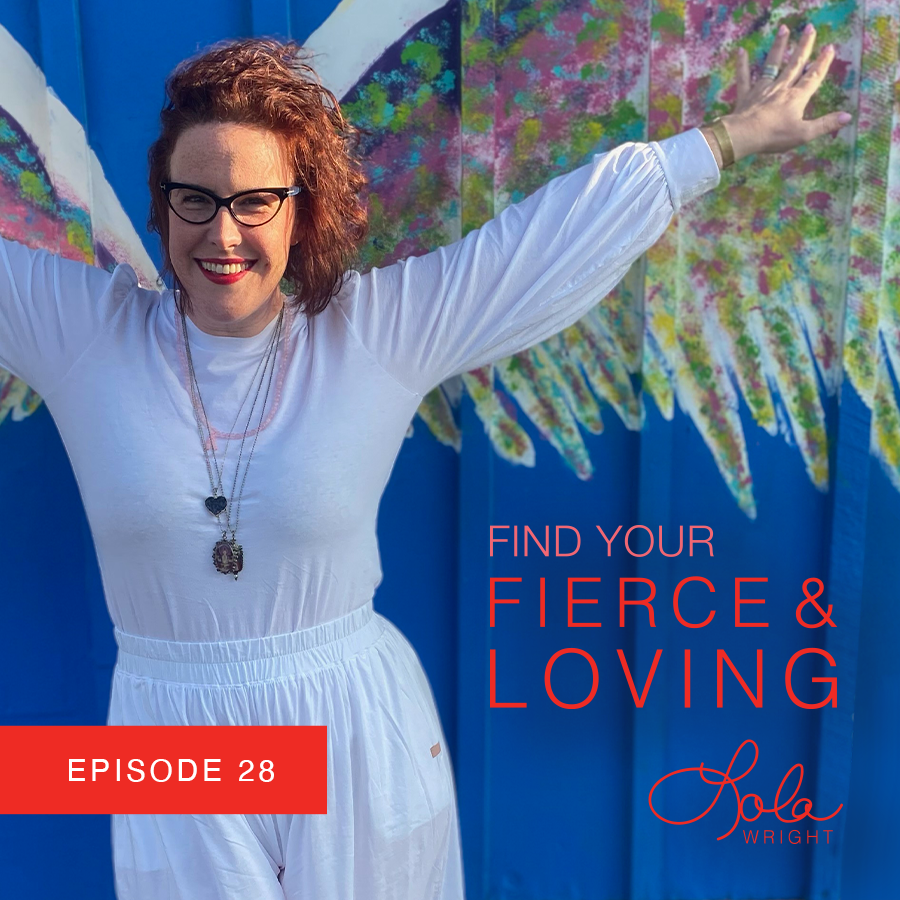
“The practice for me is the ability to watch, to witness, to notice.” – Lola Wright
The ego is often a strange and difficult part of our mind, but it doesn’t have to be. Instead of letting it control you, or trying to get rid of it altogether, learn to love your ego. You can recognize and love that scared little part of you, and let it serve you instead of controlling you.
Show Notes
I once led a series at the Bodhi Center centered around the beautiful book Stillness Speaks, by Eckhart Tolle. Today, I’m bringing you a talk I gave inspired by chapter two, The Egoic Self. When I am seduced by the egoic self in stressful situations, I am flooded by negative thoughts. I’ve had to learn self-awareness and how to recognize what messages are coming from my ego.
This week on Find Your Fierce & Loving, we’re taking a step back and looking and how our ego minds affect our lives. So much on social media works to keep us in a reactive state that feeds our ego identity. Instead of giving in to it, let’s develop our practice and learn how to love our ego.
- (01:48) – The ego mind
- (10:01) – Gaining awareness
- (17:52) – Relationship with your ego
Do you want to unleash your inherent love and goodness, liberate yourself, and free humanity from the oppressive systems and structures we have created? We are here to support you in finding your fierce and loving life. Join us in Our Circle, a vibrant membership community rich in opportunities for engagement and transformation. Find out more at lolawright.com/our-circle.
You can follow Lola Wright, on Instagram, Facebook, LinkedIn, and Twitter and learn more about my work at lolawright.com.
Chicago born and built, Lola grew up in wealth and privilege, yet always sensed something was missing. She sought out aliveness and freedom in music, immersing herself in the hip hop and house music scenes of 90s Chicago. After finding herself on her own at 23, as the mother of two young children, she became determined to create a new experience.
Lola is an ordained minister with a gift for weaving together the mystical and material, she served for many years as the CEO of Bodhi Center, an organization committed to personal transformation, collective awakening, conscious activism, and community-building.
This podcast is produced by Quinn Rose with theme music by independent producer Trey Royal.
If you’d like to receive new episodes as they’re published, please subscribe to Find Your Fierce & Loving in Apple Podcasts, Google Podcasts, Spotify, or wherever you get your podcasts. If you enjoyed this episode, please consider leaving a review in Apple Podcasts. Your reviews help others find the show.
Transcript
Lola Wright (00:01): Something is stirring. Maybe you’ve felt it. We are reckoning with the reality of injustice and binary thinking that feeds the political machine. Humanity is in the midst of a heartbreaking and painful paradigm shift. That is a good thing. My name is Lola Wright, and this is Find Your Fierce & Loving. This podcast is intended to help you disrupt, untangle and free your mind of personal and collective agreements, patterns and beliefs that are holding you back and weighing you down. We desperately need your fierce and loving purpose now more than ever.
Lola Wright (00:54): I led a community in Chicago, known as Bodhi Center, for many years. It’s also the place that I met my husband at in 2007. It was an incredibly powerful and potent community that I will be forever grateful for. A couple of years ago, I led a series based on Eckhart Tolle’s book, Stillness Speaks. Today’s episode of the podcast is from one of those evenings. It was called The Evening Wake Up. You’re going to hear about the egoic mind and the trappings when we get over identified with our thinking capacity, with our limited sense of self and with our judgments. Enjoy.
Lola Wright (01:49): So, welcome to The Evening Wake Up, and the inspiration for this gathering is the book, Stillness Speaks by Eckhart Tolle. We’re going to explore a chapter called, The Egoic Self. And, I just want to make reference to the opening of that chapter and the closing of that chapter. So, the opening of this chapter says, “The mind is incessantly looking, not only for food for thought. It is looking for food for its identity, its sense of self. This is how the ego comes into existence and continuously recreates itself. It’s looking to make sense of what’s occurring.” And, he goes on to say in this chapter that, “The ego finds its existence through thought. Don’t take your thoughts so seriously.” That’s really the invitation because it is the thinking mind that will have us spin out. And, it’s not that the thinking mind ever goes away, in my experience. It’s just we become more capable of witnessing it and realizing that’s not who I am. It’s just something that occurs.
Lola Wright (03:07): So, at the end of this chapter, he makes reference to a Buddhist master who says, “No self, no problem.” And, I think that’s really the essence. It is in the separate sense of self that the experience of problems arise. When we believe ourselves to be separate, which is the very purpose of the ego, to protect, to defend and to thwart off all threat. And, when we are identified with the ego mind, the ego self, we have an experience of suffering. The practice, for me, is the ability to watch, to witness, to notice. I am on a 21 day journey to have physical activity every day for 21 days in an intentional way, not like walking from my desk chair to the kitchen. So, I just said, “I’m going to… I have a 10 punch pass at my local yoga studio, and I’m going to commit to doing these yoga classes.”
Lola Wright (04:13): And, my mind has all kinds of reasons why this is a problem. Six o’clock, it’s too late. I’d rather be with my son. Noon, I have to take a shower by noon. Okay, great. So, six o’clock, well, I actually have the luxury of usually waking up to a cup of coffee delivered to me in bed by my husband. So, six o’clock, I miss that whole game. Lots of reasons. And, I just said, “I got to do it at six. Number one at six o’clock,” as I said to Ameerah, who’s been a Yogi for two decades, “It’s 60 minutes instead of any other time of the day when it’s 75 minutes.” So, I play with the mind and I go, “I’m smart. 60 minutes is better than 75. I’ll take the six a.m.”
Lola Wright (05:03): This morning I woke up at 4:55, which my body actually wakes up early naturally, I just sometimes pretend that I’m asleep until the coffee arrives. I woke up at 4:55 and I thought, “Well, this is sort of nice. I have an hour until I have to leave. And so, I could actually go and make my own coffee and actually do a meditation,” et cetera, et cetera. So, I had two cups of coffee, and I have not been a Yogi for 20 years, so having two cups of coffee and not eating before a yoga class is not recommended. And, what occurred by about minute 45 was I was not feeling well. The story I’m making up is the acid from the coffee was not friendly to my body after a very rigorous yoga practice. Well, at minute 45, the world started to look very bleak. My mind just started going. It was like, “Everything’s falling apart. This whole life is falling apart. This place is falling apart. I am falling apart.”
Lola Wright (06:17): By 7:05, several text messages had been sent out about how bad the situation was. I drove home, and I had a glass of water and two pieces of toast and an apple, and it was the oddest thing. All of a sudden it was not so bad. And, it was such a humorous experience for me that in a matter of 20 minutes, a shift like that could occur. All that is, is the mind. And, in those 30 minutes, from 6:45 to 7:20, I was entranced by the seduction of the mind. And, you hope that when you send those texts to your friends, that they do not buy into your story with you.
Lola Wright (07:07): So, he speaks to something about this. “What will be left of all the fearing and wanting associated with your problematic life situation that every day takes up most of your attention? A dash, one or two inches long, between the date of birth and date of death on your gravestone. To the egoic self, this is a depressing thought. To you, it is liberating. So, the distinction between my essence and my ego is one, experiences, the conditions of the world as a threat, and the other occurs like here we are, that’s occurring. But, when we are in the trance of our mind, it’s very difficult to see that.”
Lola Wright (08:01): I think that most of us are walking on the planet with a highly constructed egoic identity. And, it is the source of much of our suffering because we are just one ego construct bumping up against another. And, when we do not have a cultivated sense of self-awareness, we don’t have the ability to see that. It’s just boom, boom, boom, boom, boom. It is like you and I are in a perpetual pinball machine, just getting beaten around because we don’t have the discipline of the mind to go, “Ah, that’s just occurring.”
Lola Wright (08:41): Wouldn’t it be lovely, and I have greater and greater access, and I suspect you do too, because you’re sitting here practicing, when I’m having that moment at 6:45 in the middle of a rigorous yoga practice, after having two cups of coffee and nothing to eat, to go, “It might just be that I’m having a physical sensation. And, it might just be that I have a very low threshold for discomfort in my physical body.” At which point, when it occurs, everything appears to be falling apart, and it could be nothing more than that.
Lola Wright (09:20): The challenge is, when we don’t have a practice in place to create the spaciousness between the stimulus and response, we don’t get to 7:20 and start to deconstruct it. We actually go out into the world, and we cut people off, and we have upsetting interactions with colleagues, and we say snide remarks to our partners. And so, the practice, for me, is just how can I connect with my breath and how can I watch myself? How can I watch myself? The ego, in my experience, begins to loosen when I can watch it and not take my thoughts so seriously.
Lola Wright (10:01): When you recognize that there is a voice in your head that pretends to be you and never stops speaking, you are awakening out of your unconscious identification with the stream of thinking. When you notice that voice, you realize that who you are is not the voice, the thinker, but the one who is aware of it. Knowing yourself as the awareness behind the voice is freedom. So for me, the practice looks like fear is rising. It’s showing up. And, how can I just be with the fear without the need to respond or react? There are times where we need to respond and react, but much of our fear is contrived by our egoic self.
Lola Wright (10:56): Not infrequently, tribes, nations, and religions derive a strengthened sense of collective identity from having enemies. Who would the believer be without the unbeliever? The ego is always looking for contrast. It’s always looking for duality. It’s always looking for good, bad, right, wrong. It’s always measuring and comparing. And so, one of the great critiques of our current digital climate is that we’re seeing just a veneer of something. And yet we’re our mind, our neurology, we are hardwired to compare and contrast. It’s our survival mechanism. And, when we are not aware, when we can’t witness it, it takes us out.
Lola Wright (11:51): So, I just wonder if you could take a deep breath in this now moment and bring to your mind’s eye a way that this gets activated in you, a way that this comparing mind, this tendency to contrast can get amplified in you and then you seek for evidence of it everywhere because your survival through the lens of the egoic self requires it. Our ability to see it is our ability to breathe through it and not take it so seriously.
Lola Wright (12:31): Your unhappiness ultimately arises not from the circumstances of your life, but from the conditioning of your mind. And so, that is why we can have people like Elie Wiesel or Nelson Mandela, or these iconic figures that have experienced atrocious conditions and yet, realize that the greatest place of liberation is in the mind, not in the circumstances. So, anything that any one of us are dealing with can be really given a little bit of spaciousness from, and a breath can occur there. Otherwise, we are just living in a triggered reactive state. Our media has figured this out, and it literally is a drug. It’s literally like let’s just keep feeding this ego construct, this ego identity. And then, we have Facebook rants and angry gas station interactions for no seeming reason.
Lola Wright (13:41): Literally our central nervous system is inflamed, and we have an over-identification with our ego construct. And then, everything in life appears as a threat. Even if it’s subtle. Your unhappiness ultimately arises not from the circumstances of your life, but from the conditioning of your mind. Someone or something has occupancy over your mind. The question is, is it your conscious awareness or is it your unconscious states? All of us have been mobilized by our unconscious states, likely today. At some point today, we were all probably mobilized by an unconscious state. There’s nothing wrong with that. The ability to… scripturally, it says, “Forgive them, Father, for they know not what they do.” He actually makes reference of that in that chapter. Forgive yourself. It’s just an unconscious part of me.
Lola Wright (14:53): If I were to get to 7:20 this morning and then beat the shit out of myself for spinning out in 20 minutes and texting three confidants, I’ve only actually deepened the commitment to my egoic construct. But, if I wake up to my higher sense of self that goes, “Oh honey, you’re scared, and you had acid in your stomach.” It’s like, “Okay, I can be graceful with myself. That makes sense. That’s okay. Forgive me for I know not what I do. I had forgotten. I had forgotten.”
Lola Wright (15:38): So, that’s really the invitation, is to really sit with the practice of noticing when I am living in the delusion of my egoic sense of self or when I can just witness the egoic sense of self. There are some schools of thought that spent a lot of time thinking that the game was about getting rid of the ego. I mean, that in and of itself is sort of a problematic setup because what it implies is that one thing is better than the other. Your ego serves you all the time. It’s just about not living in the delusion of the ego. In other words, in a trap of fear.
Lola Wright (16:21): So, that’s where we gather to practice, and we get to rub up against human beings to notice all the places and spaces that we’re still feeling unconscious within ourselves and in relationship to others. So, we’re going to sit with, when you think about this, what comes up for you? Because this is really an opportunity to practice together, to map this onto our lives, not theoretically, but practically. How does the egoic self show up in your interactions? How does it take up occupancy and you become in a delusion about who you are?
Lola Wright (17:07): You want to be more alive. You want to unleash your inherent love and goodness, liberate yourself, and free humanity from the oppressive systems and structures we have created. We are here to support you in finding your fierce and loving life. Join us in Our Circle. This is an affirming and radical space that will gather weekly, on-demand or live, whatever works best for your life. For more information on how you can engage in Our Circle, visit lolawright.com/our-circle. I’d love to have you with us.
Lola Wright (17:52): The gift of the acid stomach, this morning, is to become aware, “Ah, that’s not who I am.” I now have a neural pathway. I have a reminder. I have a kinesthetic experience that when I have that happening in my physical body, I don’t have to be taken out by it because I just had a new awareness. So, when you think about how the egoic self can seduce you, what do you notice? How does that show up for you? Do you have a relationship with the ego that’s like, “Damn this thing,” or can you love that part of you and just go, “Oh, that’s just a little scared part of me. That’s okay.”
Anthony (18:38): I don’t get that, “Oh, you’re just…” I get pissed at it. It’s like a little kid screaming in my house, and I’m like, “Stop. You annoy me. You’re a little brat. Quit freaking me out,” because I have this attachment like it’s not supposed to be there. It’s not supposed to keep scaring me. Like, “You little monster, you come in and go, ‘Boo.'” That’s what it feels like. I’m like, “I’m tired of it. Stop. I work hard on you going away.” And, when they’re there, it doesn’t feel like, “Oh, poor little thing.” It feels like, “You just scared the crap out of me, and I didn’t need that. I was doing just fine before you scared me.” So, then I get a little bit resentful towards it. I’m a little mad at it. I don’t really want you to…
Lola Wright (19:21): Yeah, so there actually is a way that you could respond by making it bigger. So, I would suggest either see if you could befriend it, and if that’s not what you’re feeling, then really go big with it. Because when you go big with it, when you exaggerate your response to it, you see the absurdity of it. It’s when we try to self-manage that it sort of calcifies in our being. When you can actually make it bigger and go, “Oh my gosh, what is happening right now over here on planet Anthony?” And, it’s like, imagine your small child is learning how to ride a bike, and they fall. You wouldn’t beat the shit out of them. Or, if you did, verbally you’d go, “What is really going on over here?” And, it’s just as Jim Dethmer would say, “We’re toddling. We’re just practicing.” This is not the everyday conversation folks are having. How can I expand my capacity for self-awareness, such that I may walk on the planet with greater ease and grace? That is not the predominant conversation. So, you’re already interrupting inertia on every level. That’s really a pretty amazing act.
Rich (21:00): The one thing that came to my mind as you were talking earlier, was another story that Eckhart tells about two monks. And, they’re walking and they come to a big area of water, some people know this, and there’s a girl. And, one of the monks picks the girl up, carries her across the water. You’re not supposed to do that when you’re a monk. And, they continue on for about an hour, and they’re not speaking. And, finally the monk that did not carry the girl turns and says, “How could you have carried that girl across the water?” And he said, “You’re still carrying her. I put her down an hour ago.” And, I think that idea of staying in something way after it happened, that’s the ego’s need to stay in story. And, I try to catch myself because I’m there all the time. I’m in the story. Even as we spoke the other day, I said, “I’m always trying to imagine enlightenment because if you can imagine scenarios and imagine how you would handle them when you were enlightened, then maybe that will seep into your actual life, and then you’ll respond correctly when something comes up.” That’s where I’m at a lot. I’m in my head. Like you said, “You’re in your head a lot, aren’t you, Rich?”
Lola Wright (22:18): Yeah. Well, and it’s great to… I actually think if you look at your… We love the Enneagram. And, one of the things I think is so powerful about the Enneagram is noticing your propensity for head, heart, or gut. You actually don’t even have to know your Enneagram, but you could just look at the way you move through the world. Do you tend to orient yourself around your head, your cognitive capacity? Do you tend to orient yourself around your heart, always feeling? Or, do you tend to orient yourself around your gut? Which is what I would suspect the three of us tend to do. And, it’s just great awareness because any of it can become amplified and over-activated.
Yolanda (23:04): So I, coming off of that, I am always in my head, and I always, in this practice, try to think about, “Okay, how can I catch myself in the moment when these things happen?” Or, when I catch my, well… It shows up for me, the ego shows up for me as fear. So, when I get into that loop, I want to catch myself, and I always get so frustrated because at the end of the day when I’m decompressing, and I’m going over the day, I’m like, “Okay.” I see it after the fact. I guess my question is, how do you catch yourself in the moment or make reminders for yourself that this is not what’s happening or this is a narrative?
Lola Wright (23:51): I, in my experience, it’s literally just micro practicing all the time. My practice is literally in every moment, to the extent that I’m consciously aware, is to notice my thoughts. What are the… I just literally am watching myself all the time, watching myself all the time, watching myself all the time. And, if you do that when you’re not in a triggered reactive state, it’s easier to have access to it when you are in a triggered reactive state. Like right now, we could all just check-in and go, “What’s here now? How is the ego showing up now?” If we weren’t to make it wrong. Just how is it showing up now? I have this thing that happens with these red lips where on the corners, it will get a little buildup, and I’m like, “Jesus, I wish someone would be like…” And, it’s like, that’s just the ego. It’s really invested in looking good.
Ameerah (24:53): I do it with everybody. I watch people. I observe people. I watch someone do something, and I go, “Hmm, why did they do that?” And, I do the same thing with myself. I’ll do something and go, “Hmm, why did I do that?” So, it’s just practice. It’s literally practice. When you’re doing, like Lola was saying, when you’re doing anything, if you ever do something, and you laugh at yourself, you catch yourself laughing at yourself. And, you’re like, “Why did I think that? Or why…” You know, to just ask yourself the questions when you’re feeling whatever it is that you’re feeling. “Why am I feeling that?”
Lola Wright (25:30): Yeah, I think to befriend your internal dialogue is such a great gift. Your thinking mind is always going. And, part of my resistance with a lot of meditation practices is that it’s like escapism as opposed to just befriending what’s here now. The mind is just going, and the paradox is, the more you can watch the mind, actually the less it does just go.
Lola Wright (26:05): If you enjoyed this show and would like to receive new episodes as they’re published, subscribe wherever you get your podcasts, and consider leaving a review in Apple Podcasts. Your review helps others find this show. You can follow me at Lola P. Wright on Instagram, Facebook, LinkedIn, and Twitter, and learn more about my work at lolawright.com. This episode was produced by Quinn Rose with theme music from independent music producer, Trey Royal.
Lola Wright (26:51): And, you hope that when you send those texts to your friends, that they do not buy into your story with you.




Leave A Comment