
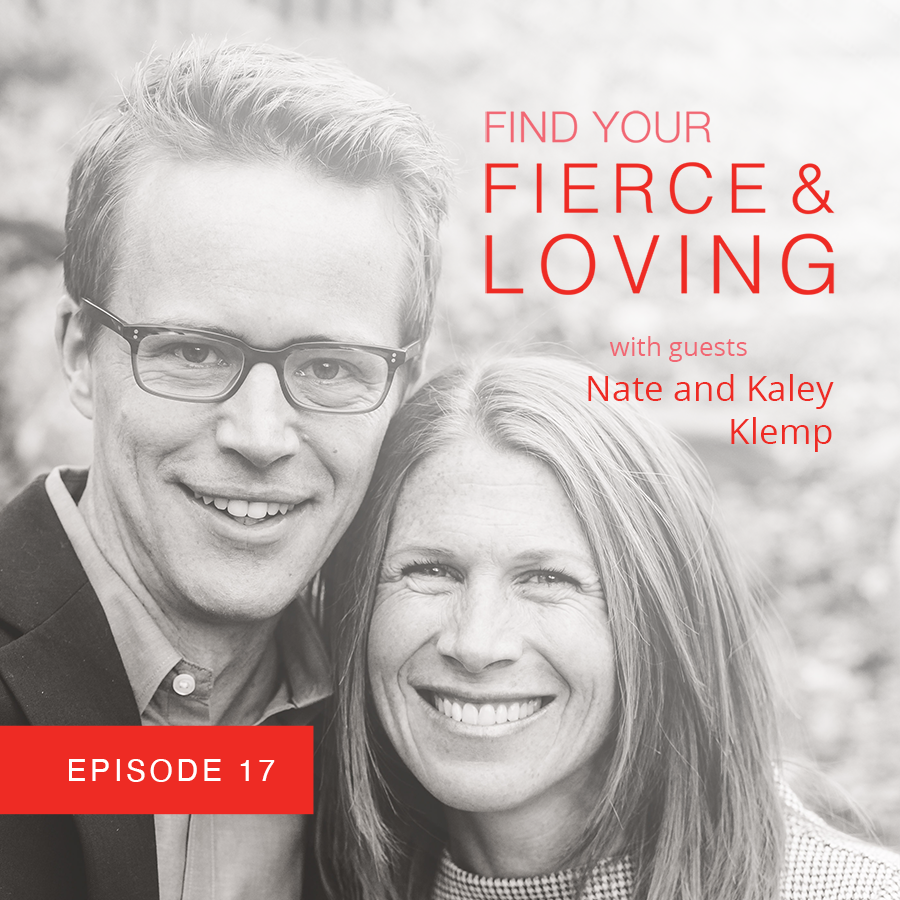
“That conversation led us to the idea of: what’s a different way to do marriage? Especially against this backdrop of “we want to be equals, we want to be teammates, we want to be partners”—but also, we want to be in love.” – Kaley Klemp
Most of us have an idea of what our ideal romantic relationship looks like: an equal partnership with a 50/50 work division. When Nate and Kaley Klemp tried to divide their responsibilities equally, they ended up frustrated and hurt. After extensive research and practice, they have a new paradigm for relationships: the 80/80 marriage
Show Notes
Kaley Klemp, an executive coach and expert in small-group dynamics and leadership development, and Nate Klemp, a prolific writer on the “inner technologies of the mind,” knew that traditional marriage models weren’t going to fit their busy modern lives. They struggled to divide work evenly until they realized the stumbling block that trips up so many marriages: they were never going to feel like everything was equal. Instead, they discovered the power of radical generosity and shared success. Now they’re sharing their transformative ideas in the new book The 80/80 Marriage.
Whether you’re in a decades-long marriage or happily single, everyone can benefit from hearing the Klemp’s remarkable new approach to relationships. Leaving behind unrealistic expectations and devoting ourselves wholeheartedly will help our relationships thrive and grow like never before.
- (2:58) – Tackling marriage
- (14:18) – Attempting 50/50
- (22:59) – Creating structure
- (30:42) – The under-contributor
- (34:21) – Redefining commitments
Nate Klemp is a writer, philosopher, and entrepreneur. He is the co-author, along with Eric Langshur, of the New York Times Bestseller Start Here: Master The Lifelong Skill of Wellbeing. He is also a weekly columnist for Inc. Magazine, and he is a founding partner at Mindful, one of the world’s largest mindfulness media and training companies. Nate holds a BA and MA in philosophy from Stanford University and a Ph.D. from Princeton University.
An expert in small-group dynamics and leadership development, Kaley Klemp specializes in building trusting, synergistic teams that are able to achieve their strategic objectives – even in the face of challenging circumstances. A favorite with Young Presidents Organization (YPO) forums and chapters, Kaley has facilitated retreats for more than 200 member and spouse forums throughout the world. Kaley is a graduate of Stanford University, where she earned a B.A. in International Relations and an M.A. in Sociology, with a focus on Organizational Behavior.
Do you want to unleash your inherent love and goodness, liberate yourself, and free humanity from the oppressive systems and structures we have created? We are here to support you in finding your fierce and loving life. Join us in Our Circle, a vibrant membership community rich in opportunities for engagement and transformation. Find out more at lolawright.com/our-circle.
You can follow Lola Wright, on Instagram, Facebook, LinkedIn, and Twitter and learn more about my work at lolawright.com.
Chicago born and built, Lola grew up in wealth and privilege, yet always sensed something was missing. She sought out aliveness and freedom in music, immersing herself in the hip hop and house music scenes of 90s Chicago. After finding herself on her own at 23, as the mother of two young children, she became determined to create a new experience.
Lola is an ordained minister with a gift for weaving together the mystical and material, she served for many years as the CEO of Bodhi Center, an organization committed to personal transformation, collective awakening, conscious activism, and community-building.
This podcast is produced by Quinn Rose with theme music by independent producer Trey Royal.
If you’d like to receive new episodes as they’re published, please subscribe to Find Your Fierce & Loving in Apple Podcasts, Google Podcasts, Spotify, or wherever you get your podcasts. If you enjoyed this episode, please consider leaving a review in Apple Podcasts. Your reviews help others find the show.
Transcript
Lola Wright [00:00:01] Personal transformation and collective awakening involve being the most alive, brilliant, inspired, creative on fire version of yourself. A version that is not consistent with the status quo. My name is Lola Wright and this is Find Your Fierce & Loving. This podcast is a wake-up call, a roadmap back to your holy purpose, an invitation to set fire to the box you’ve been living in, and watch it burn.
Lola Wright [00:00:40] All right! I am so incredibly excited to have today’s guests on the Find Your Fierce & Loving podcast. I want to tell you a little bit about them. One of them will for sure be familiar to many of you by name and that’s incredibly fun. But let me give you let me give you sort of a heads up. No.1: it’s worth knowing that they are a couple. So they are in relationship. And, you know, there is like a different dance that we do with the humans that we’re in relationship with so just know that as we enter into this space. So my first guest is Nate Klemp. Nate is a writer, philosopher, and entrepreneur. He is co-author of The 8080 Marriage and along with Eric Langshur, he is the co-author of The New York Times bestseller Start Here Master The Lifelong Habit of Well Being. He is also a weekly columnist for Inc Magazine, and he is a founding partner at Mindful, one of the world’s largest mindfulness media and training companies. Nate holds a B.A. and M.A. in philosophy from Stanford University and a Ph.D. from Princeton University. My other guest is Kaley Klemp. Caleigh is one of the nation’s leading experts on small group dynamics and leadership development. She is a TEDx speaker and the author of four books, including The 8080 Marriage, the Amazon bestseller, and one of my very favorite books, The 15 Commitments of Conscious Leadership, The Drama-Free Office, and 13 Guidelines for Effective Teams. A favorite with young presidents, organization forums, and chapters. Kaley has facilitated retreats for more than 400 member and spouse forums throughout the world. Kaley is a graduate of Stanford University, where she earned a B.A. in international relations and an M.A. in sociology with a focus on organizational behavior. Nate and Kaley Klemp, I am so incredibly excited to have you here. Thank you for joining me.
Nate Klemp [00:02:52] Thanks so much for having us. Great to be here.
Kaley Klemp [00:02:55] We are so excited to be here. Thanks, Lola.
Lola Wright [00:02:58] Yeah. So obviously we are in large part here to talk about your new book, The 8080 Marriage, and so we’ll have lots of fun doing that. I’m excited because this month we’re talking about love, intimacy, partnership. It’s a big part of my story. One of the things I don’t think you know about me is that February 15th, 2007, I met my husband Nathan at Bodhi Center, this community I then led for many years in Chicago, and we were at a small group gathering in the company of Michael Beckwith, who’s a mentor and friend and just like an incredible human. Yeah. And my husband and I had never really interacted. I mean, like a couple words around the proverbial halls of Bodhi.
Lola Wright [00:03:43] And he walked up to me after the closing meditation and he said, “Hey, I have something that I have to tell you.” And I said, “OK.”
Lola Wright [00:03:52] And at this point he’s like shaking tears. And I’m like, this is not good like this. Something about this appears to be very off.
Lola Wright [00:04:00] And he said, “Yeah, I think you might already know what I’m going to tell you.” And I was like, “OK, well, what is that?” And he’s like, “I think you’re going to be my wife.” And I was like, “OK.” And he’s like, “Did you know that?” And I’m like, “You know what?
Lola Wright [00:04:16] I think I did know that I have, like, seen you in this recurring meditation that I’ve been having and we’ve always been gardening in front of this one house.” Well, it turns out he was doing his master’s in landscape architecture. He moved into my home two weeks later. We got married five weeks after that. We closed on our house two weeks thereafter. And it was this like, really mystical, incredible… Like, it’s a great, great story. And then we went into, like, eight years of a dark night of the soul. It was sort of disastrous. And he was basically living like a Buddhist monk. And I was like, Type A, corporate soldier, single mom could not have been living more differently. So the topic of marriage and partnership is like hot on my list. What had the two of you decide to take on that topic for your coming?
Nate Klemp [00:05:10] Well, first of all, that’s such an amazing story, Lola, and it’s so crazy that you have the image of him in your head. I mean, that’s just amazing. You know, our story is similar in some respects, different in others. We met way back in 1996? ‘97? We were both in high school together at Boulder High School. We were at the same, like, lab table in our chemistry class. So my friend and I were on one side, Kaley and her friend were on the other. And we just started like hanging out and studying for chemistry tests and then all of a sudden, you know, there we were dating. We went to prom together. We ended up going to the same college, but then pragmatically broke up because we were like, you know, if this was meant to be it’ll come back, we’re too young, blah blah blah. So we end up going to college together, but we’re not together really. We get back together seven years later when I’m living in New Jersey getting my Ph.D. Kaley’s in San Francisco.
Lola Wright [00:06:11] Wow. That’s practical.
Nate Klemp [00:06:13] So like super like the worst time possible to do it. But we had this fairy tale story in some respects, the way we met. Kind of like you, very auspicious meeting and then we actually got married. And I think it’s fair to say that brought on one of the most difficult periods of our entire life. We call it the dark years, actually. Partially because we were living in New Jersey, where it’s cloudy all the time.
Kaley Klemp [00:06:42] And no, no offense to our East Coast friends because there are so many gorgeous parts to the East Coast but that was not where we were meant to thrive.
Nate Klemp [00:06:50] Yeah, but all that’s to say, like, we really struggled with this whole marriage thing. And it was similar also in the sense that Kaley was very Type A, on top of her life. She was what you might call an adult at age 26. I was a graduate student who cleaned my dorm like once every six months, you know, and spent my days reading philosophy books. So anyway, that created some really gnarly dynamics that we have been spending decades trying to unravel. And so, I mean, maybe you can tell her how we actually got to the book from there.
Kaley Klemp [00:07:29] So take that beginning and exactly as Nate saying, there were some really beautiful, amazing moments and then there were some really dark challenges. And then layer on to that, we spent some years in California, we moved back to Colorado, we have a daughter. And all of a sudden the requirements for the two of us as individuals and as a team, we’re really kind of overwhelming. And so we add we historically had not been great at the date night, but great at the date hike. So one of our favorite traditions is that we would drop off our daughter, she’d have breakfast with her grandparents, and the two of us would go kind of hike in the Colorado mountains and discuss life. And we were in this conversation about how challenging just doing our life and staying a team and feeling like it wasn’t like, “OK, cool, we’re going to hike for a couple hours and we’re going to handle our logistics.” But to be like, “You’re the person who I love. You’re the person I want to be with.” But also then recognizing we were really fraying at the seams and we were looking for some models. And I looked at my parents and they were phenomenal in their own way, not a model for us. I looked back another generation, I looked at my grandparents, I was like, sorry, there’s actually no similarities at all. And so we started talking with each other saying, OK, the context of our lives has changed. There wasn’t the clarity of division of roles that, for instance, my parents had where my mom, her role was to raise the kids and to have our family be intact. And she did a marvelous job but that wasn’t my focus. We were… I’m flying around the world, gone a couple of days a week. Whose job is it to do different things? And we were noticing how frustrated we felt so much of the time and said there’s just got to be a better way. And so in that conversation kind of led us to the idea of what’s a different way to do marriage, especially against this backdrop of we want to be equals, we want to be teammates, we want to be partners, but we also we want to be in love.
Lola Wright [00:09:46] Yeah, I feel like some of what I imagine you’re addressing in your book is like, what’s the next generation of this topic? Right? Like, I think for most people when they think, you know, there are a couple books that come to mind right? Like Men are from Mars, Women are from Venus, which I have, like, massive levels of resentment towards and just, like, I totally get why it existed when it existed but it just like, again, much like the models of relationship that you had, that does not feel like a map for me at all. Another one would be probably like Five… The Five Love Languages. That’s probably another very popular one. I can’t actually think of, I mean, I think Esther Perel is probably, like, the closest thing we got going these days to, like, a modern-day voice. Right?
Nate Klemp [00:10:36] Yeah and we had the same feeling where we were thinking about all the canonical marriage books, Harville Hendrix, Gary Chapman, Five Love Languages, John Gottman, who’s done amazing research, Men Are From Mars, Women Are From Venus, as you mentioned, these are all interesting books. They contain some really great insights. But they were all written somewhere around 20 years ago and they were written for a context that’s totally different than our generation’s context of trying to make marriage work with kids and careers and social media and the distractions of modern life and the pace and the speed of modern life. So we had the same feeling where we were like, you know, it feels like there’s a need for a marriage model that’s really about this context, which is so unique and so different.
Lola Wright [00:11:25] Mm-hmm. One of… My husband and I have been really willing to explore, like all kinds of paradigms in our relationship. In an effort to be like, “OK, we’re committed to being with each other like you are my person. I want to do this life with you. And like, we keep butting up against some recurring themes and patterns, like maybe we should explore an open relationship and like it doesn’t feel like a right fit for us.” And I have zero judgment around the paradigm of open relationships makes perfect sense to me. And we could say, you know, my mind is still too colonized and like all that kind of stuff and perhaps that’s true. I just know I can’t like when I try on, like, saying “Hey,” to my 11 year old or now 12 year old, “I’m going to go over to such and such’s house tonight. I’ll see you in the morning.” Like, I just can’t get there and I don’t have a willingness to do it in the shadows of my life. So then it’s not a good fit for me. I think that this really is something that couples are struggling with and I think it probably independent of whether you’re officially married or just intimate partnership. And, you know, we talked about this night when you and I were on a call the other day, the work that you’ve created is not set up in like the binary, cisgender, hetero framework. Your work is really intended to be applicable to committed partnership, is that right?
Kaley Klemp [00:12:58] Exactly. I think Lola as you’re saying that, it’s so funny, just yesterday, Nate and I were having this conversation and we have a similar experience for ourselves where we try on, “Hey, what are other models besides sort of the structure of marriage that we have that could work?” And I love the way that you framed it where we go, “Gosh that just doesn’t fit for us.” But there are lots of sweaters that I try on that I go, “That’s not the right color on me,” or “That one’s itchy,” but it’s amazing for someone else. So it’s not to say that there’s a right or wrong or good or a bad way to do any of this. I think the way that we’re writing in 80:80 is intended to be as assistive or supportive of relationships in any format that they’re showing up. And I think sort of the backdrop, if we talk about you know, “What is 80:80? Cool, cool ratio, like what are we talking about here?” It’s really built on this idea of how’s your mindset and what’s the supporting structure? And I think it’s interesting that you know, as we looked at the canon, as Nate was saying just a minute ago, there’s something about the emotional trauma that people have experienced and how that translates. What we’re saying is, how are you holding your mindset as you enter the relationship? And what we’re noticing is that people have been trying to make it fair and striving for the sense of 50/50 fairness. And really what that leads to is a whole bunch of resentment. And I love your statistics around, like why we actually can’t do 50/50.
Nate Klemp [00:14:38] Yeah, I mean, so that is really kind of the starting point of our book and the starting point also from our own personal experience because when we got married and we faced this question of how do you balance equality and love and our personal ambitions with this shared project of running a life together? Fairness was just kind of the obvious first principle that we went to and so we found ourselves falling into that and we found as we interviewed about 100 people for this project, that this was just this like theme that kept coming up again and again, that every couple had their own version of some sort of fight around fairness. And what was really interesting in writing the book is we started exploring some of the literature and psychology showing that essentially this idea of fairness is almost like an illusion. Right? Just in the sense that we’re prone to essentially underestimate everything our partner does because of availability bias. The fact that I can see everything I’m doing, I can’t really see what Kaley’s doing like she might go to the store this afternoon and I’ll have no idea she went to the store right? So I tend to underestimate her contributions but then they’ve also found in psychology that we have a tendency to overestimate our own contributions.
Lola Wright [00:15:57] I don’t… I just want to make sure my husband doesn’t hear this episode. I’m like, oh, my gosh, I think that’s really true. I think I grossly overestimate my contribution.
Nate Klemp [00:16:07] What’s really interesting is that the research shows we’re actually pretty good at estimating our contributions to the workplace where work is pretty continuous. But at home, work is so discontinuous where it’s like I might help my kid for like three minutes and they go do something else that we’re really bad estimators of how much we do. So it just results in this situation where we can’t ever agree on fairness because it’s impossible like our cognitive biases are set up in such a way that there’s no way we could ever do it, even with perfect information.
Kaley Klemp [00:16:42] Well, and I think so much of the work that we do in our families is invisible. Right? That story example, then whatever it is, you know, grocery show up in the refrigerator or whatever happens, there is evidence of it. But a lot of the ways that we support our family are just thinking about it. And the emotional labor is totally invisible. So how much time do I spend thinking about how we’re going to do a COVID safe and yet connected meal with people outside so that we get to celebrate your mom’s birthday? Like there could be several hours of churning that occurs in there that really has nothing to show for it. And so, you know, but it feels like, “Hey, you don’t care.” And that, I think, is a really interesting point of fairness, is that some of it’s about: What do you do? But a lot of it is also about: How much do you care? And exactly is Nate saying we could never get there. And so instead of striving for 50/50, the idea of how can you create a mindset of radical generosity? How can you strive not for 50 but for 80? And when both people are really sort of stretching toward that 80 percent, all of a sudden it’s whatever the activity is, OK, I’m unloading the dishwasher, my internal dialog is not, “It’s not my turn to unload the dishwasher,” It’s “How is this a win for us?” Right? “How can this be in service of our family?” and “What does radical generosity look like?” And you end up in this really cool, virtuous cycle of and so I give from radical generosity that contribution shows up. But then my glasses switch too and I’m looking for the generosity of my partner and I appreciate it and there’s sort of that call and response that occurs between the two. And then you’ll know this from 15 Commitments, but what we’ve really found it to be essential in marriages, is also clearing out all the gunk. Clearing out all of the looping thoughts and the stories we make up that would keep us from that open heart, that mindset, and experience of generosity with our partners.
Lola Wright [00:18:49] Yeah, there are a few things that are coming up for me as I hear the two of you speak. One is, a couple of years ago, I had this, like, sort of out of the blue awareness that up to that point I had been relating to my relationship with my husband as like one of the most beautiful singles, tennis matches in existence. It was like there would be these moments of like a great volley and then there’d be this moment where I’d destroy him and he’d destroy me. And it occurred to me like, “Oh my gosh, that’s the context!” We actually are relating to each other as opponents as opposed to like what if the context for our relationship was like a world-class doubles team. We would actually see each other completely differently. So that’s like, that really was a really great context shift for me. The other thought that’s coming up for me is, you know, I think… So, many years ago, a teacher said to me, “What if you arrived in a relationship, any relationship,” ‘cause I actually think much of what you’re talking about is applicable to any relationship, right? “What if you let go of this idea of 50/50?” Which, by the way, is fundamentally rooted in scarcity. I mean, if we really just were to call that out and he said, “Well, what if you showed up 100%,” and I took that on for a lot of years and if we flag like 100% responsibility. Now, the challenge with that, I will just say as a type A like, you know, whatever, I can get sort of dogmatic with that. And then it’s like it’s 100 percent or nothing. And it’s like, oh my gosh, that is crazy-making. And when I got, I think it’s I think it’s made reference in The Big Leap actually, like, what if 80% would be good enough? You know, and that’s like who’s actually measuring if it’s, you know, 74%, 82%, whatever but the spirit of the thing is what I hear you talking about, to shift out of this scarcity context, like, “Well, I did my 50%. Where are you at?” It’s like, no, we’re actually leading with generosity, but it’s not about being dogmatic.
Nate Klemp [00:21:02] Yeah, I totally agree and I think that context shift, the tennis analogy is amazing. Because that’s exactly what we lived through for years and years and years. I mean, we really… we took the fairness paradigm to its absolute limit. Like we lived it, we embodied it, we pushed it to the very edge. And what we found, which I think was really interesting because we were a relationship where Kaley was the over contributor, I was the under contributor. And there are a lot of relationships like that. And that pattern, by the way, shows up in same-sex marriages as well. It’s not just in heterosexual marriages, but in a lot of heterosexual marriages, it’s a, there’s a sort of gendered version of it which we had. And what was really interesting about it is that fairness had this intention of, like, making things more equal. It had a good intention. But the effect was that it actually made things less equal like it… So for me as the under contributor, the more that Kaley brought up ways in which things weren’t fair or criticized me or nagged me for not cleaning the grill for the seventh time as the under contributing partner, I lost all motivation to do anything, right? At that point, I was like, “Well, nothing I do is going to be good enough, so screw it. I’m not going to do anything.” So that’s what was so paradoxical about it. You know, you think like, oh, this is pushing us toward equality, and yet it seemed to be pushing us toward inequality. And so this context shift where we finally started to think like, OK, well, maybe there’s a different way of approaching this. It seemed radical and it seemed crazy, especially from that vantage point of fairness, like, why should I give 80? I’m already giving everything as it is. And yet that shift in mindset seemed to be the thing that allowed us to actually reach equality, paradoxically.
Kaley Klemp [00:22:59] And I think that what you’re saying Nate, is so brilliant because it also allowed us to shift the structure. That, the tennis analogy, like, I hope that we can steal that because that’s so, so good. That… It… Once the mindset was that radical generosity, we can come to the same side of the net and actually win together. And that’s really the second part that if, if I think about 80/80 marriage, the first pillar is that of mindset shifting from spareness to radical generosity. But the second pillar is structure. That I think there can be sort of like, “Well, we’ll just be radically generous and maybe the table will set itself or…” There’s something there around then creating the structure where you say if we’re a doubles tennis team, every point that you score is a point for us. And every amazing volley that you make and every crazy serve that you do, I get to cheer as loudly for your incredible gift to our life, or your shot, as I would for my own. And it does, it really changed, I’ll say for us, how we thought about, how do we ask these questions even differently? So it isn’t you know, “Hey! Are you going to volley that?” It was, “Hey, is that approach going to serve our life?”
Lola Wright [00:24:27] Yeah, I love that because I think that you’re absolutely right. Like a world-class doubles team is not going to leave things to chance. Like they have a game plan, you know what I mean? So that idea of structure, I love that. Like the table’s not going to set itself. Do we have… So it’s… In the realm of commitments and agreements, we’ve organized ourselves in a particular direction. We’ve transcended the model of scarcity that’s built on this perceived sense of equality, 50/50. We’re going into a state of generosity. So that’s the commitment, the way we’re organizing ourselves. We still are served by having clear agreements, as our friend and… Jim Detmer would say, “Who’s going to do what by when?” Like, it’s not like, and sometimes I think especially as you know, many of us are creative and artistic and that can sound oppressive. But paradoxically, as you said, it, the thing that you may suspect as oppressive, in fact, becomes the portal to your freedom.
Nate Klemp [00:25:33] Yeah, absolutely. You know, we talk a lot about this and especially in this field of consciousness, which is the real world where we’re all playing in, we have certainly seen that there’s this trap of getting lost in what you might think of as the absolute plane of reality, where everything is consciousness, you know, the self begins to dissolve and we’re able to see pure awareness and all these great liberating things which are super important, like not to diminish those at all. I mean, they’re amazing, but I think there is a tendency to sometimes get trapped there and say, “You know, when it comes to the relative plane, it’s all good, like everything is fine.” And yet, you know, like I think about my day later today, I’m supposed to pick up my daughter at school. And at the absolute level, if I don’t show up and she sits there for an hour, it’s fine. That’s her experience. She’ll certainly grow from it. I think that trauma could serve her in all sorts of ways. And yet in the relative realm, it’s like I should pick up my kid because that’s a very easy way for me to avoid having her suffer for no reason. So, you know, and that requires structure for me to get there and for us to coordinate these things. And so, like so we definitely wrote this book with the thought that structure, as you said, like freedom some, sometimes is only available through some constraint or some structure. You know? Absolute freedom is not freedom at all. It’s kind of this weird experience that often doesn’t work out very well.
Lola Wright [00:27:12] I love that you are saying that because I have such an aversion to these, like, super esoteric principles that are.. that, like, there’s no reconciliation of the application in the material realm. So like my grandmother would have said, “Oh gosh, it’s one of those spiritually bound,
Lola Wright [00:27:33] they’re of no earthly good,” you know? And she was like a deeply spiritual woman, but she understood the intersection of what one might call our humanity and our divinity. Like we are in this dimension of reality. And it can be used, as you call it, a spiritual bypass or sort of, you know, a release of responsibility to be like, “All is well, all is. Oh, that’s their experience. They chose that.” That doesn’t mean you got to be an asshole.
Kaley Klemp [00:28:02] I think it’s very often tempting to see the spiritual bypasses in the most intimate relationships. That in some ways the grace and the goodwill that is initially created can sometimes create really bad behavior. And there’s a parallel, I love this story, so my daughter, she is now nine, she was, I don’t know probably six or seven at the time, she was just being a pill. And I was like, “Listen, your teacher said that you are delightful at school. What’s going on?” And she goes, “Oh, Mom, I used up all my good behavior at school.” And I think that there can be this sense like, oh, I used up all my good behavior at work. Or I used up all my sort of presence in this other environment and you get the dregs. And exactly to your point, this intersectionality of what does radical generosity look like in practice? And what are the agreements that we make with one another? What are the roles that we intentionally choose? Some because it’s suited to our giftedness. Let’s use our genius as a way to inform how we divide labor in our lives. Absolutely. And then to create choices which in many respects is around how do we use integrity? Where you say, what is my authentic yes and what is my authentic no? Right? Like use that to say, what are our shared values, that translate to priorities that then become boundaries where there are clear lines where you say to make that agreement and keep it, I am choosing no to this other opportunity or this other invitation or choose something else that isn’t in service of the agreement I’ve made, especially in the spirit of radical generosity with which I’ve made it.
Lola Wright [00:29:58] You want to be more alive. You want to unleash your inherent love and goodness, liberate yourself, and free humanity from the oppressive systems and structures we have created. We are here to support you in finding your fierce and loving life. Join us in Our Circle. This is an affirming and radical space that will gather weekly on-demand or live whatever works best for your life. For more information on how you can engage in our circle, lolawright.com/our-circle. I’d love to have you with us.
Lola Wright [00:30:42] One of the things that you talked about, Nate, is… I love how comfortable you were or are stating Kaley as the over contributor and you as the under contributor for a couple of reasons. One is, I think like there’s so much shame around being the under contributor in our society and so much heroic energy around being the over contributor. So I love, like, the neutrality with which you say that. What do you make of that? Sort of we hold up this idea of the over contributor as being really revered and the other contributors, like, what a loser.
Nate Klemp [00:31:25] First of all, yes, I think you’ve nailed the description of that pattern and it becomes this dynamic where one partner can almost like get off on feeling the societal praise for being the super person, often the superwoman, and the other person, in my case, the under contributor can feel just this sense of shame that leads to a kind of withdraw. And, you know, it was interesting, we talked to a number of other couples where this dynamic was in place and one of the things we started to realize both in our own life and in some of these other couples, is that
Nate Klemp [00:32:11] there’s a kind of 100% responsibility thing going on here, I think a lot of your listeners will be familiar with this concept that, you know, in some ways you are creating the reality that you are living in. And I think marriage is a great laboratory for this idea of 100% responsibility that often we are creating the conditions that we complain about. Right? And so for me, certainly, I was doing a lot to create the conditions where there was this very troubling dynamic that was very difficult for me. But then I think we started to also see how Kaley was contributing to this dynamic. And we, you know, we talked to… I talked to one man who his marriage ended in divorce over this pattern. And what he said is like, “Look, I went into this situation. I was a real doer. But, you know, my wife was a doer as well. And she just sort of ended up doing everything, probably because of historical accident and gender roles and all sorts of other things. And as a result, I just stopped doing and then the story became, why doesn’t he do anything?” And that became like the fundamental rupture in their marriage that led to divorce. So.. so, yeah, I think there’s a… there’s so much to unpack there, but it’s a really interesting and complicated dynamic.
Kaley Klemp [00:33:30] And I think you nailed it, too, that the hero gets that temporary experience of “I’m so great and I’m so awesome.” And then that martyr slide back down to the victim where it becomes the resentment around really the unconscious commitment: I have systematically trained you to not contribute and now I’m going to keep doing it from a place of ego and resentment and flirt between those two lines. It’s a really, it’s an addictive place to be both for the ego hit and smack in the hero moment and sort of the righteousness piece that shows up in that martyrdom.
Lola Wright [00:34:18] Mm-hmm. So a couple thoughts. One of the commitments that Nathan and I have in relationship to one another is that we do not say, like, “till death do us part.” That’s not the context that we live in. The context that we come from is we’re committed to this relationship being, as you said, a laboratory for our own growth and evolution. And if at some point we determine, I think we feel complete here like, you know, the growth, the evolution, the learning that we needed and wanted from this container, if you will, if that becomes complete, then we’ll cross that bridge. So that’s just I just want to offer that because I think it’s incredibly helpful, like when the mind is like, “Oh, my God, I’m going to have to deal with this forever.” It’s like, it does sound sort of bleak, you know, especially if you haven’t gotten to a point where it’s like it’s working for you. Right? So I’m curious, like, do you two have any kind of a context like that? You know, I think historically, and Nate maybe this comes up for you, given your background, but it’s like marriage as an institution, there was a lot of obligation sort of embedded in that. There’s… there are… there’s an investment portfolio or a dowry on the line. There are like all these considerations. It’s like we’re free from that to a large extent. I mean, for me, actually, it was good that I was, I had the trappings of a mortgage and a marriage because I’m a runner, so I would have been like, “I don’t need this shit in my life. I gotta get out of here.” The mortgage was like, that’s a pain in the ass to untangle from and that was enough to have me sit still long enough to get on the other side of the thing. But less and less we have those kinds of limitations. Right? So then what becomes the context if religion isn’t it and if financial limitations aren’t it?
Nate Klemp [00:36:18] Yeah, I think it’s such a great question. I love how you rooted that in the history, which is fascinating. I mean, you know, up until maybe 70 years ago or so, like marriage had this very pragmatic purpose. It was really about economic advantage and survival and things like that, maybe building some political alliances. Right? But then you get this rise of romantic love in the Enlightenment
Nate Klemp [00:36:44] and it kind of culminates in the fifties where all of a sudden we’re talking about love is something that’s chosen and love as being a primary reason to get married. You know? And this is like radically new in all of human history. So I think it is worth acknowledging that. And I… and especially now in our current context, you know, there are obviously pragmatic reasons to get married, but it’s largely about this idea of something like romantic love, sharing a life together, that sort of thing. So I think that’s super interesting and, you know, for us we don’t have the sense that, you know, “till death do us part,” I don’t know that we’ve ever said something like that. We also aren’t averse to it I don’t think. I mean, I think for us, where we’ve landed on this question of kind of like what’s the context that brings us together? Is a evolution from where we started, which was a place where it was kind of like, I want to do amazing things as an individual, I want… I had all these personal ambitions for myself and Kaylee had all of her career ambitions and personal ambitions. And we were kind of like married, but really trying to do these amazing things as individuals. And sometimes my ability to do the things I wanted to do interfered with her ability to do the things she wanted to do and we’d fight about that and that’s where fairness would come in, right? So that was kind of our initial context was one of like, you know, this aspiration toward individual exceptionalism, which was like drilled into us in college and, you know, growing up, you have to do something amazing. You have to be somebody. Right?
Lola Wright [00:38:33] Sounds exhausting. Just hearing you describe it, right.
Nate Klemp [00:38:37] Yeah! And that was kind of the initial context. And I think the evolution that’s happened in our life and that that we’re trying to articulate in this book is that we’re trying to reframe our life in some ways, our careers, the whole business of what we’re up to as this kind of shared project. You know, we said we would never work together. We would never write a book together. We would never even write an article together. And this, in some ways, has been this crazy experiment for us to see, like what happens when we, when we actually work together and see if we can create something beautiful together. And so that, I would say that’s the main context, is kind of trying to create a shared sense of success in our, in our life across every dimension, really.
Lola Wright [00:39:23] Yeah, my sense is that that requires enough of the ego identity deconstruction to be available for that. Like that there was obviously, you know, Michael Beckwith says “Pain pushes until vision pulls.” And so there was, there had been enough pain sort of pushing you forward and then something shifted, which wasn’t like by magic, you know, you created a shift in consciousness and a vision emerged for another way of being in relationship together, which to me is like, sounds awesome.
Kaley Klemp [00:40:00] I love the way that you just framed that and love Michael Beckwith for the way… it was exactly as you’re describing that our old way of, sort of, the pain or the push of fairness wasn’t working. And I… and then the vision could pull to say what would shared success look like, what would 80/80 look like? And the words weren’t there to describe it as it was being sort of formed but there was this sense of another way as possible. I think the boundaries around all of that for us were commitment. That whether you call it partnership or life partnership or marriage or something else or it’s a mortgage, whatever it is, that there’s something that holds the container so that there was a willingness to do the work with this person. That I think sometimes there can be something like, “Wow, gosh, this isn’t convenient anymore. See you never,” right? Or a sense of like, “Gosh, this isn’t fun or easy, huh, a bunch of my stuff is showing up, and eh I prefer not to face that.” And I think that an intimate relationship can be such a powerful crucible for facing the pieces of our personalities and our backgrounds and our history and our egos that would have us repeat something painful. And if we’re willing to go through it with this person that we love so much becomes possible on that other side.
Lola Wright [00:41:35] One of my teachers, really brilliant breath worker by the name of Jim Morningstar, said to Nathan and I early on in our relationship, he said, “Relational intimacy is the final frontier.” And I think it’s so it serves.. it has served me so many times to be like as someone who is devoted to my awareness, awakening, evolution, growth, expansion, contribution, the conflict that I experience within myself, projected onto the other person before me is actually an indication of the commitment that I make to expansion, awareness, growth, et cetera, et cetera. And so it’s not a problem. It’s an opportunity. You know? And we talk a lot about this, you know, if all of existence is in fact for you and not happening to you, what then becomes possible? So I would love to close with this inquiry. If someone’s listening to this and they’re not in an intimate partnership, is there still a value in this conversation and in the book
Lola Wright [00:42:42] for them and either because perhaps they desire an intimate partnership or because these principles are applicable, independent of romantic partnership.
Kaley Klemp [00:42:53] I think yes.
Kaley Klemp [00:42:56] And I would say if you are not presently in an intimate relationship, there is a design and a vision invitation that becomes possible where rather than and I doubt many of your listeners would do this, but rather than falling into a relationship, where you go “huh,” that this can facilitate that by the co-creation of and a partnership in a way that feels intimate and growth inspiring with some of the tools that then add to it. And I think it’s really valuable to have in your toolbox. And to your point, I was having a great conversation with a friend we were talking about 80/80 and she said, “Can you have a relationship with a child?” I was like, gosh, that’s a really interesting question. What would that look like? Could you have… Could you have an 80/80 relationship with a parent? I think that there are stretches where I’m not sure that you can have 80/80 relationship with, oh, I don’t know, the person who delivers your mail but possibly. I just don’t know what shared success looks like in that context. Right? But there is… there is an invitation into mindset and structure that I think is applicable. Its perfect use case is marriage and intimate relationships but are there that I think you could use elsewhere.
Nate Klemp [00:44:27] The other thing I would add, I used to be a jazz piano player and my teacher would always tell me “It’s much easier to start with good habits than to unwind bad habits,” and I think that’s true of piano playing, but it’s also very true in relationships. I don’t think you have to do what Kaley and I did where you start with some nasty patterns and habits and you spend a decade or more trying to unwind those habits. I think, you know, a better way to approach relationships would be to say, “Hey, what would happen if we started with habits that were a little bit more skillful?” And maybe we’re not perfect. Right? But if you lay down some of those habits at the beginning, there’s a kind of path dependency to that that lasts over time. And it’s just so much easier to start with good habits than to unwind some of these things that they can really take years to unwind, speaking from personal experience.
Lola Wright [00:45:24] Well, I hope that you two got like a multiple book deal with your publisher because I can totally see the application of this. I’m like 80/80 business partnerships, 80/80, you know, educational systems. It’s like, wow, what if we actually had a radical paradigm shift from this limited perception of equality into like a generative contributory like aliveness? You know, I mean, that’s just like I’ll just say, I’ll just say, like having watched, you know, this, you know, please don’t take this out of context, like having watched the response from our school district with COVID. It is… The response is inside of crisis. The response is inside of, like, survival, really. And it’s like I don’t say that… I think the teachers have done an incredible job under very unknown circumstances but the mindset as you talk about in this book, it’s like imagine applying an 80/80 mindset to all relationships. What then could be possible? So just huge appreciation. I think it’s a… it really is a paradigm shift of a conversation. So how can people find the book?
Nate Klemp [00:46:46] So the best way to find the book is it’s on Amazon, all major sellers. We have a website, 8080marriage.com, and we’re on Instagram, Facebook, all the usual places.
Lola Wright [00:46:56] Cool. And what do you think the future is? Like, you know, once what is there a future for people engaging with you and the book in some way beyond reading it?
Nate Klemp [00:47:06] Absolutely, yeah. We have a number of projects in the works. We also do a weekly newsletter where we kind of unpack like one idea around this concept. So that’s probably the best way to keep up on all the latest, but definitely thinking about a lot of ideas around how to bring this to the world in a way that’s beyond just the book.
Lola Wright [00:47:28] That’s awesome. I have a lot of appreciation for you to thank you for making the time to bring this conversation forward and so many blessings upon this book. May it be one that contributes to people’s deep sense of intimacy and connection.
Nate Klemp [00:47:44] Thank you so much, Lola.
Kaley Klemp [00:47:46] Thank you so much.
Lola Wright [00:47:49] If you enjoyed this show and would like to receive new episodes as they’re published, subscribe wherever you get your podcasts and consider leaving a review in Apple Podcasts. Your review helps others find this show. You can follow me at Lola P. Wright on Instagram, Facebook, LinkedIn, and Twitter and learn more about my work at lolawright.com. This episode was produced by Quinn Rose with theme music from independent music producer Trey Royal.





Leave A Comment