
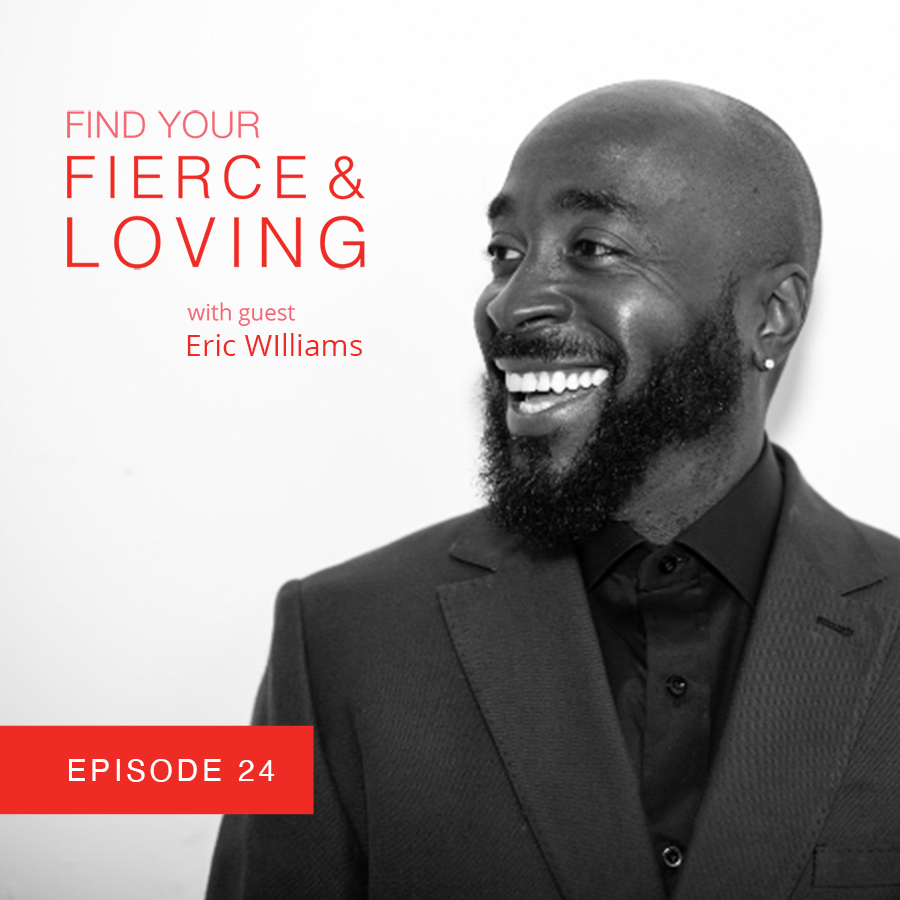
“I try and use this space for good. And hopefully not just for me, but to inspire other folks to do something similar. This could be a restaurant, but it could be something else also. How do we use our spaces to help other people?” – Eric Williams
How can you build up both you and your community at the same time? Eric Williams, founder and creative director of The Silver Room, has nurtured artists, created community spaces, and provided programming as part of running an independent retail store. With every step he takes as an entrepreneur, he lifts up his neighborhood and his city.
Show Notes
Eric Williams started his adult life by studying finance in the classroom and selling products on the streets of Chicago. Over many years he built his business into The Silver Room, which operates not only as a store but as a community—supporting the neighborhood, hosting artists, and putting on an annual block party attended by tens of thousands of people.
This week on Find Your Fierce & Loving, Eric shares the lessons that helped him weather the extraordinary challenges brought by the last year. Listen in to hear his remarkable insights on the importance of maintaining a positive mindset, nurturing the next generation to be compassionate and curious, and why sunglasses are the great equalizer for all people.
- (05:56) – Career beginnings
- (11:43) – Radicalism
- (15:41) – Impact of COVID
- (19:59) – Parenting
- (25:09) – Positive mindset
- (31:26) – Block party & building community
Eric Williams is the founder and creative director of The Silver Room, a retail space, community events hub, and art gallery. As a social entrepreneur, Williams successfully addresses the historic disenfranchisement in communities of color over the past 20 years by providing space, mentorship, and programming that responds to his core constituents’ needs. In 2018, Downtown Hyde Park dedicated its inaugural Economic Impact Award to the Sound System Block Party, and in 2019 the event brought over 100 musical artists, 100+ small business owners, and more 50,000 celebrants to the neighborhood, generating an estimated $2.3 million dollars in economic impact for the Southside of Chicago in one day.
In 2019, Eric Williams established The Silver Room Foundation. This foundation exists to further the reach, promotion, and education of artists and creative entrepreneurs, and to strengthen, leverage, and lend structure to the efforts of the social impact placemaking work catalyzed by Mr. Williams over the past 25 years. The Silver Room Foundation mission is to create intentional art-centered experiences, spaces, events, and programming to increase the health, wellness, equity, and economic prosperity outcomes for communities of color on Chicago’s south and west sides. Williams holds a degree in finance from the University of Illinois at Chicago and was a 2017-2018 Loeb Fellow at Harvard University’s Graduate School of Design.
Do you want to unleash your inherent love and goodness, liberate yourself, and free humanity from the oppressive systems and structures we have created? We are here to support you in finding your fierce and loving life. Join us in Our Circle, a vibrant membership community rich in opportunities for engagement and transformation. Find out more at lolawright.com/our-circle.
You can follow Lola Wright, on Instagram, Facebook, LinkedIn, and Twitter and learn more about my work at lolawright.com.
Chicago born and built, Lola grew up in wealth and privilege, yet always sensed something was missing. She sought out aliveness and freedom in music, immersing herself in the hip hop and house music scenes of 90s Chicago. After finding herself on her own at 23, as the mother of two young children, she became determined to create a new experience.
Lola is an ordained minister with a gift for weaving together the mystical and material, she served for many years as the CEO of Bodhi Center, an organization committed to personal transformation, collective awakening, conscious activism, and community-building.
This podcast is produced by Quinn Rose with theme music by independent producer Trey Royal.
If you’d like to receive new episodes as they’re published, please subscribe to Find Your Fierce & Loving in Apple Podcasts, Google Podcasts, Spotify, or wherever you get your podcasts. If you enjoyed this episode, please consider leaving a review in Apple Podcasts. Your reviews help others find the show.
Transcript
Lola Wright (00:01): Personal transformation and collective awakening involve being the most alive, brilliant, inspired, creative, on fire version of yourself. A version that is not consistent with the status quo. My name is Lola Wright, and this is Find Your Fierce & Loving. This podcast is a wake up call, a roadmap back to your holy purpose, an invitation to set fire to the box you’ve been living in and watch it burn.
Lola Wright (00:40): I am so incredibly excited to have this extraordinary human being on Find Your Fierce & Loving today. Eric Williams is the founder and creative director of The Silver Room, a retail space, community events hub, and art gallery. As a social entrepreneur, Williams successfully addresses the historic disenfranchisement in communities of color over the past 20 years by providing space, mentorship and programming that responds to his core constituents’ needs. The Silver Room’s annual Sound System Block Party in Hyde park and CONNECT Art Festival in South Shore have worked to successfully transform Chicago streets and empty lots into sites of celebration that strengthen communities of color and fuel economic growth. In 2018, Downtown Hyde Park dedicated its inaugural Economic Impact Award to the Sound System Block Party. And in 2019, the event brought over 100 musical artists, 100+ small business owners, and more than 50,000 celebrants to the neighborhood, generating an estimated $2.3 million in economic impact for the South Side of Chicago in one day.
Lola Wright (01:57): In 2019, Eric Williams established The Silver Room Foundation. This foundation exists to further the reach, promotion, and education of artists and creative entrepreneurs, and to strengthen, leverage, and lend structure to the efforts of the social impact placemaking work catalyzed by Mr. Williams over the past 25 years. Silver Room Foundation mission is to create intentional, art centered experiences, spaces, events, and programming to increase the health, wellness, equity, and economic prosperity outcomes for communities of color on Chicago’s south and west sides.Williams holds a degree in finance from the University of Illinois at Chicago and was a 2017-2018 Loeb Fellow at Harvard University’s Graduate School of Design. And from my perspective, more important than all of those extraordinary accolades, Eric Williams is one of my very, very good friends and a profound inspiration to me. So I am deeply, deeply grateful that he’s here to share his story. Eric, welcome.
Eric Williams (03:12): Hey! What’s up Lola? How are you?
Lola Wright (03:12): I’m good. I’m so happy you’re here. You know that I love to brag about you. I love to celebrate you. You are not nearly as self-congratulatory as I think you should be, but I think your humility is part of what makes you so incredibly attractive to so many people. So, I’m curious because this space is all about supporting people in finding their fierce and loving, and I feel like that is exactly who you are. And by fierce, I mean someone who’s passionate, alive, wild, not constrained, not confined, not suppressed, not oppressed but really activated, unlocked, alive, on fire, that kind of thing.
Lola Wright (03:56): Loving is this tender, affectionate, attentive aspect. And, I think you have this beautiful capacity to integrate the range of the human experience. I guess I would ask you, how did you get to where you are now? And, certainly there’s not one quick and easy answer. But, most people are, I think to a large extent, sort of dying on the vine, really just sort of going through the motions. That is not you at all.
Eric Williams (04:25): Yeah. No, that’s definitely true. So, thank you for that great introduction, and I’m loving the fact that you are in your element. TV, radio, podcast. This is awesome. This is fantastic. I think a lot of it comes from my grandmother and my mom. If I have to think about just thinking that question, like off the top, the older I get, the more I think about who I am as a 50 year old now, was informed from my grandmother. Just the basic tenants. She was a church lady, and do unto others and embrace diversity. There’s no good and bad. Everyone is the same. All those basic elements I think I learned at an early age. I was never really this person who wanted to do things just for money.
Eric Williams (05:10): It was always about doing good things, and how can you do good things to help people and be happy in your life? So, growing up I wasn’t really sure what I was going to do with myself, and I went into finance because, I actually told you the story in that, I actually wanted to make money to open up a nightclub. That’s what I wanted to do. I was inspired by Frankie Knuckles. And, I was like, “Okay, I want to do this. I want to be involved in music.” My father actually owned a bar for 30 years. So, I grew up around music. Hurricane was one of his first DJs. So, the music thing was something I always embraced. I was really good at math. I got into business and at some point I figured out… How can I embrace this love of business, this background I had, which actually led me to be a street peddler, a street vendor.
Lola Wright (05:56): I will tell people about that time in your business career because I think it’s easy to look at you now and all the success and notoriety that you have accumulated, but most of your career has just been just work.
Eric Williams (06:15): It was a grind. It was a grind.
Lola Wright (06:17): Right.
Eric Williams (06:17): So, I mean the short version of it. I went to UIC. I was studying finance. And as you know those from Chicago, that was a block or two from Maxwell Street. And so I was kind of fascinated by this idea of this market, and I was going to Maxwell Street even before, when I was a little kid, I would go. And, I was like, I found myself in close proximity to this market that had always kind of had this little, this romantic energy to me in some ways. So, I wandered down there. I met some people. Long story short, I started buying t-shirts, buying stuff, and selling those to the students to make money.
Eric Williams (06:52): And then I was doing really well doing that. And then I started selling to other people. So, I was studying finance, but I was really enamored by this market. This idea of me buying some socks, I mean, buying some t-shirts for three or four bucks and sell them for $10. And, making $7. This is back, late 80s, early 90s, $3.35 an hour was the minimum wage. I’m like, “I can make a lot more than three bucks an hour by selling stuff on the streets.”
Lola Wright (07:17): Was it really $3.35 cents an hour?
Eric Williams (07:20): $3.35 an hour was the minimum wage when I was in high school for many, many years. And, I got a raise to $4.15. I was like, “Wow, I’m making four bucks an hour.” But, I could make a lot more with this hustle game. So, it was interesting because I was studying finance and so many parallels to the market, to stocks, and selling t-shirts. It’s all about supply and demand which was a very early lesson I learned. Where to go. What’s hot. If it’s late in the day, I can drop my prices. And so it was all these parallels between studying finance and street peddling. But most importantly, the street peddling for me taught me about people, and how to be good to people, and also what it felt like when people weren’t good to you because people would see me on the streets, and they would ignore me.
Eric Williams (08:05): I’m like, I’m a college student but that shouldn’t matter actually how you treat me. So, I learned a lot. You never know who’s walking past you, and I just treated everybody the same. So that was, I think a big part of my… Who I am right now came from that experience, being a street vendor. And, once I got out of school, I went to finance for a short period of time. It was less than a year, and I quit. I didn’t have a job, and I went back to street peddling because that’s all I knew at the time.
Lola Wright (08:33): Wow!
Eric Williams (08:33): And, I started selling around the country, I was going to Freaknik, and I was Caribana. And, I started printing t-shirts and that was a very humbling experience to be outside sometimes and days like this, trying to sell a pair of socks at the gas station. And, you make $20. It wasn’t always roses, and you have some days where you do really well. I made thousands of dollars. And, I think that kind of taught me that this is day to day. I got to look at the long term, the long game of this, and I have to be humble. And, I had many of days I didn’t make any money. And, I could tell you stories. We don’t have enough time to tell you all the stories, but there was some days where I… It was tough. It was tough. And, I don’t forget about those days. Even 30 years later, I know that those days could sometimes come again, maybe. So, I have to make sure I keep pushing, just keep pushing along.
Lola Wright (09:24): The Silver Room has become like a fixture in the city of Chicago. I mean, it’s so much more than a retail space. It’s really as said in your bio, a community hub. Why do you think it has had the potency that it’s had? And, there are certainly plenty of business owners that do not try to take on community inside of retail.
Eric Williams (09:50): Well, a lot of it again came from my childhood, and my father, and his idea of giving. But I was introduced to Wicker Park by a guy named Kendall at lit-x. And so I don’t know if I ever told you this story or not. I don’t know if I told you, but…
Lola Wright (10:04): I don’t think so.
Eric Williams (10:05): So, the guy that owned the lit-x, it was just a poetry place in Wicker Park, back in the 90s. I was on the corner of Balbo and Michigan Avenue, literally on the corner with t-shirts on the street, laid out. This guy walked past and said, “Hey brother, who are you? What are you doing? Blah, blah.” I’m like, “I’m a street vendor. I got these t-shirts, got socks.” He said, “I have a store in Wicker Park. And, if you want to, you can put some of the stuff in my store on consignment.”
Eric Williams (10:32): I’m like, “Okay, cool.” He goes, “I’ll meet you Monday, whatever time it was.” Right. So I’m like, “All right.” I didn’t know this guy. And so I go down to this place, walk in the basement, and it was just a really interesting place. It was like something sparked in me. I’m like, “Oh, this is interesting.” Like they’re selling incense. And, there was like this little portrait thing in the back, blah, blah. But, this guy gave me a chance and opportunity. So, I put my stuff in the store, and it sold out. He called me a few days later. He goes, “Oh, what you brought in is sold.” I brought some more stuff, and it started selling. And so that went on for a couple of years. And so from lit-x, I met a community of people that I wouldn’t have met, honestly. This whole everybody had dreadlocks and doing poetry.
Eric Williams (11:11): That was a different world for me. But, I appreciated this space that was a retail space actually, but it was much more than that. So The Silver Room was actually influenced by lit-x. And, when I opened the space up, I had to make sure though there was a balance because he was definitely more culture, less business. I said, there’s no culture, there’s no business. So, I have to make sure that this is a strong business and with my background, I was able to do that. But lit-x was a big influence on me for sure, and this idea that we can have arts and culture and entrepreneurship in the same space.
Lola Wright (11:43): So, you and I have talked about economic models and this idea of like socialism or capitalism. We’ve talked about abolish the police, or we’ve talked about these sort of radical positions. And, oftentimes in our conversation, I actually feel like I’m more radical than you are. I think you’re pretty moderate on some of these topics. Can you talk a little bit about how you sort of arrived? You’re a true businessman.
Eric Williams (12:15): Yeah. Yeah, for sure. Well, okay. So, first of all, I’m going to give you a little pushback. I can push back on what the term radical means.
Lola Wright (12:23): Yes. Totally. I totally agree.
Eric Williams (12:26): And so for me, I look at the history of our country from 1619 that was built on the backs of black folks and capitalism that we’ve never enjoyed the fruits of our own labor. You think about the “American Dream” which is buying houses and small businesses. It’s like, okay, we haven’t been afforded that opportunity. And, probably if I’m honest, because of the background that I went to, in finance and studying business, I saw that as opportunity for black folks to also be able to create something. And also, we talked about this before, when I was in my early 20s, I was in the nation of Islam, and that also talked about self-reliance and build those things for yourself.
Eric Williams (13:06): And so for me, capitalism is a dirty word sometimes. But for me it was like, I’m an entrepreneur. I’m making this happen for myself. I can hustle and make something, not just for myself but also for my community. So, if I can sell some stuff, make a little money, create a space and create wall space for my friends who are artists, create jobs. I have no qualms about that. That to me is very radical. And, I think that The Silver Room has been a radical space in many ways.
Lola Wright (13:32): And, you and I both know tons of people who are profoundly righteous who’ve made very little contribution to humanity.
Eric Williams (13:42): Yeah, that’s true. And again, this is a for-profit business. I never, I have no problem saying that. But, I also can argue that The Silver Room, as a for-profit business has had a huge impact on many people’s lives in the city. In many ways more so than some nonprofits and a lot of nonprofits. So, for me, it’s not necessarily because the functionality of this for-profit business, what’s the end result? Folks have had opportunity. Folks have made money. Folks have had their first time having their first art show. They’ve had book releases. They’ve done all these things because of this space. So, I think that’s very radical.
Lola Wright (14:21): There’s a lot of nuance in how you approach these things too because what you’re basically saying is, “I’m not delusional about the notion that I, Eric Williams, will deconstruct the systems that we are living in. These systems are deeply embedded, and I am going to work within the systems to make the kind of change that I desire.”
Eric Williams (14:43): Exactly. I mean, and we talk about this all the time too, about this idea of changing systems and radical change. And, I think that we should always fight for that, for sure. But, meanwhile, I’m living in a space that I’m in right now, and this system that I figured out how to navigate, this system of retail that I can make a little bit of money is how I choose to express myself in a very radical way. And, you can be an entrepreneur, a capitalist, the way you want to call it and still do good things. I don’t think those things have had to be antithetical. I try and use this space for good, and the older I get, the more I’ve done this, the more I see this platform as a very unique space. And, hopefully not just for me, but to inspire other folks to do something very similar and say, “Well, this could be a restaurant, but it could be something else also. It could be this one thing, but it doesn’t have to be just that. How can we use our spaces to help other people?”
Lola Wright (15:42): A lot of businesses have been impacted by this pandemic that we are in the midst of. You certainly could have felt brought to your knees and just said, “I can’t do this. It’s too hard.” What had you persevered because I know we’ve talked many times over the last year, and you’ve had a number of highs in your business during this pandemic. I mean, I think too… I say this cautiously because I don’t want people to hear it as an opportunity to self-blame or whatever, but I think so much of what you’ve demonstrated in your business is really about mindset and choice and just circumstances and conditions may always present themselves as a challenge and who will I be in response to that?
Eric Williams (16:37): For sure. And, that comes from, again, my childhood. That comes from really believing that I can control a lot of my destiny. Also, the secret, all those metaphysical things also, but…
Lola Wright (16:52): Totally.
Eric Williams (16:53): Positive energy. How do you take something that’s perceived negative? Because sometimes it’s the perception of it being negative. How can you flip that and say, “No, you know what? My store closed down because of coronavirus. I had two days to figure things out.” So, the first thing I have to do is put myself in a positive mindset before I do anything else. So, rather than say, “Oh, I can’t make any money, or my employees…” All those things actually are not good things, but more importantly, let me say “This is happening for a reason, right? This is giving me pause to reflect.”
Eric Williams (17:26): “This is giving me time to spend more time with my daughter. This is giving me time to research online business, and how can I create a better online business? So, I think it really does start with the mindset, and I try and be positive all the time, even in… And, sometimes it ain’t easy, you know what I mean? But, if I can do that for me, I just… I’ve learned something always good comes from that. So, I think when we closed, the first thing I wanted to do was be very positive and just embrace the time that we had because there was a lot of uncertainties. I thought it’d be two weeks. We’d be closed for two weeks. Who knew it would be three and a half months. But, what I did is I kind of said, “Let me study more about retail.
Eric Williams (18:09): Let me research the top online stores.” We went from making almost nothing in the last year to doing really, really well with our online store. “Let me do something beautiful for the community. Let me remodel my store.” I didn’t have to do that honestly, but I wanted to do that to show the world that we’re still here, and we can put out beautiful things in a physical space. And, people want to be around positivity. People want to be around success. It’s like, when you walk past a restaurant’s long line, you’re like, “Oh, this must be good.” So, that’s the kind of mindset I always put myself in. How can I create something that’s positive in our community? So, I think we made the right move plus the fact that we were already a resource for the community.
Eric Williams (18:53): So, when we did close, people were looking to us for not just trying to sell them stuff. I mean, that’s part of the business for sure. But, I think more importantly, I wanted to be a resource for folks. Where can you find grants? Here’s some tips on mental health. So, come to Silver Room, not just to buy stuff, but also in a virtual space still be that conduit for something positive. And, that was my mentality. I think that just really helped, and all these good things started happening.
Eric Williams (19:19): And, we started getting listed on Buy Black Here, and go over here, and I was getting emails and just.. It was just crazy. And, it’s been my busiest seven month period since we opened in the history of the store. In the last 23 years, I’ve never been busier, but I honestly feel like I embraced this really positive attitude. And, not to be like, “Oh, I understand all the horrible things that have happened the last eight months.” I’m not trying to, like… I understand what’s going on in the world from George Floyd, obviously to the pandemic. But, I try and embrace positivity, and I think that’s been super helpful for everybody.
Lola Wright (19:57): Yeah. I actually would say that’s a radical act. You talk about your daughter who is like seemingly always by your side. And, I wonder, what is it that you hope you give her? If there’s one thing that she takes away from you as her father, what is the lesson? In the same way that you sit here today and talk about your mother and your grandmother and your father… What is the gift you hope to leave her with?
Eric Williams (20:30): I know it sounds so simple, but I want her to be a good person. I want her to be selfless. I want her to be empathetic. I want her to live her life for passion. I want her to see all the gifts that she’s been given and recognize them and try and pass them on other people. And, she’s already that way, and I kind of drill at her. We got kids, you know what I mean? There’s sometimes to be a little… But, I see her already blossoming and growing into this very compassionate person, which I love. And, if she’s compassionate, and she has a thirst for knowledge, whatever she does in life, I’m happy with. So, that’s my homie.
Lola Wright (21:13): By virtue of her privilege, she has sort of a window into a wide spectrum of the human experience, specifically in a city like Chicago from her school environment, where she has sort of infinite levels of access at a very prestigious school to just traveling with you around the city. She has an unusual perspective. Is she aware of that?
Eric Williams (21:41): I talk to her about that. And again, I keep going back to my street peddling days. So, one of the spots I used to sell on, it was a really good location. It was Chicago Avenue and West Street around the corner, and I was set up there, and I loved that location because you’re right by Michigan Avenue. So, you got folks with tons of money. You’re right by the Gold Coast. You’re right by the Red Line. You got folks going to the west side. You’re right by schools and students. And, I mean, to really see the diversity of the world was a lesson that I think it was probably my most important lesson. How can you communicate with everybody? Because you don’t have a choice who walks past you. It’s going to be that dude who’s hustling.
Eric Williams (22:27): It’s going to be that person who got $8 million, and you don’t know who’s who. And then living in a city as diverse as Chicago, you never know who are you going to run into. And, being that her mom is Indian, they have a certain culture that she gets from her side. But, I want her to understand the privilege she has of her school. I’m taking her to 79th Street, 6 N. Halsted, 63rd Street. Why are these buildings this way? What happened to this community? You need to understand that things happen for a reason. There’s a historical context to all of this.
Eric Williams (23:02): I want her to see everything, the good and the bad, but not just to see it, to understand how we got to where we’re at. And, put these pieces together. For me, life is always a puzzle. I love traveling, and I’ve been around the world be it from China to India to Cuba. Wherever we’re at, there’s something that we have similar in the world, you know what I mean? And, I want to kind of figure out how these things work and how they connect. And, I want to show her how things connect. So, I show her stuff. We talk about it. She asks questions. I ask questions. I talk to her about the importance of asking questions as she gets older. You’re going to be a lot better off asking more questions than talking.
Lola Wright (23:43): Mm-hmm.
Eric Williams (23:43): And, so she’s kind of getting to that point where like it’s not giving the best answers, it’s asking the best question. And so she…
Lola Wright (23:49): Totally.
Eric Williams (23:50): Yeah, so she definitely getting there. So, and I’m living vicariously through her. As a 50 year old, she’s 12 years old, I’m seeing things in her, that like she’s way ahead than I’ve ever been. She’s like light years ahead. So, I really enjoy trying to impart certain knowledge and information to her that she won’t make the same mistakes that I made. Or, if she makes them, she’ll figure out how to get past them pretty quickly. Well, we all going to make mistakes, but how do you not see this as a mistake? And, you can’t just get past it. So, it’s a lot of fun being a dad with her, man. I have fun. Every day is fun.
Lola Wright (24:24): You want to be more alive. You want to unleash your inherent love and goodness, liberate yourself, and free humanity from the oppressive systems and structures we have created. We are here to support you in finding your fierce and loving life. Join us in Our Circle. This is an affirming and radical space that will gather weekly, on-demand or live, whatever works best for your life. For more information on how you can engage in Our Circle, visit lolawright.com/our-circle. I’d love to have you with us.
Lola Wright (25:09): There’s a lot that you’ve said around the power of focusing your mindset and maintaining a positive mental attitude as we might say. But, I imagine there are times when you feel scared, when you feel vulnerable, when you don’t know what to do. What is your hack in that moment? What do you do to help shift out of that?
Eric Williams (25:30): Embrace it. And, I can think of a baseball analogy. I love baseball, and I was watching. This was back in the days of Harry Carey. It’s a long time ago. And then, it was this baseball player. He liked his pitches low and inside. So, he can pull the ball. I don’t know if you’re a baseball fan or not.
Lola Wright (25:51): No. I am not.
Eric Williams (25:52): He liked his pitches at a certain place that he felt very comfortable in the way he hit. So, if you’re a pitcher, you know okay, this guy likes his ball here. I’m going to throw it here in a different direction. And, this guy was happy. He was striking out, and he went to his coach. And, the coach talking about, you have to embrace what they’re doing to you right now. They ain’t gonna throw this ball in your sweet spot. You got to adjust. And so, he started hitting the ball to the opposite field. For those who know baseball, they understand what I’m saying. And so he wasn’t able to pull the ball. He was hitting the ball in the opposite field. End of the day, he still got hit. And so that kind of stuck with me. And like, I think what it stuck with me was you have to embrace whatever’s given to you. You ain’t always going to get the pitch the way you want it.
Lola Wright (26:42): Usually you won’t, right?
Eric Williams (26:44): And so to answer your question, I expect some days to not be great. Like today, it’s a snowy day. I’m probably not going to have the financial day I would have in the middle of July. But, that’s okay because you know those days are coming. So, you have to embrace it and just be okay with it. So for me, I try and do certain… I try and drink a bunch of water. I try and do my yoga or Pilates or meditate. I try and always read something every single day. I try and write a little bit if I can. I try and eat healthy. If I can do those… I try and talk to some friends every day, if I can. If I do those things, man, I’m good. Whatever else happens is going to happen. If I can do the things that I can control, which is what I just mentioned, I can control the things every single day then I’m going to have a good day.
Lola Wright (27:31): Yes.
Eric Williams (27:31): And, if I have a “bad day,” you know what? It’s okay. There’s tomorrow, will be a better day.
Lola Wright (27:37): I imagine there are a lot of people that come to you, and I’m like, “Oh, I feel like Nathan and I come to you.” And we’re like, “So what do you think about this? We’re thinking about this. What do you think? What do you think? What do you think?” So, you’re sort of like that guy, right? Where people like go to you, they bounce ideas off of you. I imagine you’re hit up with all kinds of creative inspirations and ideas all the time. What’s your sort of intuitive sensibility around the difference between who succeeds, I have that in air quotes, who succeeds and who doesn’t? Or what’s an idea you’ll get behind, and what’s one you won’t? What are the delineators there?
Eric Williams (28:18): That’s a great question because I think about that all the time, actually. I think about the space that I have and how it can be a benefit to other people. So, I think about the things that I buy. I get always an inquiry, “Hey, my cousin makes t-shirts, here’s the design.” I see the design, I’m like, “It’s not that great of a design.” But, maybe this is a really good person. Maybe this person just hasn’t seen other kinds of designs that I could help them, influence them to say, “Hey, can we tweak this a little bit better and maybe just a different kind of material?” Blah, blah, blah. So, it’s not always about the best quality always. It’s about the person for sure. Are they willing to learn? Are they willing to work with me to grow?
Eric Williams (29:06): The biggest compliment I have is when somebody tells me 20 years later, “For the first time, I had my book list in your store. Now, I’m a bestselling author. The first time I deejayed was in your store. Now, I’m playing at Ibiza. So for me, the person is most important. The talent, you can always teach somebody how to be more talented in some ways, to a certain extent you can. My space isn’t about just finding the top, the best people, that’s not it. You know what I mean? And some people do that, but that’s not me. I’d rather work with people and kind of help them grow in some ways. So, it’s a good mix. From having a little bit of talent, but more importantly, being a good person.
Lola Wright (29:49): Yeah. And also willingness, the fire in the belly, right?
Eric Williams (29:54): Yeah. Exactly. Exactly. And, I’ve seen it come and go. I’ve seen people who actually weren’t talented. They had a lot of desire, but I’ve seen people. And, we know a lot of these people who have become super successful when they have that rare mix of a lot of talent and a good work ethic. You always, always going to win.
Lola Wright (30:12): One of the top sellers in the store, I think, are the sunglasses. I feel like, you want sunglasses, you go to The Silver Room. What is it about sunglasses that people love?
Eric Williams (30:26): Well, I keep going back to my childhood days. The first thing I really sold was sunglasses on the corner. That was the thing that I sold the most. And, my friend told me a long time ago… He said, “You should always sell sunglasses and crosses.” He said, “Because everyone wears sunglasses. The sun affects everybody the same. It doesn’t matter how big you are, no matter how small you are, no matter how old. The sun is this unifying thing that everyone is always going to like need a barrier from.” So, sunglasses, doesn’t matter who you are. So, they always sell. And, I always sold crosses because my friend said this long time ago… He says, “God will never go out of style. You should always have crosses in your store.” And, I never, to this day, I’ll always buy crosses because God will never go out of style, and the sun always…
Lola Wright (31:18): That’s so funny.
Eric Williams (31:19): And the sun’s always going to be there. So, it doesn’t matter where you go. You’re going to need some sunglasses.
Lola Wright (31:26): So, after 20 years you have two consecutive summers where The Silver Room Block Party is not happening because of the impact of the pandemic. How does that feel for you?
Eric Williams (31:38): Again, it was a relief in some ways last year because there’s a lot of work. I don’t think people have any idea the amount of work, the amount of money, the amount of time, resources that goes into putting on this one day event.
Lola Wright (31:53): And, just took for context, this started out in an alley. I was at the first one. There were like 200 people there. I literally have a picture of my kids onstage with Peven Everett when they’re teeny. And, it’s grown to how many people show up for this?
Eric Williams (32:10): 45,000 people. But, I think for me, even the Block Party has been a testament to just say, “Let’s just do something that’s good.” It wasn’t about making money. It wasn’t about having a million people. Let’s just put out some goodness into the world. So, some great art. This is for everybody, no matter what color you are, no matter how old you are. It’s for everybody. And, that has just grown and grown and grown and grown. So, it’s a lot of work for me. It hasn’t been financially beneficial at all, at all. It’s a whole other discussion.
Lola Wright (32:42): Basically, just to be clear, it costs you money every year?
Eric Williams (32:45): I’ve lost tens, hundred of thousand dollars if I added up over the course of the last 16 years. Yeah. Because it’s a free event. So nobody pays, but I have to pay. It’s not free for me. So yeah. So, the model that started worked when it was 500 people. Who cares a couple of thousand dollars? When you start getting to 10, 15, 20, 40,000 people, you got security. You got porta potties. You got all these expenses that are just not paid for and not covered. And…
Lola Wright (33:16): I think it’s important for people to realize that you have deliberately chosen for it to remain a Block Party versus a festival such that it could be accessible to all of Chicago not some of Chicago. And, like that’s an important, really important distinction that I think also is a very clear line to your commitment of service. I mean, you didn’t use that word, but you’re someone who orients your existence around being a contribution to others, even down to The Block Party.
Eric Williams (33:45): Well, exactly. And, you’ve been involved for many years, and my original thought was really like this. It’s symbolism in so many ways. It’s like, how can us as a community come together and create something beautiful? So, I have friends that are talented artists, “Hey, you know what? Can you guys come and sing and dance and perform? I’ll put this together, then the folks will come and be a part of this too.” So, the idea was that, a radical act. How can we as a community come together and create something very, very, very beautiful that wasn’t really about any exchange of money at all? It was about just us coming together to create something but the bigger that comes… Yeah. It’s more than what it was 20, 15, 20 years ago.
Eric Williams (34:34): And so for me last year to kind of be able to take a pause and recalibrate and rethink what this could look like moving forward. It was a good thing to me, honestly. And, this year who knows. I mean, we’re still in the middle of a pandemic. I can’t really think about having a event for 40,000 people when it’s not safe at all. But again, everything happens for a reason. If we take a break, it’s great, and the next year we’ll figure something else out. But yeah.
Lola Wright (35:02): Do you have any sense of inspiration as to what you imagine will be different?
Eric Williams (35:07): I don’t know. It’s funny you asked that question because people are always try to prognosticate in like what the future holds, and I’m like, “You know what? I’m very… I’m okay saying I have no idea. I don’t know.” I mean, short term they’re talking about limited spaces and our capacity will be this much. But, I don’t know. So, for me to even take time to think about it, it’s not… I mean, I don’t know, I have no idea. But when it comes to that time, I mean, I will figure something out.
Lola Wright (35:35): You and I are both Chicago born and built. This is a complex city. Just as we close, I’d love to hear that which concerns you most about the state of the city, and that which inspires you most about where it’s headed.
Eric Williams (35:52): Wow! I mean, as you know this past summer was tough for a lot of people, for a lot of reasons. And, I think sometimes you don’t really value what you see until you see other things. And, so for me, like just traveling around the world so much, I see all the good in Chicago but also see some of the things that we need to change also. Segregation obviously is a very easy one that’s been since this whole city started, you know what I mean? And like how can folks work together and see one another, the differences, and the love that we could have for one another? Social economic plea. This city is a tale of two or three cities. Someone described it as… It’s Manhattan smashed up against Detroit, and you kind of feel that way.
Lola Wright (36:45): Wow!
Eric Williams (36:47): The Downtown area is what it is and you got the rest of the city. And, I think for me, that’s the thing that’s most dark is like this income inequality. And it’s vast, as you know the life expectancy between someone Downtown and someone in Inglewood is 20 something years. I mean, it’s a tale of two cities for sure. And, how can we fix that, and it’s a tough one. Politically, just culturally, all these things that it’s just like don’t mix. And part of The Block Party for me was to bring all these different kinds of folks together. I have a theory about Stevie Wonder. I don’t know if I told you my whole thing about Stevie Wonder. Stevie wonder is much like the cross, is much like the sun. Everyone loves Stevie Wonder, right?
Eric Williams (37:36): Everybody loves Stevie Wonder. So, if I can play Stevie Wonder, you’re going to get the folks from Downtown, the west side, from Bridgeport. We all can come together from this common good. And, I also saw this when I was a ticket scalper with sports. There’s two things that I see people will come together. There’s sports and music. When the Bulls were winning, it was the best time ever. Everyone loved the Bulls. And so we didn’t think about our differences because we had this thing that was in common which was a sports team that we all were rooting for. So, how can we do that in our everyday lives, have this common thing that we’re all rooting for to bring us together. And so, that’s a hope, and that’s what the story is.
Eric Williams (38:20): And, I do that through products. And it’s, I can bring some sunglasses for $15. I can get something over here that might cost $300. This might be for this professor at UFC. This like little Black Lives Matter pen that costs five bucks might be for the Kenwood High school student. Now, they’re in the same space. They have something in common. Now, we can work some magic once I get them together. The same thing with The Block Party. If I can play some house music, some hip hop, I can play some rock. These people who won’t normally be together, now they’re in the same space. And, maybe if they’re walking to go get something to drink, and they might bump into one another and have a conversation. And so all the things that they think are so different, those things are all gone because they’re in this one space together having a good time.
Eric Williams (39:03): And their differences don’t seem so different because they’re having a good time. So, that’s kind of how I think about creating space. Is bringing folks together without even telling them. I’d say this to you now, but I don’t say that, that’s what it is. That’s actually what it is. And, when you get there, you feel it. For me, it’s about the emotion. Is the most important thing of throwing any event. I’ve thrown thousands of events throughout my life, in the store and The Block Party. The most important thing is the emotion, that when you leave this event and you leave this space, you feel better than you did when you came in.
Eric Williams (39:35): That is my goal when you leave out of there. It’s like me going again and go back to me going to house music and Frankie Knuckles. When you would leave the party, you’d be like, “Man, that was the best party ever.” You’re just singing those songs on the way home, and the next day, talking to your friend, “Man, you remember he played this. Oh…” Blah, blah, blah. That’s the energy that I want to always create in my spaces, that you leave and people you talk about it, and you feel good. It’s like a cleansing.
Lola Wright (40:00): Totally. I mean, I oftentimes say like dancing at Red Dog at three in the morning was church.
Eric Williams (40:06): For sure. If a lot of people who come from different communities where they’re not always accepted to be able to come and just be yourself, no matter who you are, is the best thing that I can provide for people. And, we talk about this term, safe space, whatever you want to call it, it’s a safe space. It’s a place, a spiritual space. Whatever you want to call it. A sacred space. If I can create that for people, then I’ve done my job.
Lola Wright (40:36): One of the things I have so much appreciation for you around Eric is, it’s interesting that you say the thing that troubles you the most is segregation. And, we could define that in so many ways. And, the antidote that you offer is integration. And, I think that word is so much more textured than the way that we think of segregation or integration. What you’re talking about when you talk about integration is, integration of the mind, the body, the soul. Integration of going beyond the binary. It’s not either this or that. I mean, that’s always true about you. You’re like a weaver. You weave things together. You integrate things that are seemingly unable to be integrated.
Eric Williams (41:22): Yeah. They can be, but that also comes from music and from deejaying and thinking about the great DJs who were able to kind of weave in different kinds of music to tell a story throughout a night. So, it’s not just one kind of music, it’s like, what story are we telling? And so for me, it’s always about a story. And so again, it’s not always in your face that I’m telling the story, but this whole life’s mission for me is about telling a story to bring folks together. And, it’s not about, again, being the same, it’s about embracing your differences.
Eric Williams (41:54): And, just thinking about me traveling, I was in China a couple years ago, I was in eight different countries. And, I started noticing that people are the same. People want safety. They want to fall in love. They want to have their kids be educated. They want to celebrate. They want to dance, and they want to be spiritual in some ways. And, that’s really it. I mean, everything else is so a fluff, but these five or six things, no matter where you are, no matter how much money you have, that it’s very simple in some ways. So, I try and provide those things to people without even telling them.
Lola Wright (42:33): I love you Eric Williams. Thank you for sitting with me, hanging with me. Thank you for making my work, my play. If you enjoyed this show and would like to receive new episodes as they’re published, subscribe wherever you get your podcasts, and consider leaving a review in Apple Podcasts. Your review helps others find this show. You can follow me at Lola P. Wright on Instagram, Facebook, LinkedIn, and Twitter, and learn more about my work at lolawright.com. This episode was produced by Quinn Rose with theme music from independent music producer, Trey Royal.
Eric Williams (43:27): But, for me it came down to, let me just do unto to others as I would have them do unto me. And, just be good and try and put out goodness in the world. And it will come back to me.




Leave A Comment