
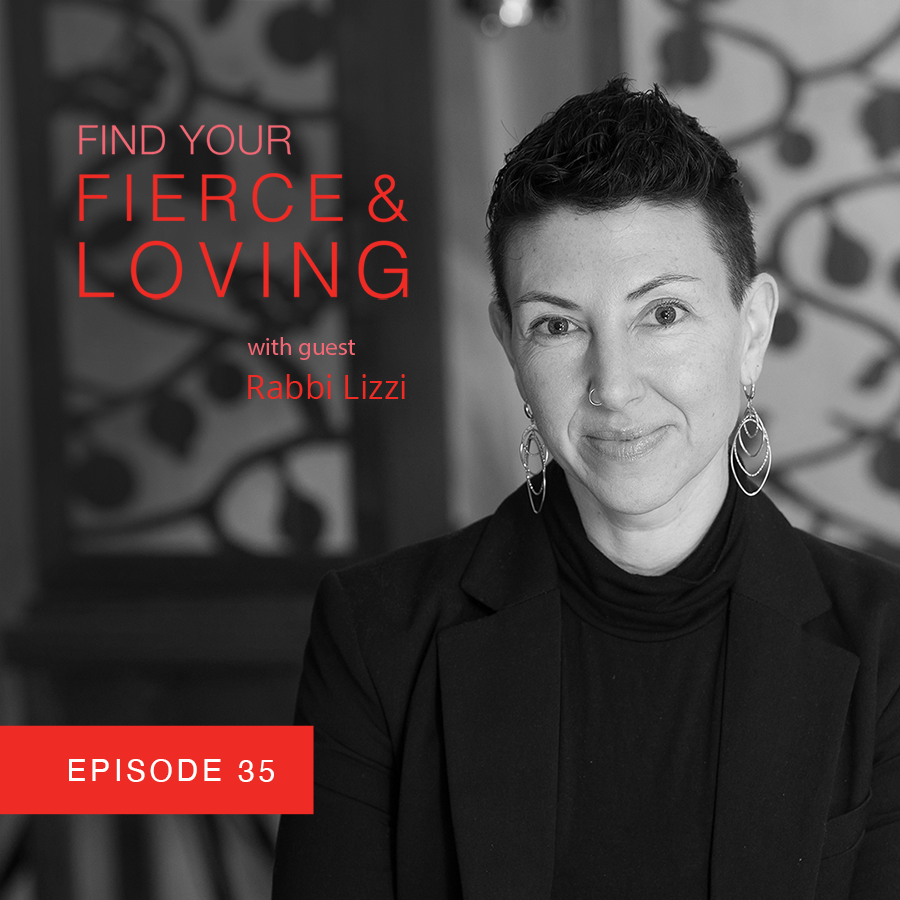
“There’s an instinct right now on planet Earth for identity groups to be turning inwards, as if that inward turn will protect us from oppression. And that’s the move that we as Jewish people, but also all groups as human people on this planet, need to be turning towards each other.” – Rabbi Lizzi
How do you identify? That’s a question that Rabbi Lizzi Heydemann has spent her entire life dissecting, and an answer that she is continually evolving alongside.
Show Notes
When Rabbi Lizzi Heydemann was growing up, she identified her family as German and Polish, since her grandparents had immigrated from those areas of Europe. However, when she visited Germany, she saw the contrast between a German identity and a Jewish identity. Between those early visits and her role now as a Jewish leader she went on a journey of discovering culture, privilege, oppression, and all of the ways those intersect in her life. That journey, and the others like it that she guides her community members through, continues to this day.
Listen in to this week’s Find Your Fierce & Loving to hear about how identities can be both empowering and limiting. Human beings have infinite potential for collaboration and discoveries—if they properly invest in themselves and others.
- (03:41) – Race and identity
- (23:10) – Relationships
- (29:26) – Love
Rabbi Lizzi Heydemann is the founding rabbi of Mishkan Chicago, an independent, post-denominational Jewish spiritual community in the city of Chicago. She grew up on the South Side of the city and graduated with Honors in Religious Studies and Philosophy from Stanford University, and was ordained by the Ziegler School of Rabbinic Studies in Los Angeles. Rabbi Lizzi currently serves as the senior Rabbi and Founder of Mishkan Chicago, where she leads services, guides the organization’s vision, and hosts the podcast Contact Chai, a podcast that features weekly sermons and inspired, down-to-earth Judaism in conversation. Outside of Mishkan, she currently sits on the board of T’ruah: the Rabbinic Call for Human Rights and the first rabbi to be a part of the Chicago Commons Project, a program run by the University of Chicago School of Divinity that cultivates a cohort of the city’s faith leaders. She was named one of Jewish Women International’s Women to Watch in 2018 and is a frequent presenter at conferences nationally on prayer leadership and revitalizing Jewish communities. She is married to Henry Bernstein, and is the mother of two children under 4, Judah Lev and Adira Hannah.
Do you want to unleash your inherent love and goodness, liberate yourself, and free humanity from the oppressive systems and structures we have created? We are here to support you in finding your fierce and loving life. Join us in Our Circle, a vibrant membership community rich in opportunities for engagement and transformation. Find out more at lolawright.com/our-circle.
You can follow Lola Wright, on Instagram, Facebook, LinkedIn, and Twitter and learn more about my work at lolawright.com.
Chicago born and built, Lola grew up in wealth and privilege, yet always sensed something was missing. She sought out aliveness and freedom in music, immersing herself in the hip hop and house music scenes of 90s Chicago. After finding herself on her own at 23, as the mother of two young children, she became determined to create a new experience.
Lola is an ordained minister with a gift for weaving together the mystical and material, she served for many years as the CEO of Bodhi Center, an organization committed to personal transformation, collective awakening, conscious activism, and community-building.
This podcast is produced by Quinn Rose with theme music by independent producer Trey Royal.
If you’d like to receive new episodes as they’re published, please subscribe to Find Your Fierce & Loving in Apple Podcasts, Google Podcasts, Spotify, or wherever you get your podcasts. If you enjoyed this episode, please consider leaving a review in Apple Podcasts. Your reviews help others find the show.
Transcript
Lola Wright (00:01): Something is stirring. Maybe you’ve felt it. We are reckoning with the reality of injustice and binary thinking that feeds the political machine. Humanity is in the midst of a heartbreaking and painful paradigm shift. That is a good thing. My name is Lola Wright, and this is Find Your Fierce & Loving. This podcast is intended to help you disrupt, untangle and free your mind of personal and collective agreements, patterns and beliefs that are holding you back and weighing you down. We desperately need your fierce and loving purpose now more than ever. I am so very excited to have today’s brilliant guest with me. Let me introduce you. Rabbi Lizzi Heydemann is the founding rabbi of Mishkan Chicago, an independent, post-denominational Jewish spiritual community in the city of Chicago. She grew up on the South Side of the city and graduated with Honors in Religious Studies and Philosophy from Stanford University, and was ordained by the Ziegler School of Rabbinic Studies in Los Angeles. Rabbi Lizzi currently serves as the senior Rabbi and Founder of Mishkan Chicago, where she leads services, guides the organization’s vision, and hosts the podcast Contact Chai, a podcast that features weekly sermons and inspired, down-to-earth Judaism in conversation. Outside of Mishkan, she currently sits on the board of T’ruah: the Rabbinic Call for Human Rights and the first rabbi to be a part of the Chicago Commons Project, a program run by the University of Chicago School of Divinity that cultivates a cohort of the city’s faith leaders. She was named one of Jewish Women International’s Women to Watch in 2018 and is a frequent presenter at conferences nationally on prayer leadership and revitalizing Jewish communities. She is married to the beautiful Henry Bernstein, and is the mother of two children under 4, Judah Lev and Adira Hannah. I am so happy to have her here more than all of her accolades, I know Rabbi Lizzi as a beautiful presence, a loving co-creator, co-conspiror, and we knew each other originally or we met when we shared space at Bodhi Center in Chicago’s Lincoln Park neighborhood. It’s interesting because some people don’t realize I am an ordained minister. If you’ve been traveling with me for a while you know that. I like to have faith leaders on here, but I always have a particular sort of vein of faith leader, and those are that which I understand to be a more mystical presence and those who are also pushing the envelope of what we understand community frameworks to look like these days. So, I certainly know that that is true of Mishkan Chicago, and I love your mystical presence. So, welcome to Find Your Fierce & Loving, Rabbi Lizzi.
Rabbi Lizzi Heydemann (03:21): Thank you very much, and I feel so grateful to be able to reciprocate. A year ago, more or less, you came and joined me on Contact Chai, and I said many of the same things about you and your spiritual presence. And so, I feel grateful to get to be here with you on your platform here.
Lola Wright (03:42): Thank you. Thank you. I think that when we spoke, if I remember correctly, was it just in the wake of the George Floyd murder? I mean, we were in the midst of the pandemic. I’m not remembering if it was just before his murder or just after.
Rabbi Lizzi Heydemann (04:01): It was after. It was after. It was in the lead up to a Jewish holiday that is about the sort of… the falling of the wall so to speak, about the destruction of Jerusalem and that as a metaphor for pain, suffering exile, loss but also rebuilding using different models and structures because maybe those old models and structures fell for a reason. And so, we were having that conversation.
Lola Wright (04:31): So, I’m curious what have been sort of the threads that you’ve been seeing as a leader, as a mother, as a human being independent of all these labels? What are the threads that have emerged for you since we were last together in July?
Rabbi Lizzi Heydemann (04:50): I think that’s actually one of them certainly. Just putting a lens that as a white person and white Ashkenazi Jewish person, I didn’t always look at the world through that lens. That’s coming out of the privileges of being in a society where white is the lens that is sort of expected as the default and other things are sort of the not. So, not really realizing until relatively recently actually the ways in which I’ve walked around with blinders on my own eyes. So, that’s been part of my journey as a person and also as a leader for sure because my community, as a Jewish community, there are many Jews of Color and quite often in sort of mainstream Jewish spaces, they are not represented and certainly in the numbers in which they exist. And, part of that is because of exactly what I’m describing. So, bringing that lens to leadership and going, “Wow. How can our organization begin to examine the ways in which we haven’t been seeing?” Like, really fully seeing the Jews of Color in our own community and begin to create deliberate space for people to come together and begin to have these conversations among white Jews.
Lola Wright (06:18): Can you see in your own, and I don’t know because I’ve never had this conversation with you, but can you see in your own family history where assimilation occurred? And, I don’t know if that exists in your family history.
Rabbi Lizzi Heydemann (06:34): Oh, yeah.
Lola Wright (06:36): So, it’s like we came here from wherever we came, and it was clear that there was a game being played in this land. And, in order to protect our own survival, we had to assimilate or we chose to assimilate to that game so that we could preserve ourselves. And, it’s not often not done that consciously. But yeah.
Rabbi Lizzi Heydemann (06:57): Or, it is quite conscious. I mean, all of my grandparents, all four of my grandparents, came here escaping Anti-Semitic oppression. Either that was explicitly fatal or had that potential or that was just the feeling in the air, that like, “If we stay here long enough, we will not make it out.” Whether that was Poland or Russia or Germany in the 1930s. And, especially my grandparents who came here from Germany. When they came to America, they tried to forget German, and they did not really want to have anything to do with their Jewishness. And, it was as much about blending into an apple pie, red, white and blue America as it was about trying to escape an identity that had endangered them. And, on the South Side of Chicago in the 1940s and ’50s when my dad was growing up there, there were still signs outside of the golf club that said, “No N word or Jews or dogs.” So, being Jewish in America was a liability at that point too. So, I understand the instinct within my grandparents and even within my own parents to want to push that part of them away. And then, I understand the instinct within myself for example, as a kid in the 1980s to say, “Wait a second. That’s a part of myself I love and want to learn more about.” And, my parents send me to a reform movement synagogue.
Lola Wright (08:39): And, when they did that, was it because they were religiously observant or was it that they’re culturally observant?
Rabbi Lizzi Heydemann (08:46): They were really neither, and they thought to themselves, “We owe it to our kids to give them what we didn’t have.” I think they felt the feeling of a palpable absence of whatever Jewish meant or should mean to them. They came from the… All of their parents were people who left oppressive societies where Judaism was a liability and so none of their parents wanted anything to do with it in America. And, they as Jewish people… Because you sort of… You’re Jewish either by descent or by consent. You either inherit it from your parents or you decide, “I want to become Jewish,” and you become. You study and you convert. So, it’s not limited to people who inherit it from your parents, but it’s something you can inherit from your parents. It’s sort of an ethnic identity that can also be part of an ethnic identity that’s Moroccan or African or Spanish or from any part of the world. So, Ashkenazi Jews like myself, are from different parts of Europe and also Jewish. And so, I sort of identified as being German and Polish and Russian and also Jewish. And, the Jewish part of me I learned more about in religious school. That was important to my parents that I get that. And, in school when I was in grade school, I was in third grade, and we had the opportunity to choose a language to learn. And so, we could choose Spanish or French or German. And, most kids chose French and Spanish because French is sexy, and Spanish is actually you know what? The spoken language…
Lola Wright (10:23): Practical.
Rabbi Lizzi Heydemann (10:24): … all over the world and in America and all. And, I chose German. I was in the one… There were multiple classes of Spanish and French, and there was one little class of the kids who wanted to speak German. And that for me was like, “I want to know my people.” And, it was this wanting to reclaim my forgotten ancestry, and when I then went to Germany multiple times, I traveled to Germany when I was 11, when I was 14, when I was 17. And then, later in my ’20s, I spent whole summers in Germany wanting to reconnect with my roots, and what I learned through that process was that I was not actually German, I was Jewish, hat the deeper thing within me was this thread that has been following around my people from the times of the Torah through all of these historical memories, whether actual history or mythic history. And so, what I was saying earlier about the fall of the temple… That is actual history, and it’s also mythic history. And so, it has an actual historical… There’s actual historical evidence of a temple that stood and people who worship there and Jews that had sacrificed… The sacrificial system and the priests and the whatever. And at that, the Romans destroyed it, and the Jews as a result dispersed all over the world. But, the mythic history of that, the mythic story of that, is sort of like on the spiritual level that we were talking about. But, what did that represent? What were the systems built into that? The hierarchies of power that actually needed to come down, that they couldn’t have continued to stand. What do we learn from the falling? Anyway. But, all of that’s my history. Forget the ends. And so, that puts my Americanness in perspective too. I could have gone anywhere. The Jewish people… We’re all over the world because we often went wherever we could go. And so, being Brazilian or Ugandan or Jewish, you know that or excuse me or American. The part of that for me, that’s the noun-ness. There’s an adjective, and then there’s a noun. So obviously, I’m a human being, and we’re all human beings. And, that’s the most fundamental. But, on top of that for me is that I’m Jewish. And so, I’m like, “I’m an American Jew, Jewish human being.” And, sort of in that order from least to most important.
Lola Wright (12:49): What’s interesting to me about that is one of the first questions I usually start off with in my Normal white people. work. is how do you identify? And, for White Anglo-Saxon Protestants, for sure, that group very consistently. For white, maybe there’s no sort of clear sense of religious lineage. It’s a very confusing question. It’s really interesting. Because oftentimes, white people, and I put that in air quotes, don’t actually have a lot of relationship with their identity because as you said earlier, it’s so much the water we swim in. And so, we’re not actually faced with or consciously faced with the dissonance that requires an examination. And so, I think it’s really interesting, and I would just say for those that are listening, how do you identify? And, how does that inform me? Like you said, “I came to understand it wasn’t that I identified with being German, I identified with being Jewish.” And, we could say that you inferred this, but I want to know explicitly what does that mean for you? When you say, “I identify as Jewish,” there’s not obviously a right answer to that, but on planet Rabbi Lizzi or on planet Lizzi, what does identifying as Jewish mean to you?
Rabbi Lizzi Heydemann (14:23): I mean, I can tell you. I can describe to you a moment when I was 11 when I was on an exchange program in Germany. So, I spent four weeks in Stuttgart, Germany. And, in German schools, they have Holocaust studies, and they also have religious studies. So, depending on what religion you are, you either did like Katholisch or Gaelic. It was like Catholic or Protestant, basically. And so, there were three different classes. First of all, for the religion class, I was like, “Well, where do I go? They don’t have a Jewish option here.” So, that was the first time when I sort of realized there is a category that I do not fit into here. In a public school in Germany, I don’t fit in. So, I just sort of went and was a spectator and in whichever the other classes. And then, in the Holocaust class, I realized at some point, people were sort of looking at me like I was…
Lola Wright (15:21): The expert.
Rabbi Lizzi Heydemann (15:22): Well, I was both the expert, but they were confused by me because I’m supposed to be dead. I mean, and I’m even emotional thinking about this, because I remember thinking, “What’s so special about me?” And, what’s special about me is they are going through a national reckoning. They have been in a national reckoning for the past 70 years with Natzism and how it not just destroyed two-thirds of the Jews of the world, but in Europe, that lived in Europe. Most of the Jews of the world lived in Europe, and it destroyed two-thirds of European Jewry. That was supposed to be me. And so, for me to sit there, they were confused about my existence. Of course, they know there’s still Jews in the world. But, for me to say, “No, my grandparents are German. They were German Jews,” to sort of explain how it is that I come to be. But, I remember just thinking, “I am different.” And, the different that I am is by virtue of this identity, this Jewishness. At that time, it was more of an identity. I think the way that Nazis saw Jews, which was as a racial group, right? And, as we know, race is a construct. Race is false. But, that was how I sort of experienced it then too because I didn’t really know beyond that what it meant. What does it mean to be Jewish? And so, I think that was the experience that set me off on a journey of exploration like, “Okay. What does this mean?” It’s not just going to be a racial thing or an ethnic thing for me. That’s not enough. Even the language of identity. It’s like some of that you have to discover what that means to you. It’s not just something inherently built into you. Much of my work now as a rabbi is helping people discover what being Jewish means to them or could mean to them. It’s not like it’s just born into you, the what it means. What is Shabbat? What is this practice of a weekly rest day in which we suspend all hierarchies of employment and money and power and come back to a day of rest of radical egalitarianism? What is that value about and why is it so important to Jews? What are the practices around eating? Keeping kosher. What sense does it make? This whole two sets of dishes. Not eating milk and meat products at the same meal. All of these different sort of wacky, very idiosyncratic practices. Judaism held on to a lot of that very idiosyncratic, spiritual practice. So then, I have to ask why? So, that’s been my life’s work honestly is sort of dusting that stuff off and uncovering it and discovering its beauty and in sometimes discovering where it can work can actually be oppressive or problematic. And then, having to reinterpret, redefine, rewrite. And, all of that feels very life-giving.
Lola Wright (18:39): In the realm of identity, there is the identity that we experience in this dimension of reality. And then, do you have a relationship with an identity beyond what I call this meat suit? What is that like for you? Who and what and where are you in relationship to your essence, the unseen realm beyond this body?
Rabbi Lizzi Heydemann (19:09): I went to Burning Man one year. I wish I could say I went to Burning Man many years in a row, or I’m a real burner. I’m not. I wish I were. But, I did go to Burning Man one year with my best friend who is also a rabbi. She’s an actual burner. And the way, I don’t know if this is always the case or if it was just the year that I went, but the way it was laid out is there was a center, the playa, and then radiating out from the center were the streets so to speak, like the different places where you might build your camp and then streets connecting all of the concentric circles of the streets. And, if you walked around this city… Right, Burning Man basically becomes the second-largest city in Nevada for one week during the summer. It was incredible. I recommend it to anybody. But, I was imagining how God, from her place, sort of on high so to speak, and I don’t actually believe in a God in the heavens, but sort of like looking down on this concentric circles of humanity, creating and singing and loving and doing drugs and coming to know each other in these really deep and profound ways. It was so colorful, and I just thought like this is how God sees the world sort of in its fullness, creativity, colorfulness, humanity. It’s like a little microcosm of the beauty of what is possible for humanity. And, I saw myself as a part of that, like a little cog in concentric circles of human radiance, that at the end of the day, you can’t tell from that high place or are those Jews? Are those Muslims? Are those Christians? No, it’s just a lot of human beings doing their human thing. And, at its best, it is collaborative. People share. There’s a sense of abundance. There is a sense of possibility, and that’s sort of that’s the world in which I see myself, my essence, my soul. And, I believe our souls sort of return to the great heartbeat of the universe, whatever that is, and then probably are reborn, reincarnated into new souls or new bodies again and again. I don’t think with our meat sacks, our souls die too. There’s a prayer that is in, if you open up like an orthodox prayer book, that’s like a bedtime prayer that you can say before you go to sleep that is essentially a prayer forgiving anybody who hurt you today and forgiving anyone, just letting go of your anger or the resentment that you’re carrying, forgiving anybody who hurt you in word or in deed or in thought in this lifetime or in another lifetime. And so, when I read that, it’s like we have these cycles, I imagine, gilgulim, which sort of just means wheels of existence. And, we’re just in one of them.
Lola Wright (22:25): You want to be more alive. You want to unleash your inherent love and goodness, liberate yourself, and free humanity from the oppressive systems and structures we have created. We are here to support you in finding your fierce and loving life. Join us in Our Circle. This is an affirming and radical space that will gather weekly, on-demand or live, whatever works best for your life. For more information on how you can engage in Our Circle, visit lolawright.com/our-circle. I’d love to have you with us. How do you maintain or experience access to the freedom I imagine you experienced in that Burning Man encounter when you take on the identity of mother, of wife, of rabbi. I think one of the things I oftentimes talk about is… Faith leaders for sure, and then married people and parents so often will experience the trappings of their identities and their roles which will oftentime lead to these shadow experiences of affairs, addiction, whatever the case may be because we’ve constructed an experience for ourselves that does not afford us or celebrate the full range of our existence. So, I’m curious how you navigate that as a mother, a wife and a community leader rabbi. How do you stay free?
Rabbi Lizzi Heydemann (24:11): That’s a great question, and it also again hits on the limitations of the word identity. How do you identify? Because you could get trapped into thinking I identify as X. People who are X don’t do Y. As a Jew, I don’t eat pork. I know plenty of Jews who eat pork. As a Jew I… So, I think that’s one of the reasons why identities can be limiting, trapping, and we should not take them too seriously. Obviously, there’s a depth and a seriousness. Of course, both internally expressed and externally imposed that comes with identity. And also, we have to be really careful not to get trapped by the identities that we take on or that people put on top of us. And, I’m so lucky. I’m married to somebody who lets me have adventures. I got married in my late ’30s.
Lola Wright (25:15): I will never forget being at Bodhi, and you were speaking that Sunday. And, I’m like, “So, what’s going on in your life?” And, you’re like, “Well, I’m sort of seeing someone.” And, I’m like, “Is he here?” And I think it was like, “Yeah, he’s a couple of rows back.” And I’m like, “Oh, my gosh.” And, it was just the beginnings of that.
Rabbi Lizzi Heydemann (25:34): I mean, Lola, I think if we’re being honest, you said, “What’s going on in your life?” I said, “I’m sleeping with somebody.”
Lola Wright (25:34): I think that’s exactly why I love her.
Rabbi Lizzi Heydemann (25:45): I love you, Henry. I definitely thought of you as more than that. But, it was early. And, it was early. And, I was, I don’t know, 35. And, I’d done enough dating to know this could work, this could not work. But, if it’s going to work, he’s going to be willing to come to church with me on a Sunday morning, to come to Bodhi, and he’s going to think it’s cool. I’d done enough dating actually, and this is sort of an answer to your question. I had dated people for whom the identity of rabbi… It wasn’t that cool. It was like, “Okay. So, she’s a rabbi. That’s not my favorite thing. I’m not religious.” And, I put up with that because honestly, I was desperate. Getting into my early ’30s, mid 30 I was like, “I couldn’t see myself with somebody that… He doesn’t need, she doesn’t need to love my job. I don’t have to love their job. That’s okay.” But for me, rabbi is an identity. It’s not just a job. It is what I do, and what I think about all the time. It is intellectually, socially, religiously, spiritually.
Lola Wright (26:48): And, I would actually say at least from my experience, it’s also an essence. It’s an identity and an essence. In my experience, you would not answer the call of that because it’s convenient or pays well or whatever the case may be. I mean some people are being paid well and maybe you are. So, I hope you are. You should be paid well.
Rabbi Lizzi Heydemann (27:09): Thank you.
Lola Wright (27:09): But my point…
Rabbi Lizzi Heydemann (27:11): I know what you mean.
Lola Wright (27:11): That’s not why you pick it.
Rabbi Lizzi Heydemann (27:13): No, in fact the dean of my rabbinical school, when I was considering rabbinical school, said to me, “Can you see yourself doing anything else? Because if you can, do that.” He was like, “If you can be a computer programmer, if you could be a therapist, if you could see yourself doing anything else, seriously go away. Go do that.” And the answer was, “No.” I couldn’t see myself doing anything else. And so, when I brought Henry that morning to Bodhi it was because I needed to know that my partner also loves this about me and is going to love or at the very least like understand the lengths to which I will go in this work, in this vocation and might not love every minute of it. I think it was cool and fun and sexy early on. And then, it’s sort of like, “Okay. You have kids.” And, this is something I think probably anybody with clergy parents like a PK, preacher’s kid, deals with is the feeling as a child of my parent cares more for the community than they care for me. They’re at work all the time. They’re there for people who need them. They answer the phone for community members, but I need help with my homework. I haven’t quite gotten to that. I haven’t gotten to that level of consciousness with my kids yet. They’re both under four. But, I think they are beginning to sense that when mommy is at work, mommy wants to be at work. Mommy doesn’t want to be bothered. So, I’m trying to communicate both a sense of like boundaries around what I do and essentially saying I… And also, love to them. And also, like there’s a place for you, and it’s not when I’m having a conversation with somebody at work actually. I want to make sure they know there’s a place for them at services. I want them to know that their voice and their little bodies are totally loved and valued in the Jewish community at services et cetera. And also, that when mommy’s working, mommy doesn’t want to be bothered.
Lola Wright (29:27): In my studies, I’ve come across the Aramaic word hooba, which I understand comes from the Semitic root ha or hav. The Aramaic word in my understanding means love, and it derives from roots that mean to set on fire. And, I’ve been sort of obsessed with this context because I think in a puritanical western world, we have a very adolescent understanding and interpretation of love. And so, when I play with the word hooba in my mouth and in my body, it feels very guttural and it feels very… It just feels very different from the sort of young lace petticoats and chest kisses that we’re raised to believe love is. And, my understanding the root of ha and hav accurately as set on fire and as the sort of undergirding root of this word hooba. And, does that ring true for you that this idea of love is a kind of setting on fire?
Rabbi Lizzi Heydemann (30:47): I can’t speak to Aramaic as well as I can speak to Hebrew, first of all. For whoever taught you the Aramaic of that, they may know more Aramaic than I do. In Hebrew, the word lehava is like a torch or a flame. And, the word ahava is love. And, I will tell you very often when I would say to Hebrew school teachers, “This word sounds like this word. Are they related?” And they would say, “No, they’re not related. They just sound similar.” So, it’s always possible that’s the case. However, I will say, language emerged before the written expression of language emerged. So, I think it’s impossible that words that sound similar are not related in some way. I don’t see how that is possible. There’s also the word for love is related for the word to give. And so, there’s also the dynamic of it. I think when people think of love, right… You’re saying like lace petticoats and stuff. But, in the Hebrew Bible, love is a kind of practice. There’s a sense of service in that there is… It’s not a feeling so much as a practice.
Lola Wright (32:06): I love how Thich Nhat Hanh talks about… He has a teeny little book called True Love. And, he talks about the four aspects of love. And, one of the words that could be easily overlooked is love is not about a desire. It’s actually about a cultivated ability which is a practice. I love that.
Rabbi Lizzi Heydemann (32:26): And, I was thinking about the metaphor of fire. And so, a part of Jewish literature I didn’t mention earlier is Midrash. And, Midrash is like if you could imagine a page of the Torah as… It’s like a piece of parchment. First of all, Torah to this day… Torah is written in the way that it was written in the ancient world which is on parchment by hand with a quill in ink essentially letter by letter by letter with beautiful Hebrew calligraphy. But, there is much more white space on the page than there is ink much more white space. And so, Midrash is what the rabbi’s kind of imagined in the white space as being the story around the story. So, you have Moses receiving Torah on Sinai but they say, “Oh, Torah. What’s Torah?” It is black fire on white fire. What does that mean? It’s not just some letters on a page. There’s like… There’s life, and there’s heat, and there’s dynamism, and there’s danger to it. So, I think there’s something in that too when we think of a relationship with ancient text or with sacred texts it’s like, “Oh, this is supposed to be simple. It’s supposed to be…” There’s a direct connection between reading the words and being inspired or enlightened, and it’s like I actually think the practice of sacred texts study sometimes sets you on fire in a good way. And then, also sometimes in a way that’s like you’re angry. This is bullshit. This is sacred text. That kind of thing. Good. God wants to wake that up in each one of us. It’s interesting also because another metaphor for Torah for Jews is water. And so, if we’re always on fire, that’s also not good for us. So, there has to be some of the balance between the sort of like, the passion, and the fire whether it’s anger, whether it’s love, passion. And also, the sort of the soothing ness and the nourishment and the sense of having this be something we draw direct nourishment from. And, we need to feel that, and if we go too long without that, we start to feel parched.
Lola Wright (34:52): What is the prayer that you offer the world and the species given where we are right now? What’s your sense of if you were to leave us with an invocation or an invitation? What is it that you’re sensing is wanting to come forward? What are we in the time of?
Rabbi Lizzi Heydemann (35:16): There is a traditional Jewish prayer that appears at the end of every important major prayer. It comes at the end of the Amidah which is sort of the heart of any prayer service whether it’s weekday or Shabbat or the High Holidays. There’s an Amidah, a standing prayer, and it’s one in which you sort of you put in your own words. You’re given the words of the tradition, and it always ends with the words Oseh shalom bimromav hu ya’aseh shalom aleynu ve’al kol yisrael v’al kol yoshvei tevel Ve’imru Amen and what that translates to is may the one who creates harmony in the cosmos make peace here among us. And then, it names explicitly who is the us among your people Israel and let us say amen. And, what we have added… What we and many progressive Jewish communities have added to this prayer, is not just among your people, the Jewish people call, all the peoples of this planet. And let us say amen. And so, what I think what that’s doing there is there’s a cosmic awareness that we are here doing our own thing that is quite different than the sort of… Of course, there’s chaos, and there are asteroids and meteors that leave their marks on Mars and the moon. But, fundamentally, we think of the cosmos as orderly in adhering to a kind of harmonious structure that allows day and night to be predictable for us and seasons relatively speaking. And, that here on Earth humans are messing with that order. And, the first place we need to look is internally. So, help me make peace within myself. Help me find balance and harmoniousness within myself. Help me extend that to my people, right? I think one of the reasons why you asked me about identity earlier and like I’m a Jew is because I feel like we have our circles of efficaciousness of where we can exert influence. And for Jewish people, we share a language. We share a tradition. We share practices. We share holidays, and that’s a language that I feel very comfortable speaking out of and speaking to. And, I feel needed to speak within that context. I feel not nearly as powerful if trying to speak. These are the people to whom I feel like I can bring that language and reinterpret creatively the tradition we’ve inherited. But, it also can’t stop there. It needs our sense of internal peace cannot just be internal. And, that’s the place where we are right now. I feel like there’s an instinct right now on planet Earth for identity groups to be turning inward. As if that inward turn will somehow protect us from oppression from without. And, that’s the move I think we as Jewish people but also all groups as human people on this planet need to be turning toward each other. And, bringing the prayers that we would bring for ourselves to others and the resources that we would want for ourselves to others. And, that’s my prayer is that we can do that. We can take that cosmic harmoniousness, embody it within ourselves, bring it to our communities and then leverage our communities to be sharing that prayer and those resources and that sense of common shared humanity to our world.
Lola Wright (39:02): Rabbi Lizzi Heydemann, I love and appreciate you. I want to see you in the flesh. I’m ready for this warm weather. I want to sit outside somewhere and just be with you. Thank you for hanging with me here.
Rabbi Lizzi Heydemann (39:15): That would be so lovely. Thank you for all these great questions and the conversation, Lola. I’m very honored to be here and to hang out with your listeners.
Lola Wright (39:24): If you enjoyed this show and would like to receive new episodes as they’re published, subscribe wherever you get your podcasts, and consider leaving a review in Apple Podcasts. Your review helps others find this show. You can follow me at Lola P. Wright on Instagram, Facebook, LinkedIn, and Twitter, and learn more about my work at lolawright.com. This episode was produced by Quinn Rose with theme music from independent music producer, Trey Royal.
Rabbi Lizzi Heydemann (40:11): Every religious group and not religious group and artistic group and if you can’t have a car you can’t drive around a car but you can if it’s made out of paper mache and looks like a fish. We’re like, you can if it’s a cupcake. It’s like an alternative universe and…




Leave A Comment