
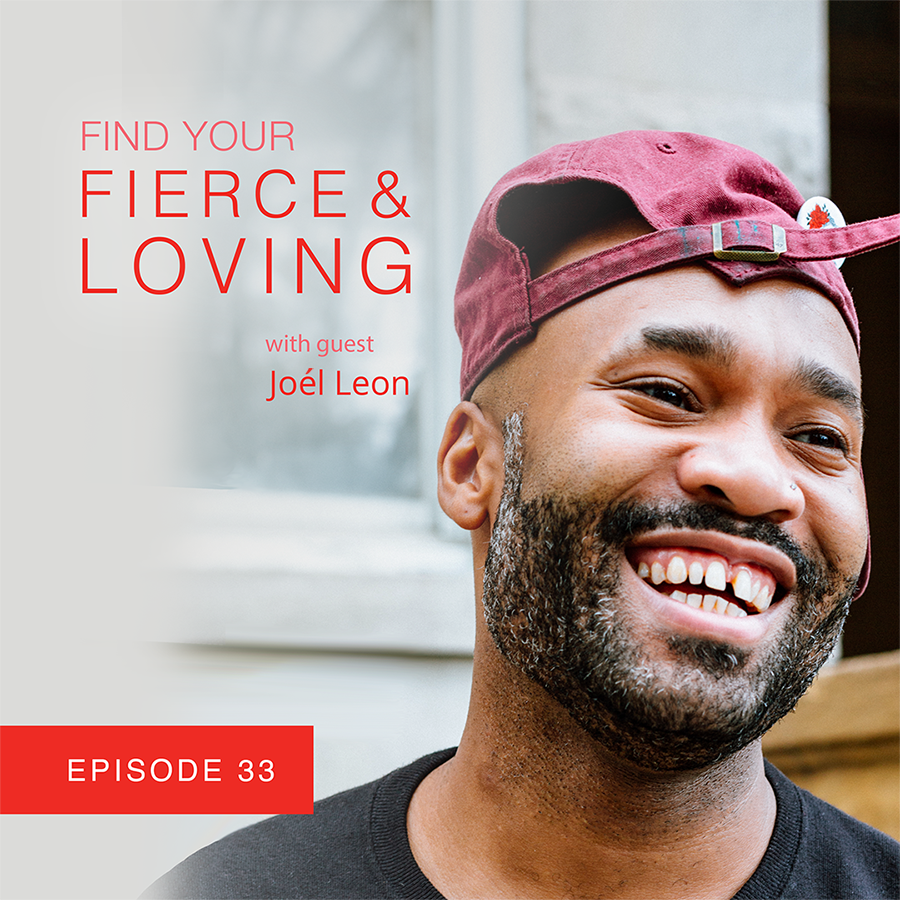
“I didn’t feel like I saw anybody from my perspective, coming from where I came from. So I just started speaking it on my own terms.” – Joél Leon
An abundance mindset is oriented around creativity and collaboration. Abundance involves expansion and freedom—it involves moving energy without attachment to what is returned. It means trusting. When we talk about abundance, our attention is often seduced by the accumulation of material possessions and wealth. Joél Leon wants to talk about universal abundance instead, and practice sharing that gift with his community.
Show Notes
Storyteller and performer Joél Leon didn’t see many people speaking about mindfulness in a way that addressed him and his community. He now uses his own experiences to bring those principles back to Black people, and fostered a thoughtful community through social media.
Today on Find Your Fierce & Loving, Joél talks about the joy of creation over competition and how he celebrates seeing other people share his work. With his daughter in his lap, he shares the practice of nurturing kindness and serving as a role model for his children and other people online and in person.
- (02:48) – Abundance
- (08:58) – Collective awakening
- (14:27) – Social media & creation
- (26:27) – Ase’
Joél L. Daniels, also known as Joél Leon, is a Bronx born and raised performer, father, author, and storyteller who writes and tells stories for Black people.
His TED talk on healthy co parenting has been viewed over 1.5M times. He’s worked with The Gates Foundation, HBO, Nike, Twitter, and the TODAY Show, and has been featured in EBONY, The Independent, Newsweek, Medium, BBC News, Sirius XM, Forbes, the Huffington Post, Blavity, and others.
He is a Creative Collective NYC Creative Class alumni, winner of the BCA Bronx Recognizes Its Own Award in Poetry, and author of “Book About Things I Will Tell My Daughter” and “God Wears Durags, Too”. He is repped by Folio Literary.
Do you want to unleash your inherent love and goodness, liberate yourself, and free humanity from the oppressive systems and structures we have created? We are here to support you in finding your fierce and loving life. Join us in Our Circle, a vibrant membership community rich in opportunities for engagement and transformation. Find out more at lolawright.com/our-circle.
You can follow Lola Wright, on Instagram, Facebook, LinkedIn, and Twitter and learn more about my work at lolawright.com.
Chicago born and built, Lola grew up in wealth and privilege, yet always sensed something was missing. She sought out aliveness and freedom in music, immersing herself in the hip hop and house music scenes of 90s Chicago. After finding herself on her own at 23, as the mother of two young children, she became determined to create a new experience.
Lola is an ordained minister with a gift for weaving together the mystical and material, she served for many years as the CEO of Bodhi Center, an organization committed to personal transformation, collective awakening, conscious activism, and community-building.
This podcast is produced by Quinn Rose with theme music by independent producer Trey Royal.
If you’d like to receive new episodes as they’re published, please subscribe to Find Your Fierce & Loving in Apple Podcasts, Google Podcasts, Spotify, or wherever you get your podcasts. If you enjoyed this episode, please consider leaving a review in Apple Podcasts. Your reviews help others find the show.
Transcript
Lola Wright (00:01): Something is stirring. Maybe you’ve felt it. We are reckoning with the reality of injustice and binary thinking that feeds the political machine. Humanity is in the midst of a heartbreaking and painful paradigm shift. That is a good thing. My name is Lola Wright, and this is Find Your Fierce & Loving. This podcast is intended to help you disrupt, untangle and free your mind of personal and collective agreements, patterns and beliefs that are holding you back and weighing you down. We desperately need your fierce and loving purpose now more than ever.
Lola Wright (00:54): All right, I’m so excited to have this brilliant being with me today on Find Your Fierce & Loving. His name is Joél L. Daniels, also known as Joél Leon. He is a Bronx born and raised performer, father, author, and storyteller who writes and tells stories for Black people. His TED talk on healthy co parenting has been viewed over 1.5M times. He’s worked with The Gates Foundation, HBO, Nike, Twitter, and the TODAY Show, and has been featured in EBONY, The Independent, Newsweek, Medium, BBC News, Sirius XM, Forbes, the Huffington Post, Blavity, and others. He is a Creative Collective NYC Creative Class alumni, winner of the BCA Bronx Recognizes Its Own Award in Poetry, and author of “Book About Things I Will Tell My Daughter” and “God Wears Durags, Too”.
Lola Wright (01:52): He is repped by Folio Literary. I have been following him for a few years on Instagram, and I am like… As I told him earlier, I’m sort of fangirling over here. He’s probably one of the great sources of inspiration for me on Twitter and on Instagram on a daily basis. So Joél, as I said to you, I feel this sort of buzzing in my body, so thank you for being here.
Joél Leon (02:23): Well, thank you for that beautiful, beautiful reading of my bio. It feels way too long when you’re reading it out loud. I have got to get accustomed.
Lola Wright (02:29): In comparison, it’s short. I will tell you sometimes I’m like, “Oh dear God. Okay, here we go.”
Joél Leon (02:36): It’s not even over yet. But no, thank you so much for this for the time and space and for that intro. I am very much excited to be here and sharing this space with you today. So thank you for this, for sure.
Lola Wright (02:48): So a few things that come to mind, you put out a tweet and a post today about abundance, and it was basically a declaration. Like you are abundant and you are prosperous. And ironically, I had a post that came out very shortly thereafter, and it was about a very similar concept, around abundance and prosperity and prosperity of spirit, the truth of who you are.
Joél Leon (03:14): Right.
Lola Wright (03:15): Not just measured by your stuff. When I saw that, I was like, “Oh, this is an example of one mind.” And that’s sort of an old school metaphysical term, like we are intrinsically connected. Nothing is happening in isolation. And so there’s this old, old excerpt from this spiritual philosopher named Ernest Holmes. And he says, “There is only one life. That life is God’s life. That life is perfect. That life is my life now.”
Lola Wright (03:47): And that for me has always been a source of strength. If there’s only a one life…
Joél Leon (03:52): I love that.
Lola Wright (03:52): Then that means nothing and no one is in truth opposing me. And I bring that up because we’re living in a time, especially with the state of media, where there’s a lot fueled by believing in opposition. And I think one of the things that you do so beautifully is offer this affirmative voice of what I would call truth, and I would call it radical truth with a fair amount of nuance, which by the way, is next to impossible to do on social media.
Joél Leon (04:35): It is very difficult.
Lola Wright (04:37): And offering a cultural critique at the same time, without adding to the drama. I’m like that is like threading a needle… radical truth, nuance, cultural critique, and transcending drama. I’m like, “Let me take a class with this man”.
Joél Leon (04:56): Thank you for that because it’s great when you… I mean one mind, right? It’s great when you encounter the people who get it. For me it is, but it’s also been a process, and I think this process is very familiar to a person such as yourself, Lola, who I think has been doing the work for me. When I think about prosperity, I only think of it with regards to spiritual well-being and spiritual wealth. And a lot of that for me is also reframing the language. Because there’s a general connotation you have when we use words like prosperity and abundance. It generally comes back to how many things I can accumulate or what I’ve accumulated or what my financial success and stability looks like.
Joél Leon (05:45): And for me, it’s always wanting to create space for multitude of conversations to live within each other while offering an opportunity for us to all benefit from that experience or that affirmation. Because at one point in time it did feel affirmations were kind of corny for me specifically.
Lola Wright (06:07): I get it.
Joél Leon (06:09): Right. And not even an idea that it doesn’t benefit people, but for me, it was always in the back of my mind. I go, people think this dude’s a cornball. Because I think, and again, I feel like I can speak for the both of us here because we both have been following each other for a similar period of time. It became a cool thing to have affirmations. I don’t think, as much as people want to kind of lambaste it, I think the idea remains like, having affirmations be popular is not a bad thing. I don’t think it can ever be a bad or too much of people sharing that truth with the world. And for me it was like, I wanted to share what I was experiencing and what I was learning and sharing it. I started utilizing Twitter as the platform to do that, where it was just me putting these ideas I was having. Ideas that were very much centered around mindfulness, around the Buddhist practice.
Lola Wright (07:08): And how did you get oriented with that?
Joél Leon (07:12): I felt like I was fucking up, and I needed some guidance, honestly. I was in a relationship at the time that I was just struggling to show up and find myself in. And honestly, there was a… And I mentioned this in a recent podcast… There was this book and actually I’m going to look it up right now, but it was a book that Iyanla Vanzant wrote for Black men.
Lola Wright (07:33): I love her. She and I are trained in the same tradition.
Joél Leon (07:37): “The Spirit of a Man”. It’s a book I found when I was living at Atlanta, and it was just in a used book pile, whatever. And I picked it up and that book started the journey for me because Iyanla was talking about words like surrender, and surrender as biblical as it is, for her she was talking to the experience of the Black man. Granted the book is a little dated if I’m being honest. It was like early nineties so some of the language is a little patriarchal. But I was able to glean from that what I needed to. And then I started just looking for different things that was speaking to what I was experiencing. So I started reading some Eckhart Tolle, and I started reading some Gary Zukav, Dharma Seed. Dharmaseed.org. It became really the place where I would just go and listen to Dharma talks every day because I needed it.
Lola Wright (08:21): That’s cool.
Joél Leon (08:22): I was using it as fuel. So when we think of the Tara Brach’s of the world and the Sharon Salzberg’s. To me, that became the place where I could really hear what I was feeling and have it be vocalized. But what I was seeing was that… I didn’t feel like I saw anybody from my perspective, coming from where I came from. I was born and raised in the Bronx. I was born in the hood, like the hood hood, and hadn’t really seen anybody who was speaking to this space in a way that felt honest and true for me. So I just started speaking it on my own terms.
Lola Wright (08:58): I think the voice that you offer is so essential, and I get so excited when I hear it coming forward because it is so important to understand the ways that our personal journey inquiry transformation is intrinsically connected to our collective awakening. And the movement out of which I come is largely consumed, historically, by white consumers.
Joél Leon (09:33): Yeah.
Lola Wright (09:33): That don’t necessarily by virtue of privilege and position and power in this society realize that our navel-gazing is insufficient. And in fact, our navel-gazing is part of the problem. You know what I mean?
Joél Leon (09:56): Yeah.
Lola Wright (09:56): This is what I’m saying. The voices that are emerging around personal transformation and a collective awakening are so important because personal transformation is intended to be in service of collective awakening.
Joél Leon (10:12): Absolutely. And I love how you framed that. And to your point, it begets the question like, an awakening for whom? Who was this awakening, at a certain point in time? And so for me, what I realized was like, as a cis-hetero Black man who has privilege in that regard like I’m able-bodied, I’m a man still regardless of… I’m Brown skinned. So there are things that allow me to just show up in spaces that I could recognize. But for me the ideal, the ideal has always been getting a platform so that I can elevate the conversation and also potentially platform other voices that have been doing the work. I’ve been doing the work way before I got here because my intention was never to be a person who helped kind of steer the conversation of personal transformation per se.
Joél Leon (11:08): But it was, these are my thoughts. This is what I’m thinking. This is what I’m feeling. And there’s a platform for me to share it and started to see that there were other people who were gravitating towards, who were looking for answers. But also to your point earlier, like nuance, because I think all of this is nuance like none of this shit is black and white. When I think about personal transformation, for me it was recognizing my privilege again as a cis-hetero Black man but then also trying to see how I could potentially learn through trial and error. I was saying things that I was experiencing in hopes that I could explain it in a way that felt relative to the community because like I’m reading the books and again like no one is coming from this vantage point.
Joél Leon (11:51): Not even seeing it as a… Seeing it as an opportunity but less of an opportunity with the table stakes and growing my platform, but more like an opportunity for our own personal growth and well-being. We don’t have the language. I didn’t have the language growing up, but now I can give this language to my nephew. So when my nephew, when he was 16 at the time, we would have a conversation about, “Yo, Unc, how did you learn how to be quiet?” There was no wherewithal, no awareness to that, but he has that language because I fueled him with it. So we can talk about what it means to be kind versus nice and what it actually means to be living your truth.
Joél Leon (12:30): Because I spent a lot of time trying to appease other people who expected me to be a certain kind of Black man in order to either fulfill the appetite for what they deem to be an appropriate, masculine representation of Blackness or whatever the case might be. And it took me a long ass time to get to a place of this is who I am. This is how I show up and hopes that it would allow others to feel like they could do the same for themselves. You know?
Lola Wright (12:55): What is the distinction between kind and nice for you?
Joél Leon (12:59): For me, kind is the energy. I think nice is the way in which we do things. You can do nice things for people which is cool. I love when people do nice things for me. I remember very clearly wanting… I liked being a nice guy. It’s a trope that men love to lean into when they’re hoping to get their way, to a certain extent. What I realized, as I got older, was that kind was a more generous and more understanding way of walking in the world. And again, kindness is really, for me, it was the embodiment of the person. Nice, it seems to be the thing that you get to do, but kindness… Through doing things through kindness it’s like the level up.
Joél Leon (13:50): It’s very much to me, similar in how I view empathy and compassion now. And in some of that, I wasn’t… I gleaned from Sharon Salzberg, where it’s, for me, empathy at this point are table stakes. Being empathetic is important, but compassion is really the action that’s connected to that empathy. So to me, kindness is very much in that same space. We get to be kind and that kindness again, invertebrates. Niceties don’t change the world. I think that energy of kindness can, if we’re fortunate enough, to be a part of it.
Lola Wright (14:27): I recently did an Instagram live with my 21-year-old son. And we talked about the murder of Daunte Wright, and you know what his experience is as a young Black man, as a young person consuming media. Does it occur for him in a particular way? It’s interesting. My kids… My older kids… They don’t have the same attraction to social media. I think they’re pretty fatigued by it, and I think they see the drama of it. So I’m curious for you, how do you navigate that in your own being? Staying informed, staying relevant to the people who follow you, being a leader, adding your voice, and not just contributing something to get engagement or the likes or the drama or the righteousness? How does that live for you?
Joél Leon (15:31): I think some of that lives in the timing of it for me and paying attention to where I am physically in my body. I don’t tweet or share anything unless I feel compelled to do so. Prime example, I was… What was I doing after we got the verdict for Derek Chauvin? I was coming from a photo shoot, and I was walking in the street and this Black man I had no… We had all been paying attention to Twitter, waiting to hear the verdict. And there was this Black man driving in his truck, and I just heard him, “Guilty”. He got stuck in traffic, and he was just shouting it the entire time. And for me, that inspired me to say something, right. So for me, it’s always been about paying attention to my feelings while also trying to recognize the energy of the community.
Joél Leon (16:25): Not everyone’s going to feel the same. It’s also knowing when to, for me, when to tune out. And then also when we’re talking about paying attention to the community, knowing who… If someone is saying the thing that maybe I want to say, let me let that voice do that work. That’s also just as important. I don’t need to be the voice. There’s so many other voices. And I would love for us all as a community to be able to do that. Like gauging, “Do I need to show up in this space in this moment in time, or am I just filling a void that I have or feel?” And I can recognize when I’ve done that before. Not necessarily when it comes to our loss and our grief and our trauma, but more like, “Oh, I feel like maybe I need to say something now on social because I haven’t said anything in a day.” As opposed to being able to sit back, relinquish ego in that space, and re-sense or recalibrate and say, “How do I need to show up for myself today?”
Joél Leon (17:26): Because what generally happens is when I redirect that energy towards, “How do I need to show up for myself?” I then generally wind up showing up in ways that feel more proficient and sufficient for me, and I think the community. As opposed to looking to fill a gap that’s missing in my own spirit and what is needed because I feel that very much, and I think you can relate to this.
Joél Leon (17:49): When we’re sharing or speaking to whatever is happening, especially when we’re talking about the trauma that could sometimes… I think can take over social. When we take a step back and look at what it is we’re being called to do or not do, for me, that’s the energy that shows up most effectively because then I’m just speaking from a place that’s bigger than me. And I’m tapping into the truth. I’m tapping into the source as opposed to looking for something that’s going to help me get to that source.
Lola Wright (18:26): Yeah. What I keep hearing as you’re speaking is the distinction between competition and creation. And this idea, like creation comes from within, and it’s not something that needs to be contrived. And it moves at its own cadence and flow and pace. And actually, you can trust it very deeply when you rest in it. Competition is rooted in scarcity, the way we understand it in our culture. And so it’s really about, “Okay, I got to kill something off so that I can get there before the next.”
Joél Leon (19:02): Yeah and like racing each other for no apparent reason. And not even really being sure of a destination which to me, the more I’ve actually relinquished the idea of a destination, the more freer I’ve become. There were things, you know this. Once I do this TED talk, then. Once I work with this person, then. There’s always another then. There’s always some other proverbial mountain that we need to climb for our own well being and then we can justify it. But at the end of the day, the most liberated I feel is when I’m just in flow in doing the work and there’s a difference. Tapping into the source feels differently. I feel that way generally when I’m on stage. If I’m rapping or if I’m performing, there’s a level of connectivity to the source that is very much inherent, which is why I miss performing in front of people.
Joél Leon (20:07): We did some virtual shows, myself and my best friend, Arthur Lewis. And those shows just weren’t the same because there was no audience. We were doing virtual performances for people that weren’t there, and the connection is different because there is an energy. When you say one mind, I get excited because essentially that’s what we’re doing. We’re all connected. Which is why I also, kind of in separate tangent, but I don’t feel a type of way if I see an idea that I’ve had being shared. Because to me, we’re one mind. No idea is new. So who am I to think that this thing that I’ve written or this thing that I’ve said, or this idea that I’ve had, hasn’t been adopted by somebody else? The other day, I want to say, I coined the phrase for right now. I coined the phrase, Afro-normalism, because…
Lola Wright (21:00): I saw that. Yeah.
Joél Leon (21:02): And shout out to Ebony Janice because Ebony Janice is very much like that’s the homie-homie. And she’s very big on citing like citing things like our work. You don’t have to be from an institution in order to cite your work. But Afro-normalism, it’s not new. It’s the idea of, how do we talk about the mundane experiences, the boring experiences of Black life in a way that feels joyful and good for us? Like Black people making tea. Black people walking. Black people parenting. How do we tell those stories, and what space do those stories get to live in? Where for so long, as a poet, I used to feel like I had to write about trauma, or I had to write about hardship or write about Black love. And there was a way that you had to perform spoken word pieces in…
Lola Wright (21:55): Trauma porn.
Joél Leon (21:58): All of that. And for me it was, I love the poems I loved the most where… if I wasn’t reading Ginsburg or if I was reading Bukowski and he was talking about getting the mail or watching TV, shit that I was, I don’t see Black folks getting to talk about that. Or we feel limited or we’re being limited to certain stories. And so for me, it became that, how do we create…? And it goes back to the point I brought up earlier, how do we get to recreate language and reframe language that feels suitable for us in the moment?
Lola Wright (22:32): Yeah. It’s something that I struggle with because I have an unwillingness to use these platforms to use trauma as entertainment, which I think is in large part what people do. And I think especially people who are just waking up to the quote on quote, Injustices of the United States of America. We talk about performative activism, but it’s more subtle than even that. It’s this idea of, “I got to hurry up and say the thing so that everybody knows that I’m tracking on this conversation,” and I have an aversion in my body to that such that I ended up not wanting to say anything because I don’t even want to participate in that.
Joél Leon (23:24): You don’t want to be seen as a part of this problem and wanting to get the soundbite out the quickest. I think of prime example of that, DMX. We were talking about DMX’s death before it actually happened. Something similar to that was, some of that potentially, of course, was this idea of wanting to get the news out first. I think some of it was just because there were so many varying sources coming around and collectively as a community we, and it’s something I shared recently, we mourned together. The Black community grieves together. We hurt together. So one death feels like a million. One loss feels like a thousand. It’s compounded because again to your point, this one mind.
Lola Wright (24:13): And also the distinction between individualism and communal existence.
Joél Leon (24:17): Yes. And how that community, for me, I’ve really been trying to push this idea of community as lifesaving because I’ve seen that how we look at the pandemic, where it’s been so hard to create community virtually for a lot of people because for some people that’s not their expertise. There’s so many layers and nuance, right? The experience and the experiences we’re having. Especially now because we’re trying to learn how to navigate these new territories. This pandemic is still new. A year’s not a long time. A lot happens in a year.
Joél Leon (24:57): And so what I’ve been trying to preach for a lot of us is that grace and forgiveness and kindness, that is required and when we’re doing that, I think that also allows us to be mindful of again, to your point. Am I doing this… Am I trying to lean into the trauma for conversation’s sake and for points? Or is there a real call here to meet yourself in this space? And I think we missed the boat when we keep looking at ourselves, as opposed to what does the community need? Because honestly, if I’m fulfilling the needs of the community, I’m generally more than likely fulfilling the needs of myself, if again, if I’m tapped in, if I’m doing the work.
Lola Wright (25:42): You want to be more alive. You want to unleash your inherent love and goodness, liberate yourself, and free humanity from the oppressive systems and structures we have created. We are here to support you in finding your fierce and loving life. Join us in Our Circle. This is an affirming and radical space that will gather weekly, on-demand or live, whatever works best for your life. For more information on how you can engage in Our Circle, visit lolawright.com/our-circle. I’d love to have you with us.
Lola Wright (26:30): So at the end of your TED talk, you landed on Asé and you know, that is a Yoruba word. And in the Western world and the United States of America, we’re most familiar with Amen and the English translation of the word Amen is and so it is. And we could say the Yoruba equivalent of that is Asé. And that word actually has an even more potent articulation than Amen because what it essentially means is this word creates. It is a creative capacity in and of itself. First of all, I love to break stuff down because I think sometimes people use words because it’s hot, but we don’t always know what they mean. And I just had such appreciation for you using that word.
Lola Wright (27:23): I have to be mindful using it as a white woman because it’s very easy to have white people appropriate practices, especially in the spiritual space. But I would love to hear from you why it was important that you close with that and or what does that word mean for you uniquely?
Joél Leon (27:44): You know, a few things. Me saying Asé at the end of that talk, it was also, for me, the same reason why I wore a blue bandana in my breast pocket during the talk. I was very intentional towards the end of that talk. The shout-out… I’m going to bounce around a little bit. But call and response, right. Very much ancestral, very much a part of hip hop culture I grew up in. But also when we look at enslaved peoples, and we look at the continent and the diaspora that is Africa and the Caribbean as well. It is very much in the chanting of names and name-calling. And so for me, when I’m shouting out those Black men whom I love is very much rooted in that. Asé is very much rooted in that.
Joél Leon (28:37): The bandana, which was for me, a tribute to Nipsey Hussle. A Black man we lost to the struggle who was murdered. And for me, it was a very much an ancestral calling and utilizing a very white space, which is TED in order to do that. It’s something that I’ve said from, from early on, pardon the language. But I want to take my niggers with me, wherever I go. I take the Bronx with me wherever I go. And so it’s always imperative for me to show up in spaces that are generally not created for my experience and bringing my experience into those spaces as a form of disruption. And also as a form of healing to like illuminate, highlight and showcase that we get to be here too. We’re supposed to be here too. We get to hold space here too. We get to tell our stories here too.
Joél Leon (29:33): And utilizing language that is speaking to that experience to me, so that like when my daughter West or my other daughter Lilah sees it, they know their father was speaking from a place that is true to him and true to them as well, you know what I’m saying? So they feel like they are a part of it. Because for me, that’s always the underlying thing. How do we make the community feel like they’re supposed to be here and welcomed in the space at times when we often aren’t?
Lola Wright (30:01): Again, living from the inside out rather than having the environment dictate who you’re going to be. It’s so funny because halfway through that talk, I was, “Who is this talk for?” That was the literal question. I kept being, “Huh. This man is a brilliant man. Who is this talk for?” Because I know those rooms, you know what I mean? And then almost seconds later, you started calling out who I imagined were people that were really crucial to you, that you held high or hold high. And as you wrapped up, I’m, “Oh, he created an altar up here. That’s really what he did”. This was an altar. It was beautiful.
Joél Leon (30:44): One of the names I mentioned Kareem. Kareem was from around my way. Kareem died of a heart attack, maybe a few years after his mother had passed away. I grew up with Kareem, and Kareem was a father. And I went to school with Kareem. And so for me, when I think about how many times the talk has been viewed, I think about how many times people have heard the name, Kareem. That to me is like this most important. People talk about the co-parenting and that’s cool. It was hard getting to a place where I were both Lilah’s mother and I could coexist in a friendly, loving space. But for me, that talk was an opportunity to bring Blackness into the space and bring the Bronx into the space.
Joél Leon (31:38): It could have been a talk on art. It had been a talk about anything. It was just more about bringing those names and bringing the spirit of those names into those spaces. The brothers that I grew up around, the brothers that I love, the brothers that I uphold to a point in a certain light. That was the most important part of it for me.
Lola Wright (31:55): So I’ll just wrap with this. What are you most excited about? I know it’s a weird time? I’m with you. The best place for me is a microphone, a stage, a room full of people and a band up on that stage.
Joél Leon (32:16): Like we do it. And I appreciate that about you. There’s such a vitality in how we show up that I think is encouraging because I also feel like so many of us as light givers, we tend to, for whatever reason, tend to think, and you brought this up already, we tend to think that we are in a silo of this work. When it’s like, there’s so many of us doing it. The thing I’m most excited about is my oldest daughter, Lilah being here, being here in New York for the summer. That is the thing I’m probably most excited about right now. But working on the essay collection, which is great. Having conversations with wonderful humans, such as yourself. Those are the things I tend to get most excited about. But for right now, really it’s the potential for the essay collection.
Joél Leon (33:03): I’ve never really felt… I’ve never been a person to be like my work is needed, but I’m finally at the place of the work that I’m doing, as far as the essays are concerned, I’m talking about body image, right? Like my body image as a Black father. When I think of the work that Kiese Laymon did for “Heavy”. “Heavy” to me, was one of the most beautifully written books that I’ve seen by anybody, Black man, woman, non-binary person. But the way he talked about his weight, for me, was inspiring because Black men generally don’t talk about their bodies unless their bodies are the ideal body. Right. And my body is not the ideal at all, at least for me.
Joél Leon (33:45): And so wanting to be able to talk about that, talking about porn addiction. There’s so many things that I wanted to talk to and throw for the essay collection that I felt really happy about that I feel like is going to land, hopefully, land the way in which I want it to. But then also that coupled with my daughter’s visit here for the summer. So those are the most exciting things for me right now.
Lola Wright (34:08): Of the favorite quotations that I referenced is from Eckhart Tolle and he says, “One of the greatest sources of grace known to humankind is acceptance of the unacceptable”. And I think it’s applicable even to one’s body. Can I accept the unacceptability of my body?
Joél Leon (34:31): Absolutely. I love that. That to me is going through the… That’s so powerful because there’s so much that we deemed to be unacceptable. And I think also, unfortunately, I don’t necessarily even think we deem that we’ve been taught that it’s unacceptable. And so we’ve adopted it as.
Lola Wright (34:50): Yes.
Joél Leon (34:53): And again, you do this work, is something that I encourage us all to do is just to investigate more what the truth is and who gave this to us as a truth. Wanting to keep this as a truth for my personal development, not… Because if I’m doing that, then I’m feeding the community. I can’t speak for the community. That’s not my job. My job is to translate what I’m getting from the source in a way that feels relatable to the community, and the community can take from that if they want to.
Joél Leon (35:26): But I can’t speak for the community which is also why I want us to have more conversations about cancel culture because we have kinds of culture, but we’re not talking enough about restorative justice.
Lola Wright (35:39): Yes.
Joél Leon (35:40): They live in tandem, but we’re not getting the second half of the conversation. So for me being able to talk about speaking for the community. I can’t… I’m not going to… There’s certain things that I think feel black and white, but a lot of it is grey. So I want to talk about the grey.
Lola Wright (35:56): My recommendation is give yourself the gift of being with this beautiful being, Joél Leon, by following him on Twitter and on Instagram. His handle is @iamjoelleon. How else can people engage with your work these days? I know you have two books out. We’ll have those in the show notes. If people are like, “I want more”. I mean, that’s sort of the way we roll. It’s like, “Give me more”. How can they get more?
Joél Leon (36:24): That’d be great. I mean, if people want more, that’s awesome. Instagram is always going to be the best place because I have my weekly series with Ebony.com Sunday Manifest. So they share that on their channel. I post about it generally every week that it goes up on each Sunday. The link in my bio is always going to be probably the most updated information. That’s going to be my website. That’s going to be a show or like a podcast, right. Or whatever the case is. The link in the bio is going to take you everywhere you need to go and everywhere hopefully you want to be. And then the Twitter, JoelakaMaG. That used to be my rap name, MaG, for those who were wondering, shorthand for MacGyver because MacGyver, if you gave him anything, he can make something happen. So, that’s what I felt like.
Lola Wright (37:13): I love that. Well, Joél, I speak so many blessings on your work. I’m grateful for it in my life. I just, I affirm. I know. I claim. I demand. The word ask in its Latin root actually means to demand. We relate to the word, ask, hopefully, something will happen over here. But it’s like, “No, speak that thing. Say that thing’.
Joél Leon (37:36): That’s beautiful to know and awesome. That is awesome.
Lola Wright (37:39): So many blessings on your work. Thank you for your willingness to hang with me, and I know that when we are back open for real, I would love to have you on a stage in Chicago.
Joél Leon (37:50): I would absolutely be there. Absolutely.
Lola Wright (37:55): If you enjoyed this show and would like to receive new episodes as they’re published, subscribe wherever you get your podcasts, and consider leaving a review in Apple Podcasts. Your review helps others find this show. You can follow me at Lola P. Wright on Instagram, Facebook, LinkedIn, and Twitter, and learn more about my work at lolawright.com. This episode was produced by Quinn Rose with theme music from independent music producer, Trey Royal.
Joél Leon (38:29): And so like when you talk about that nuance, I think some of that…
Lola Wright (38:46): Are you living in an experience of all your worlds converging by virtue of young children and a pandemic and all the things?
Joél Leon (38:55): Everything is happening right now, right now in this moment in general.
Lola Wright (39:00): This is the moment when we practice for actually, right?
Joél Leon (39:05): Yes. This is exactly why we do the work. So we can show up.
Lola Wright (39:10): Is that West?
Joél Leon (39:11): Yes. This is West.
Lola Wright (39:13): Hi West.
Joél Leon (39:14): West do you want to say hi?




Leave A Comment