
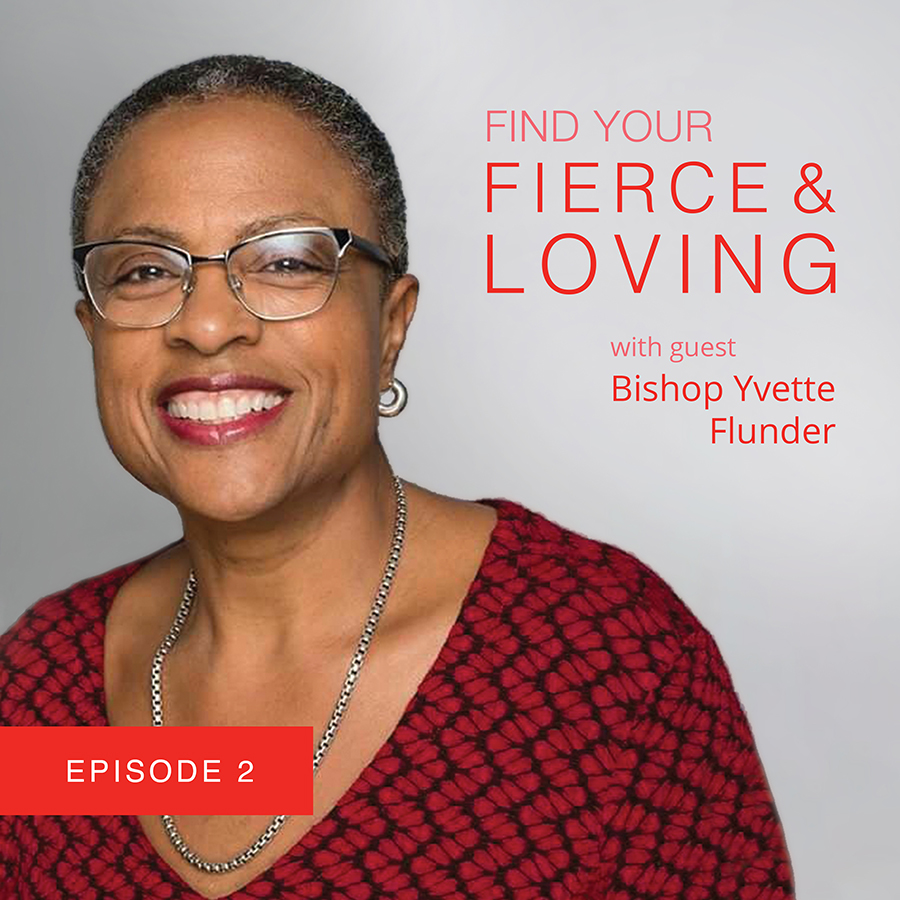
“If we realized that we have the power as the people, to decide to take back our own decisions and abilities and our own power; to make good and right decisions for the good of the whole, we will leave room and space. There are many different flowers in the Garden of God. And there are many different ways in which those flowers cross pollinate. There’s room and space for all of us to grow and be healthy and we can make room.” – Bishop Yvette Flunder
Humans are beautiful, powerful, and worthy of celebration—that is a necessary reminder gained from this episode. Bishop Yvette Flunder calls out the oppressive tendencies of religious dogma and government systems. She has devoted her life to a radical call for justice. I spoke to Bishop Flunder about cultivating fierce love. Take a listen and remember that you are a “designer’s original.”
Show Notes
When society does not accept you for who you are, it takes radical self love and potent community to experience real freedom. Bishop Yvette Flunder found herself in this position when she realized that traditional religious frameworks weren’t designed with her in mind.
Bishop Yvette Flunder is my guest this week on Find Your Fierce & Loving. We had a wide-ranging conversation and Bishop Yvette had an electrifying perspective on the state of politics, religion, and the necessary ingredient each of us is at this moment on the planet. As Bishop Yvette Flunder says, closets are for brooms. It’s time for you to come out into your light.
Take a listen to the episode for more of Bishop Yvette Flunder wisdom and her beautiful choir voice.
- (01:55) – Pentecostal struggle
- (06:04) – Justice and Jesus
- (09:54) – Repression to obsession
- (13:43) – Reclamation
- (15:34) – Chains of self-depreciation
- (23:43) – The source of salvation
- (30:49) – Privilege in exile
- (36:42) – Death rattle
- (40:02) – In utero realities
- (44:37) – Designer’s original
Rev. Dr. Yvette Flunder, a San Francisco native, has served her call through prophetic action and ministry for justice for over thirty years. This call to “blend proclamation, worship, service, and advocacy on behalf of those most marginalized in church and in society” led to the founding of the City of Refuge United Church of Christ in 1991. In 2003, Rev. Dr. Flunder was consecrated Presiding Bishop of The Fellowship of Affirming Ministries, a multi-denominational coalition of over 100 primarily African American Christian leaders and laity. Rev. Dr. Flunder is on the Board of Starr King School for the Ministry and DEMOS and has taught at many theological schools. She is a graduate of the Certificate of Ministry and Master of Arts programs at Pacific School of Religion and received her Doctor of Ministry from San Francisco Theological Seminary. She is also an award-winning gospel music artist and author of Where the Edge Gathers: A Theology of Homiletic and Radical Inclusion. You can find out more about Bishop Yvette Flunder by following her on Facebook @bishopyvetteflunder, and Instagram or Twitter @bishop_flunder.
Do you want to unleash your inherent love and goodness, liberate yourself, and free humanity from the oppressive systems and structures we have created? We are here to support you in finding your fierce and loving life. Join us in Our Circle, a vibrant membership community rich in opportunities for engagement and transformation. Find out more at lolawright.com/our-circle.
You can follow Lola Wright, on Instagram, Facebook, LinkedIn, and Twitter and learn more about my work at lolawright.com.
Chicago born and built, Lola grew up in wealth and privilege, yet always sensed something was missing. She sought out aliveness and freedom in music, immersing herself in the hip hop and house music scenes of 90s Chicago. After finding herself on her own at 23, as the mother of two young children, she became determined to create a new experience.
Lola is an ordained minister with a gift for weaving together the mystical and material, she served for many years as the CEO of Bodhi Center, an organization committed to personal transformation, collective awakening, conscious activism, and community-building.
Theme music by independent producer Trey Royal.
If you’d like to receive new episodes as they’re published, please subscribe to Find Your Fierce & Loving in Apple Podcasts, Google Podcasts, Spotify, or wherever you get your podcasts. If you enjoyed this episode, please consider leaving a review in Apple Podcasts. Your reviews help others find the show.
Transcript
Bishop Yvette Flunder: And if somebody found out that you had been searching for your own joy by yourself, and they found out that you ran the risk of being excommunicated because you were not supposed to seek and find your own joy. Not in that way, ok?
Lola Wright: At a time when protests are sweeping the nation, here’s what I know. Your purpose is your protest. It is the most radical thing you can bring to the world. My name is Lola Wright and this is Find Your Fierce and Loving. This podcast is a wakeup call, a road map back to your holy purpose, an invitation to set fire to the box you’ve been living in and watch it burn.
Lola Wright: Today’s episode is a great privilege and joy to share with you. You get to hear from mentor and friend Bishop Yvette Flunder. She is the presiding bishop of the Fellowship of Affirming Ministries. She is a San Francisco native and has given the last 30 years of her life to the prophetic call for justice. She is an expert in the intersection of personal transformation and collective awakening. If you are deeply disturbed by the state of the world as evidenced by the absurdity in the Supreme Court, the drama in presidential politics and ongoing racial injustice, listen to today’s episode as a kind of recalibration for what is needed of you and what is wanted to move the evolutionary impulse of humanity forward.
Bishop Yvette Flunder: I believe that God honors our expectations.
Bishop Yvette Flunder: And by that. If I were a whirling dervish in the Muslim tradition, and I would twirl expecting to receive a blessing in my twirling. I believe that the divine honors our expectations. If I was in a sweat lodge waiting to see my spirit animal, I believe that the divine honors our expectations. And, I believe that they wanted to have something that made them know that they had been in the presence of the divine. And so they spoke in tongues, in languages that were spirit languages and sometimes interpreted those languages to one another. I can say a lot about it, but I’ve had this experience myself. And, I will never, for the sake of essentially being religiously correct. I will never deny the authenticity of my own experience. And so I understood what they experienced because I desired to have it and received it myself. So the issue with being a Pentecostal was not the divine presence, though, the visitation of spirit or the outward demonstration, the struggle that we had because most of us who came together as Pentecostals had had that experience. The struggle was how narrow the religion was in terms of how we should present ourselves in the world, i.e. the strong patriarchal realities. The division between the white Pentecostals and the Black Pentecostals. So, extraordinary racism that existed among us. Not being involved and engaged in the world, you know, we didn’t vote. We were waiting for Jesus. Jesus was coming on Friday. And why in the world were we, you know, were we involved in the body politic at all? I mean, that was, you know, and the superiority that comes with believing that you are the chosen, the most spiritual among the spiritual. So there is a certain superiority that almost pities other people who don’t know God in the way that we feel like we know God in interesting ways, you know? And that was the way that I was raised. And absolutely there was no premarital sex. If you married someone, and they left the faith, you had to be single, like Paul taught the Corinthians. There was no acceptance of LGBT people. You couldn’t even find your own self. If you understand what I’m saying, you couldn’t.
Bishop Yvette Flunder: And if somebody found out that you had been searching for your own joy by yourself…if they found out, you ran the risk of being excommunicated because you were not supposed to seek and find your own joy. Not in that way. Ok. So there was just everything was a sin almost, except coming to church. Eating was not a sin in copious amounts and going to church every day almost and copious amounts of church.
Bishop Yvette Flunder: But just about everything was a really long list of sins.
Lola Wright: I never would have lasted in that environment.
Bishop Yvette Flunder: For several reasons I might add.
Bishop Yvette Flunder: And so it was complicated. So for us who were classical Pentecostals are being same gender loving, being woman leadership affirming, being involved and engaged in a body politic, doing justice work, working to fight back against government. These were all the antithesis of the way that we were raised.
Lola Wright: And how did you marry all of that? I mean, because I think one of the things we’re seeing on the planet right now is there’s so much like either this or that. And what you have created an entire community, existence, movement around.. it’s fundamentally who you are known to be.. is one that can bring the both/and together. So how was that? Where did you even know that that was an option as opposed to saying either I have to throw out my spiritual truth or my practice or my identity in that way, or I have to acquiesce to all these rules and deny these other parts of me.
Bishop Yvette Flunder: You know, the homogenization, as I call it, of these realities inside of me, Pastor, I’ll be honest with you took some time. Was a real process because there is an either-or-ness in most religions if you understand. You’re either in it, or you’re out of it. No fence city. Right. And it was a homogenization. I think that it was originally.. it was Jesus and that’s it. And the Jesus that I was taught. Right. It was Jesus or justice. Not if you understand what I’m saying. It was so and so. Jesus went out and then it became justice and Jesus. Well, when they started to homogenize and I began to see justice in the teachings of Jesus, not in the teachings about Jesus, but the teachings that are attributed to Jesus. Now, Jesus never wrote anything. I say that often to Christians, and they go like this.
Bishop Yvette Flunder: Even the red letters that are attributed to Jesus in the red letter Bible.
Bishop Yvette Flunder: We have no understanding that Jesus wrote anything. We have things that are written about Jesus, or things that people said Jesus said. But the truth is, the things that people, the writer said Jesus said.. When I listen to those I understood the underpinning for most of it was justice. Justice, so it became justice and Jesus switch meant that I was to some degree bifurcated. Because internally I had the understandings of Jesus, and I had the understandings of justice. And then they began to homogenize, which was not an easy thing, because when I listen to what Jesus said, not what people said Jesus said, when I listened to what was subscribed to Jesus. It was very akin to the justice warrior that was budding inside of me. So justice and Jesus, you know, got real connected. And now I spend a lot of time doing what I call justice for Jesus.
Bishop Yvette Flunder: And what that means for me is incorporating his humanity with his divinity which I find that I have to do in order to really understand who I am. And I also have to free other people to do in order for them to be fully who they are as well. And this is the hard one. Justice for Jesus allows his humanity and his divinity to be parallel and not like this, but like this.
Bishop Yvette Flunder: A human.. a person who is fully human experiences anger and sorrow and lust.
Lola Wright: I’m just like.. There’s so much suffering in this suppression of anger and lust. Yes. And this this sort of, you know, this cooptation of the story to deny and eliminate those very beautiful expressions of life as anger and lust. You know, and the suffering that that has created in the human condition and the human experience to x those out.
Bishop Yvette Flunder: And stop telling me that Jesus was fully human. Stop doing that if you’re not going to allow him days of total pissation.
Bishop Yvette Flunder: You know, just pissed off and super frustrated and cuss worthy days, those days.
Bishop Yvette Flunder: And also, if he is going to have love, as in the Greek is Phileo love, that is in the Greek is Agape.
Bishop Yvette Flunder: Why can’t he also have Eros? I mean, you cannot continue to tell me that he’s fully human. Yes. And not allow him fully human. These beautiful, fully human realities. Yes. Which moves me in so many ways to the underpinning of the Fellowship of Affirming Ministries. The Fellowship of Affirming Ministries has we opened our hearts to understanding that we cannot say that I give God glory and praise for my mind is given to God. My heart is given to God. Out of my belly flows rivers of living water. Then I jump down to my knees and say, my knees bow before God and my feet walk before God. And everything between my navel and my knees is a disgrace. And I have to repress all of that because obsession is born out of oppression and repression.
Bishop Yvette Flunder: When we repress, we obsess, which is why in the Catholic Church might I say there’s this great push to allow or insist that women do not have a right to choose what happens with their own bodies and when is a good and when is not a good time to give birth.
Bishop Yvette Flunder: Women don’t have a right to make those decisions.
Bishop Yvette Flunder: But then this is the same denomination that is incredibly in debt to pay back the destruction in the lives of young children who were sexually abused. So you have these extreme realities because oppression or repression leads to obsession. Yes. I don’t find that. For instance, in Native American Indigenous faith or African Indigenous faith, where people are aware from a human standpoint that this is what humans are and what humans do? Yes. And when they didn’t try to make an oppressive reality associated with that, we find our way to be fully human in the world in the absence of oppression and self-hatred and self-loathing. Yes. And that coming together and beautiful homogenization of humanity and spirituality is foundational to the Fellowship of Affirming Ministries. I bring my whole self.
Bishop Yvette Flunder: My whole self.
Lola Wright: Yeah. I mean, the word that comes to mind when I think about you is reclamation like, you know, and I think sometimes we can use that word reclamation, like, oh, what beautiful prose. But I think there’s also a way in which you were like, I’m going to take that. That’s you know, because if we said this is my experience, if I sit around and wait for someone to give me the thing that they say is not mine, I’m going to be waiting all my life.
Bishop Yvette Flunder: Yes, Angel.
Lola Wright: And you were like, no, that’s not gonna work. I’m here to reclaim.
Bishop Yvette Flunder: Because I am fearfully and wonderously made by the hands of a designer. I’m a designer’s original. That’s what my friend Danniebelle Hall said. I’m a designer’s original. I’m one of a kind. Created by a master with one purpose in mind to be a showcase of God’s glory for the whole world to see. And an example of God’s beauty, as God shines through you and me. I’m a designer’s original.
Bishop Yvette Flunder: And I’m not going to have one whole part of myself closeted because somebody else has an issue with it.
Bishop Yvette Flunder: I am a co creator with God. I am lifted by the divine to eye level. God calls us friend. God calls us friend. And Jesus said to Jesus’ disciples, You are my friends. How wonderful is that? So I’m not going to diminish myself or I’m not going to see myself diminished or diminish other people and lead duplicitous lives to satisfy essentially the institutions of religion. So you hit the nail on the head. That’s exactly right.
Lola Wright: Your website reads: The tortured historical and theological view that suggests that some people are just flawed or born to be the underclass and should never expect to be on God’s A list has been the convenient method used to hold women, immigrants, the poor and LGBT people in chains of self depreciation. And so, you know, my sense is that we are actually living in the aftermath of this. Like there has been a consciousness that has been, you know, both consciously and unconsciously subscribed to, that we are fundamentally flawed, that we are wounded and broken. First of all, there’s a lot of vested interest in maintaining that paradigm in place. You know, what do you see as I mean, we could certainly look at the state of politics in this country and not just this country in the world because there’s a collective experience occurring. But what do you see is the impact of the notion that we are fundamentally flawed, like if it is so that we are interconnected, that nothing is happening in this dimension of reality, in isolation. And if we are calling a critique to the notion that we are fundamentally flawed and this space is oriented to affirm your whole and holy nature that who you are is the individualized manifestation of the most high, this glorious demonstration of life. So if we are calling a critique to the notion that who we are is fundamentally flawed. There’s been a cost to that. What’s the cost that you see we’re most in the grip of today?
Bishop Yvette Flunder: What I found out about humankind having lived to be 65 years old and I mean lived to be 65 years old. What I found about humankind is oftentimes people do not feel powerful just because they feel powerful. They feel powerful in relationship to who they can disempower.
Lola Wright: Yes.
Bishop Yvette Flunder: And the atmosphere that we are in right now. There’s several different examples of that reality, whether it is race or gender or political affiliation or in some ways having to do with location. What part of the world we are in. There is no high for some people unless they ascribe low to someone else.
Bishop Yvette Flunder: And the high by itself just doesn’t make sense to them.
Bishop Yvette Flunder: High has to have a low. Steve Bannon’s concept of a served class and a servant class was when America was its greatest.
Bishop Yvette Flunder: And somehow or another, the idea of a middle class is basically what has destroyed us in his thinking. Right? And everyone is ascribing who ought to be in the servant class, ascribing to be in the middle class means that there are no servants for the upper class. And consequently, people in the upper class don’t have the infrastructure that they need to be upper class. Well, bless their little hearts is my feeling about it. In reality, I don’t believe that you have to press someone down in order to be great if you know that you are great.
Bishop Yvette Flunder: If you know that you are in so many ways in covenant with the divine. So you are divine. And if you really do realize and I think that that is the great illness, that is the great sickness. That’s why we have to have always an other. We have to have something in the suburbs that doesn’t touch the city. And then the suburbs will give money to things that people in the city need as long as it is a pouring down and not a reaching over. You know, give great amounts of assistance and help because we have to help those people. We have to assist those people until those people start moving into our neighborhood like we did not sign up for that. That is what we did not sign up for. And I am watching it happen all over the world. And yes, it’s the same thing that is happening with Brexit in England is what is happening here with this huge upsurge of wanting to distance ourselves from even claiming to be racist and classist. And not wanting to even discuss that. In taking money from institutions and schools that teach the importance of bringing these evils to an end, essentially, and teaching people how best to deal with those realities that exist, which we’re gonna pretend like they don’t exist. But in reality, they do exist. So everything is back on the table. Why do we want a conservative Supreme Court? We want a conservative Supreme Court so that we can get these women in control of their bodies under control. A conservative Supreme Court so that we can get LGBT people back in a place of fear, back into the stuffed, back into a closet. Why do we want a Supreme Court? So we can keep people of color from continuing to come into this country and diluting the whiteness of this country.
Bishop Yvette Flunder: Why do we want a Supreme Court that is conservative? We want to have a nationalization, a nationalized religion which is Christianity.
Bishop Yvette Flunder: And a narrow interpretation of that nationalized religion in this country. We want it as much as some Muslim countries want Islam with a Sharia. If you understand. We will get you if you don’t do it the way that we say it. Now, somebody like me, Pastor, flies in the face of that on several levels. As a woman leader in a faith community, as a woman of African and Native American, in terms of heritage and bloodline and DNA, as a same gender loving woman who is married to my partner, who we have been together thirty seven years. That doesn’t qualify as a fly by night experience. And though my life is not the same as other people’s lives and I have no judgment, even with people who who have been married four or five times, who are heterosexual, if you understand what I’m saying. I have never in 37 years had a partner intimately or legally, except my partner. And that is problematic on the conversation about what gay people can be and can’t be. That doesn’t fit what it is that people have said that gay people are in terms of over sexualizing thinking of us. Only this relates to the activities of our genitalia which I find such a poor representation of who LGBT people are. It’s the same thing is that women are all weak and hysterical or that Black people are all violent. There’s so much I could say about how we stereotype one another, but I think you hear what it is. That is my heart today.
Lola Wright: Yeah, my question is like I imagine. Well, I mean, what we know to be true because otherwise we wouldn’t have the circumstances that we’re living in. I mean, my. If I were to say, you know, it’s like. First of all, we could make a robust critique on the state of politics in this country. We could make a robust critique on the state of the economy. We could make a robust critique on the state of education. You know, in this country, I mean, you know, I mean, there’s just so much material to work with.
Lola Wright: And. At some point, it’s like no one gave you permission to be who you came to be. You had to claim it. You had to say, I’m not gonna deal with this anymore. And so this is my call for human beings. I’m like, come on.
Lola Wright: Like, let’s go. There is a life force energy that is like fire in your pelvis that is waiting to rise up and out of your mouth, of your being. You’re in this dimension of reality, at this time and space to be this extraordinary and exquisite expression of life. And like, we’re sitting around and it’s like, you know, again, let’s make the critique. But like to me, if we focus all our attention on the President of the United States, we have completely missed the point.
Bishop Yvette Flunder: Well, that’s his intention.
Lola Wright: Exactly.
Bishop Yvette Flunder: That everything be about him, you know. And I believe that you’re right. And if the people lead, the leaders follow. They have no choice. The point is that we’ve been led to believe that people like him are emperors because he has pawns that make his dreams come true. He decides to do something. And then there’s these pawns – this group of people that tried to make the thing that he tries to make happen. They try to make it happen. And we believe that that’s what we have to do.
Lola Wright: Right.
Bishop Yvette Flunder: But I’ll tell you, sister, if everybody in town decided we were not gonna stop at red lights. If we all decided, that’s it. We have had enough red lights. We want purple lights. And we are not stopping not one more day. There are not enough police officers. There are not enough red light cameras. Right. To stop us all. If all of us just flied on through red lights, we’ll stop. We’ll pause at yellow lights – cautiously cross. But we’re not stopping at any red lights. It’s not going to happen. We would change the color of the lights. So your point is well taken. If we realized that we have the power as the people to decide to take back our own decisions and abilities and our own power to make good and right decisions for the good of the whole, we will leave room and space. There are many different flowers in the Garden of God. And there are many different ways in which those flowers cross pollinate. There’s room and space for all of us to grow and be healthy and we can make room. And here’s another oxymoron, and I’ll say this again, as a same gender loving woman. We are a very small percentage of the population.
Bishop Yvette Flunder: If we are eight percent, maybe if everybody was telling the truth, we’d be eight percent. If we would stop lying about our secret lives.
Bishop Yvette Flunder: Maybe we’d be eight percent. It just baffles me. And as a person of African descent, we are 14 percent perhaps of the population. It baffles me. Why such a small percentage of people in terms of sexuality, which has always been true in the human family, from the time that the human family has existed, such a small percentage of people as relates to African descent? OK. It amazes me how we can just go on and on and on and on about this. I cannot understand how an effort is made to stack the Supreme Court. To keep these percentages that I just shared with you under control, what is it so powerful about same gender loving people? What is it that is so powerful about people of African descent that multitudinous people who don’t fit in these categories have to shift the whole doggone Supreme Court to keep Shirley and I from being married?
Bishop Yvette Flunder: We’re going to be married no matter what they do.
Bishop Yvette Flunder: It doesn’t make any difference to think whatever it is that they shift and change. We were married long before the government said that we could be married. Just like my fore parents who were African people got married and their marriages were not recognized. They got married because they understood that they wanted to be with this person and make a life with this person. One day their marriages were acknowledged, but it was a long time of marrying before those marriages were acknowledged. What am I saying to you? I’m basically saying to you, there are some ways in which we can be other that terrifies the majority. How does my love for Shirley have any bearing on your marriage with your spouse at all. And with the huge percentage of people who marry and divorce even more than gay people do. Truth be told, as it relates to averages. OK. Why do I matter so much?
Lola Wright: You want to be more alive. You want to unleash your inherent love and goodness, liberate yourself and free humanity from the oppressive systems and structures we have created. We are here to support you in finding your fierce and loving life. Join us in Our Circle. This is an affirming and radical space that will gather weekly on demand or live whatever works best for your life. For more information on how you can engage in Our Circle, visit lolawright.com/our-circle. I’d love to have you with us.
Lola Wright: So, I mean, to start, to some extent, you’re answering a question I have not yet asked while I’ve asked in different ways, but the way that you have been able to create the big, bold life that you have is because you very early on realized that the source of your salvation was not found in this world because the systems and structures were not designed to validate and affirm you. And so I’m imagining at some point pretty young, you were like, hmm, I better source this from within, which simultaneously does not mean that I don’t work to change the systems and the structures. But you have a kind of stamina and fortitude that lives in your spirit because you know that your power is not out here.
Bishop Yvette Flunder: Yes. Oh, I love that. And and. Oh, that’s powerful. Thank you for that. And, I am aware of the privilege of being in exile.
Lola Wright: Please speak to that.
Bishop Yvette Flunder: You know, there are certain things if I were not aware of how privileged I am, back to the point of representing these percentages, these small percentages that that whole denominations, the conferences to work against, if you understand what I’m saying, and female in the middle of all of this, I understand the beauty of my exile because it means so much to so many that I have been privileged.
Bishop Yvette Flunder: And now that I understand that to have been uniquely chosen, to carry this privilege, in the same ways I think of you sister, to be uniquely chosen to carry a ministry of liberation and freedom and acceptance. This is not apparently for everybody. Not everybody, not everybody can handle this. And so what was once.. at one point seemed to be a curse, I now understand that being liberated to be fully me means that I had to find joy in exile without most of religion agreeing with me. I had to find joy and purpose and power without an army of yes people.
Bishop Yvette Flunder: Standing around me and I feel so godly privileged to stand in a place like this and then to be given the wherewithal to unleash that determination and that honor and that place to as many people who like me were exiled as many of them as would receive it. Would understand the greatness, the prophetic utterance that we are in the earth. To stand in these dangerous places, the only person who is you in a room and still constitute the majority.
Bishop Yvette Flunder: That is an incredible place to be, and I feel privileged. I feel humble. I feel strengthened.
Bishop Yvette Flunder: I’m just grateful that it was me and people like me and like you and the many others that are part of this army of people who are grabbing hold. The understanding that I am who God and Good says that I am. I am not what religion says I am. I am not what politics says I am. I am not what my haters say I am. I am who God and Good says I am. And when I walk in a room, I can shift the atmosphere because I am who God says I am. I offer that as a gift to all of our listeners.
Bishop Yvette Flunder: Closets are for brooms.
Bishop Yvette Flunder: Come out, come out wherever you are, in whatever ways in which circumstances have closeted you and be your biggest, best, brightest and most powerful self. Put your whole foot down and let the whole world know.
Bishop Yvette Flunder: I am a designer’s original. One of a kind. Created by a master.
Bishop Yvette Flunder: With this purpose in mind.
Lola Wright: Bishop Yvette Flunder, a contemporary mystic, one who has gone before me, for whom I bow very, very deeply. I have so much appreciation for the voice, the authority, the commitment, your devotion. Thank you for the opportunity to sit in your midst. Thank you for the opportunity to learn from you. And thank you for being someone who has eyes to see the greatness in others. I’m grateful to be among them.
Bishop Yvette Flunder: I love you, Lola. You know, I do. And give my love to the whole congregation and all of our listeners and all of our friends. It really is our time. Can I just say one more thing?
Lola Wright: Come on, please.
Bishop Yvette Flunder: This is the last. Last. It’s almost like a death rattle.
Lola Wright: Yes.
Bishop Yvette Flunder: That’s why it is such a worldwide violent push. Because we have grown. I go back to early civil rights movements. And there were certain people, kinds of people there. And it moved to gay rights movements and women’s rights and womanist rights movements. And now I look at the street and I see Black children and Brown children and young adults and white children, white young adults working together, meshed together that are saying Black lives matter and Brown lives matter. I’m amazed this is a march we have never seen before. This is a response that’s gone on now for months that we’ve never seen before because there’s a shift and a change and a coming together in a symmetry. In what it is that is happening, that the other two marches can’t compare.. the other two seasons of marches can’t compare. They were working toward this and now we’re in the biss. And at the same time that that is a miracle, there’s a massive national and international push back.
Bishop Yvette Flunder: Because it’s like a death rattle.
Bishop Yvette Flunder: This whole push back against freedom knows that its days are numbered. My eyes have seen the glory of the coming of the Lord. That’s what they’re saying. Thats’s what my folks sang during the times of slavery, my eyes have seen the glory of the coming of the Lord. There’s no question about it. There is something powerful coming this way. Somebody said, well, well, we’re going to blow it up and go to heaven. I said, no, that’s not what I hear in the spirit. What I believe is our challenge and our call and our destiny is when Jesus prayed and said, your kingdom come your will be done on Earth as it is in heaven. No, it’s not somewhere that is a destination.
Bishop Yvette Flunder: What it is, is an opportunity to bring the realm of God into the earth.
Lola Wright: Yes.
Bishop Yvette Flunder: And everything that is not the realm of God is pushing back against that. And I mean, pushing back.
Lola Wright: Yes.
Bishop Yvette Flunder: Pushing back against the realm of God. But there are those of us for whom the realm of God is already burst forth in our imagination. And we are mothering. We are fathering. We are parenting the realm of God into the earth realm.
Bishop Yvette Flunder: It will happen.
Bishop Yvette Flunder: Earth is even helping us make it happen. The planet is even helping us make it happen.
Lola Wright: As someone who has birthed four babies out of this body, I always say, you know, those last three centimeters of dilation.
Bishop Yvette Flunder: Yes.
Lola Wright: That are called transition are the most acute. They are the time in which you want to say forget it. I cannot do this. And it’s also the shortest. Yes, it is. It’s also the shortest. And so any time we say yes to the big idea of who we’re here to be, which is essentially what we’re doing as a collective consciousness. We’re saying yes to a big idea of who we’re here to be. Anything unlike it is going to come to the surface and try to take it out. That’s just the way the ego construct works.
Bishop Yvette Flunder: Right. That’s the time that we are currently and presently in. And I love the concept of birth as a birth mother. I love the concept of birth, the idea that our in utero realities, we have to essentially depend on our placental connection to our mother. And that what comes through the placenta, what comes to her is our life. But then in the moment, in the violent moment where the placenta breaks away. Right. And the placenta is lost to the child who has been living in water in a sack.
Bishop Yvette Flunder: It’s such a miracle living in water and juice. All of this time, right? All of a sudden, the responsibility and obligation is you better breathe. You don’t have a great long time to get it together. OK.
Bishop Yvette Flunder: All of that labor and all of that violence and all of that and a disconnect.
Bishop Yvette Flunder: From what used to be who you were.
Bishop Yvette Flunder: You only have a little while to come down a really narrow passage with a really big head and some shoulders, you know, you gotta get out of there. And the first thing you must do in this new atmosphere is a complete antithesis to what you were doing. It’s completely different.
Bishop Yvette Flunder: There was no practice. There was no light breathing room. You know what I mean, you were a fish for a great long time. Now you got to breathe and you got to hurry up.
Bishop Yvette Flunder: And breathe, I say to you, how prophetic what it is that you are saying, how powerfully prophetic it is that we are in that place and we need to find our breath. We need to find our breath and our breath is not going to be capable of looking back at what we once were. We’ve got to be prepared for the violent move from what was to what is and be breath ready.
Bishop Yvette Flunder: Get ready to breathe because it looks like it’s impossible. It’s kind of like that birth canal must be for the babies and something is really wrong with this. You know what I mean? I was doing great. All of the sudden the big muscles are pushing. What the hell? I mean, what has happened to me? Right. And then the next thing I have to do is something I have never done before.
Bishop Yvette Flunder: I must breathe. I can hear myself saying to myself, get ready now.
Bishop Yvette Flunder: Because if you spend too much time agonizing in the birth canal, you won’t understand the powerful thing that is about to happen. I’m ready to breathe, Pastor. I’m ready to breathe. There’s something in this nation now that’s fighting against everything that I am.
Bishop Yvette Flunder: But, I am ready, and I know breathing is coming. There’s a breathing that is coming and it’s coming very soon for all of us. I receive that. I appreciate the concept. I appreciate the idea. And all four of your babies appreciate it too.
Lola Wright: Bishop, would I be too selfish to ask to hear your beautiful singing voice?
Bishop Yvette Flunder: Oh, let’s see.
Lola Wright: Before we depart. I just. It brings me so much joy.
Bishop Yvette Flunder: Maybe I’ll sing Daniebelle’s song. The one I’ve been quoting since we have been here. Let’s see.
Bishop Yvette Flunder: You’re a designer’s original. You are one of a kind. Created by a master with one purpose in mind. To be a showcase of God’s glory for the whole world to see. An example of God’s beauty as God shines through you and me.
Lola Wright: Yes.
Lola Wright: Bishop Yvette Flunder, I’m so grateful for you. Please follow this brilliant being. You can find her on Facebook @BishopYvetteFlunder. Follow her on Instagram and Twitter @Bishop_Flunder. And just so much gratitude for you. Thank you for who you are on the planet.
Bishop Yvette Flunder: My joy. Take care of Chi-town for me, ok?
Lola Wright: I will. I got it.
Bishop Yvette Flunder: Give love to the whole family. I love you all.
Lola Wright: Yeah. Lots of love to you and yours. Peace.
Bishop Yvette Flunder: Bye bye now.
Lola Wright: If you enjoyed this show and would like to receive new episodes as they’re published, subscribe wherever you get your podcasts and consider leaving a review in Apple podcasts. Your reviews help others find this show.
Lola Wright: You can follow me @lolapwright on Instagram, Facebook, Linked In, and Twitter and learn more about my work at lolawright.com. This episode was produced by Dante 32 with theme music from independent music producer Trey Royal.
Bishop Yvette Flunder: Days of total pissation. You know, just pissed off and super frustrated and cuss worthy days. Those days.





I loved this! What a powerful and timely message. “And the next thing I have to do is something I have never done before.” Find your courage, find your strength. Together we can do this. Thank you for leading us. XO