
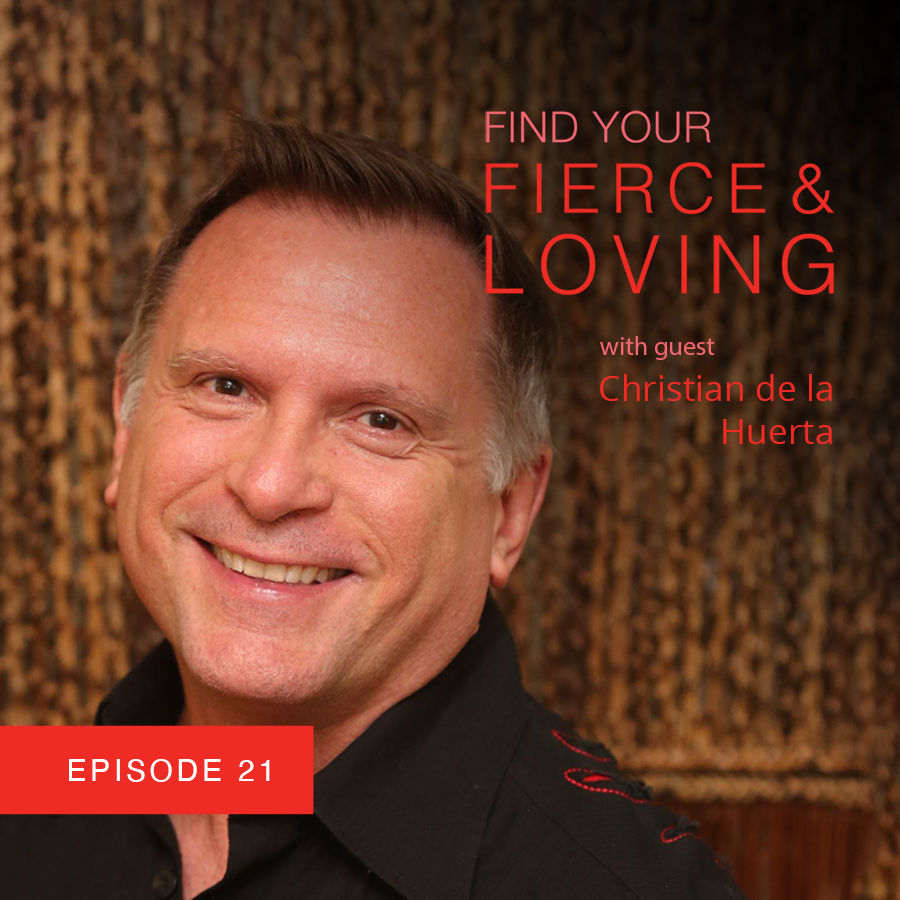
“If we put a baseball in the center of a stadium, that’s what the ego is. Who we are, really, is the stadium. And we’ve allowed this tiny, tiny part of who we are to think that it is all of who we are.” – Christian de la Huerta
Author and personal transformation coach Christian de la Huerta has used the challenges he’s navigated in his life to inform the offering that he brings to the world. Instead of pulling back, he’s teaching others how to harness the power of the breath, connect with their deeper selves, and open the path to transformation.
Show Notes
As our world expands its definition of “hero” in response to the pandemic, Christian de la Huerta knows that we all have the capability to be heroes. We are being called to a collective awakening, and to help each other through this time of great upheaval. We are living through an “apocalypse,” but that doesn’t mean the end of the world—it means lifting the veil off of the world and seeing it for what it truly is.
On this episode of Find Your Fierce & Loving, Christian shares the radical power of breathwork and committing to the emotional and physical work of healing. We invite you to find power within yourself that is not hierarchical. As we step into the future, we will seek to create true equality together.
- (03:35) – Using our challenges to inform our gifts
- (06:22) – Breath work
- (12:06) – Heroism
- (21:27) – Ego mind
- (27:00) – Shaping the near future
- (36:05) – Invocation for humanity
With 30 years of experience, Christian de la Huerta is a sought-after spiritual teacher, personal transformation coach and leading voice in the breathwork community. He has traveled the world offering inspiring and transformational retreats combining psychological and spiritual teachings with lasting and life-changing effects. An award-winning, critically acclaimed author, he has spoken at numerous universities and conferences and on the TedX stage. His new book, Awakening the Soul of Power, was described by multiple Grammy Award–winner Gloria Estefan as “a balm for the soul of anyone searching for truth and answers to life’s difficult questions.”
Do you want to unleash your inherent love and goodness, liberate yourself, and free humanity from the oppressive systems and structures we have created? We are here to support you in finding your fierce and loving life. Join us in Our Circle, a vibrant membership community rich in opportunities for engagement and transformation. Find out more at lolawright.com/our-circle.
You can follow Lola Wright, on Instagram, Facebook, LinkedIn, and Twitter and learn more about my work at lolawright.com.
Chicago born and built, Lola grew up in wealth and privilege, yet always sensed something was missing. She sought out aliveness and freedom in music, immersing herself in the hip hop and house music scenes of 90s Chicago. After finding herself on her own at 23, as the mother of two young children, she became determined to create a new experience.
Lola is an ordained minister with a gift for weaving together the mystical and material, she served for many years as the CEO of Bodhi Center, an organization committed to personal transformation, collective awakening, conscious activism, and community-building.
This podcast is produced by Quinn Rose with theme music by independent producer Trey Royal.
If you’d like to receive new episodes as they’re published, please subscribe to Find Your Fierce & Loving in Apple Podcasts, Google Podcasts, Spotify, or wherever you get your podcasts. If you enjoyed this episode, please consider leaving a review in Apple Podcasts. Your reviews help others find the show.
Transcript
Lola Wright (00:01): Personal transformation and collective awakening involve being the most alive, brilliant, inspired, creative, on fire version of yourself. A version that is not consistent with the status quo. My name is Lola Wright, and this is Find Your Fierce & Loving. This podcast is a wake up call, a roadmap back to your holy purpose, an invitation to set fire to the box you’ve been living in and watch it burn. I am so incredibly excited to have today’s guest with me. I want to introduce you to the brilliant Christian De La Huerta. With 30 years of experience, Christian is a sought after spiritual teacher, personal transformation coach, and leading voice in the breathwork community. He has traveled the world, offering inspiring and transformational retreats, combining psychological and spiritual teachings with lasting and life changing effects. Award-winning, critically acclaimed author, he has spoken at numerous universities and conferences and on the TEDx stage, and this is perhaps maybe the most fun. His new book, Awakening the Soul of Power, was described by multiple Grammy Award-winner, Gloria Estefan, as a balm for the soul of anyone searching for truth and answers to life’s difficult questions. Christian, I am so happy to have you on the podcast today. Welcome.
Christian de la Huerta (01:38): Thank you so much. I’m so happy to see you. It’s been, what, years since I spoke at Bodhi.
Lola Wright (01:44): I know. I was thinking. I think it’s been like seven years. When you reached out to me, I texted Mark Anthony Lord, and I’m like, “Hey, are you in touch with Christian? He just reached out to me, dah, dah, dah.” He’s like, “What? He just reached out to you? He’s the real deal.” He just kept saying, “He’s the real deal.” I’m like, “Oh, that’s really fun.” So anyway, I’m so happy to have you. And, I think as I was reading your new book. Well first of all, I had the thought, “Okay, well, my book in 2022 doesn’t need to come out because we have this book.” That was my first thought. I think the reason I felt that way is because it is so infrequent that I read books on personal transformation that effectively articulate the relationship to our collective awakening. So often books on personal transformation are really in the realm of naval gazing, and yours is not that.
Christian de la Huerta (02:41): No, no. Mine is a call to action, and it’s not for wimps. It actually reminded me of… I was reading on your website, and you’re right. You’re addressing people that are going to be coaching clients, and you say, “I’ll ask you to fiercely challenge your thoughts, beliefs, and stories to find the gift in your breakdowns and to lovingly embrace your discomfort as a path to new opportunities.” That’s what I’m saying in different words. It’s a heroic path to do the real, deep healing and transformational work that we’re talking about.
Lola Wright (03:18): Yeah, and it’s not just about getting your next new goodie. That’s the other thing that I so appreciate, is like, sure, do we all want to live big, juicy, fabulous lives with all the creature comforts we desire? Of course, and that’s not the big idea. So, I wonder, just if I can go back for a moment, because you talk about this in your book. And, I don’t know if we ever talked about this, but I’ve been to Cuba twice. I sang in the Havana Jazz Festival.
Christian de la Huerta (03:48): No way. I didn’t know that.
Lola Wright (03:49): Yeah, yeah, yeah, so I have sort of an obsession with Cuba. You’re Cuban.
Christian de la Huerta (03:56): Cuban born.
Lola Wright (03:57): Cuban born and did your family come during the Revolution?
Christian de la Huerta (04:03): Yeah, I lived under Castro in a communist regime for the first 10 years of my life. When I came here, I didn’t speak a word of English.
Lola Wright (04:11): So your family moved to Miami where you are now?
Christian de la Huerta (04:14): Yeah, we spent a little bit of time in Madrid because at the time you couldn’t fly directly to the states. So Madrid, and then actually when we first got here, we lived in Milledgeville, Georgia, in a huge metropolis. My dad was a shrink, and that was one of three psychiatric hospitals in the U.S. where the Cuban shrinks could practice as they were getting licensed. But for me, it was traumatic. Not speaking English, with all due respect, a redneck town that didn’t take kindly to foreigners. It was not an easy part of my life.
Lola Wright (04:51): So you talk a fair amount about how your identity has informed your work in the world. The assumption that I make is that, like when we are directly impacted by the social ills of society, by that what I really mean is when you are marginalized by heteronormativity, by nationalism, whatever words we want to use, that informs your work in the world. So, many years ago, certainly not unique to me, but I did a course called Your Mess is Your Message, and this idea of the heartache, the heartbreak, the challenges that we have navigated in our lives are really here to inform the offering that we bring to the world. And, you make reference in your book to the work of Joseph Campbell, which certainly I would say that’s what he would suggest, right?
Christian de la Huerta (05:45): Yeah, and I mean I totally resonate with what you’re saying there. Adolescence was one long depression because of just always being the other, always being the outsider for a variety of reasons. It’s like, I wouldn’t want to do it again but I’m actually really grateful for that experience because it’s that… I know the pain personally. I know self doubt personally. I know self hatred, self denial. So, for me to be able to write this book and say, “Hey, if I popped out of it, you can too.”
Lola Wright (06:22): I had forgotten until I reread your bio that you have a robust background in breathwork. And, I don’t know if we talked about this many years ago either, but I studied with a man named Jim Morningstar for a number of years in Milwaukee. So, I would literally drive for two years. My husband and I would drive from Chicago to Milwaukee just for the evening, not a sleepover. So it was a very big commitment. Can you give listeners a little context if they’re not already familiar with breathwork, what that is. Because I fundamentally believe that the absence of meaningful breath in our lived experience is actually a significant indicator of the suffering we are living in.
Christian de la Huerta (07:09): Without a doubt, and it’s interesting that especially the two major pandemics of 2020, COVID and systemic racism, I can’t breathe, that that was the prevalent thing, inability to breathe fully. I know Jim. I don’t know him personally like in 3D, but we’ve had email and virtual communication. So glad to know that you trained with him. That’s great. Breathwork is a simple breathing practice. It’s an umbrella term for different modalities. Some are more shorter, simpler, like the kind of breathing practices we do at yoga class and yoga practice. And then the breath work that you and I are talking about is deeper, longer, more intense. It can be an hour, an hour and a half. Some modalities go longer, as long as three, four hours. It’s an intense practice. It’s a circular connective breath and amazing stuff happens. I mean, not only does it heal at every level, emotionally, mentally. I don’t know anything more effective in terms of healing past trauma, but it also heals physically. I know, I realize that sounds too good to be true. You know what I hear? I’ve been saying this kind of stuff for 30 years, over 30 years that I’ve been doing breathwork. And, I come out of the Psychotherapy tradition. My dad was a psychiatrist as I said. My degree is in Psychology. When I discovered breathwork, I jumped tracks. I never went for the PhD because it works so fast and heals so profoundly at so many levels. And, on top of that, it provides amazing experiences, spiritual experiences. For lack of another word, of Oneness, of belonging, of connectedness. People have just indescribable experiences connecting with ancestors or aspects of the divine. I can’t speak about it highly enough. I wouldn’t be who I am if it wasn’t for that.
Lola Wright (09:06): What I love about bringing that forward in this conversation is because so much of the consciousness field or the mindfulness field, and I have that in air quotes, is cognitive and oftentimes is dislocated from our body intelligence and our emotional intelligence. And that’s a very typical, I would say America, arguably western tendency, is to just analyze our thoughts, analyze our suffering. But in my experience, if I don’t engage my body, if I don’t engage my breath, if I don’t engage my emotional intelligence, the transformation is either short lived or not particularly deep because the mind, the thinking mind, has a limited capacity for change.
Christian de la Huerta (10:01): Yeah, absolutely. I could not agree more and with all due respect to the psychotherapy process. In the right hands with clear, defined goals, it can be incredibly supportive and healing. And, we all know that you could sit on somebody’s couch for 5, 10, 20, 30 years and nothing happens. And, I know because they come to me, and they tell me, “Wow, I got more out of that weekend with you, that breathwork experience, with you, than I have the years of therapy.” It’s not putting therapy down, but here’s why it can fall short, because as you were alluding to, that trauma… So, we might remember what happened to us when we’re five or ten or fifteen or twenty but understanding it up here is one thing. But where it falls short, therapy, is because that trauma has been semanticized and now lives in the body. So no amount of talking at it is going to clear it. The great combination to me, the ideal combination is the cognitive therapy, coaching, spiritual coaching approach with the breath because then you have both. What the breath does is it bypasses the mind, and it goes to the source of the trauma which now lives in the body, and it clears it.
Lola Wright (11:14): I mean, obviously we’re sort of in a weird space right now because of the pandemic, but presumably you’re going to have retreats gathering in the future soon. Are you still actively using breathwork in your client work?
Christian de la Huerta (11:28): Absolutely, I mean not this year as you… this last year because we haven’t been able to have retreats but it is the… well, it’s two concepts. In all my retreats, no matter what the theme is, one is breathwork because again, I’ve yet to come across anything that heals as profoundly and as quickly and on so many levels. The other thing that I always teach is how the ego mind works because that is the source of all our suffering. If we want to have the kind of relationships that we long for and a life, a sense of personal empowerment and lives that are filled with meaning and purpose, we have to understand the ego mind.
Lola Wright (12:06): So, I want to make reference to a couple points in your book. This first part is from the preface. During times of global pandemic or natural disasters, for example, we could argue that simply getting up in the morning, making our beds, and maintaining calm, centered, and positive lives are heroic acts. Yet, I feel we are being called to more, all of us. For years, I’ve been saying, “All hands on deck.” Now that time has truly come. I think that’s a pretty radical statement because I think it is very easy for us to fall into like, “Well, I’m just doing the best I can. I’m just trying to keep a PMA, a positive mental attitude. You’re basically like, “No, no. You’re here for more than that.” Can you say more about that?
Christian de la Huerta (13:00): Yes, and that’s what I referenced, and I think that’s where your words and my words are so congruent because we’re both calling people to their highest and to do the tough work of going within and looking at why we do the things we do and understanding our patterns and understand… like being willing to face our own demons. That’s not easy and to bring choice back into the equation so that we’re not just reacting because somebody did something to us and then we’ll react back. It’s like, anybody can do that. Taking a breath and calming ourselves down and choosing how we’re going to respond. That’s the stuff of heroes. So, that’s why I call the series, Calling all Heroes. This is the first book, How does a hero? I use that term generically because heroin smacks as something else. So, I’m using hero for anybody. So, how do we step into power in a way that’s not hierarchical about putting people down, power over, power having to do with force or fear or domination. Second, focus on relationships. How does a hero step into relationships consciously and attract and navigate relationships that actually can work? Then the third book is on life purpose and leadership, mindful leadership.
Lola Wright (14:19): When you use the word hero, you’re not saying like a martyr. You’re not saying exhaust yourself in the process and go save the world. That’s not what you’re talking about.
Christian de la Huerta (14:29): No, in fact, self care. We’ve been so conditioned to think that self care is selfish. It’s the opposite way. It’s like, self care is mandatory and especially for those of us who are doing this kind of work, any kind of healing work. If we don’t take care of ourselves, it’s like what happens is we give and we give and we give and if we’re not taking care of this, we start burning out. We start exhausting ourselves, and then we start resenting the giving. Then, that service turns into servitude, and we feel captured. And, we get bitter all about it. So, it’s mandatory to take care of this, and it’s the first thing they tell us when we fly on a plane. Your mask on before even that of a baby.
Lola Wright (15:15): In chapter four, I just love this context so much. “We are living in apocalyptic times. What further evidence do we need?” You go on to say, “The real meaning of apocalypse was not about the end of the world. The word meant lifting the veil. In our times, veils are being lifted and all powerful wizards are being revealed as simple, cowardly con men hiding behind a curtain.” I love this so much. I love the context of apocalypse because it is so misused so frequently. We can relate to apocalyptic times as something bad and negative and really it could be synonymous with illuminating, something’s being revealed, known, as you said, lifting the veil. I don’t think we can undermine the devastation and despair that is existing in the human condition right now, and yet how are you finding your… how is all of this in service of something greater?
Christian de la Huerta (16:26): Yeah, it’s those veils being lifted all over the place. Systems that are just no longer sustainable. So, think about the corporate scandals that we’ve been experiencing for the last fifteen, twenty years. Think about the religious scandals, the church scandals, political scandals. So, we’re seeing all these systems that just cannot function, continue the way that we’re going. It just doesn’t work. We’ve got to figure out a different way of doing it, and that’s kind of the hopeful way of looking at where we are. From one perspective, it can feel really scary, and it is, in the sense that we’re stepping into the unknown because all these systems are just imploding in front of our eyes. So, but the other side is that if we frame it, it’s the end of the patriarchy. That’s what we’re living through. What’s really important to get to is that the patriarchal system, without minimizing and as oppressive and unacceptable as the treatment of women has been and continues to be over the last several thousand years and continues to be now… What’s really important for us to get through for men to understand is that that patriarchal system, that toxic masculinity, is as imprisoning and as limiting for men.
Lola Wright (17:47): Yeah, I think that that is… Well, first of all, I fundamentally believe that if that’s not what you’re selling, there’s not going to be enough effort to deconstruct it. So, it’s like, I mean that… First of all, as you say in the book, we are interconnected, interrelated beings. Nothing is happening in isolation. So, if one segment of the human family is suffering at the hands of a system or a structure, it implies that we are all suffering even if at face value it looks like I’m winning. We could say the same is true about race. It’s like, if the obsession is to help and save black and brown people and the delusion is not that racism is deeply toxic to white people, we have completely missed the point.
Christian de la Huerta (18:37): That’s right.
Lola Wright (18:38): So, I love what you talk about here. The idea is not that as we deconstruct patriarchy, we’re calling forward matriarchy.
Christian de la Huerta (18:49): Yeah, I mean hopefully most of us know that before there was a patriarchy there was a matriarchy, and we worshiped the goddess for thousands of years before the monotheistic, more recent manifestations of the divine. So, but in my perception, it’s not about going back to that, it’s about reaching balance because the world’s been running off balance, off kilter for way too long. So, we don’t want to go back to this. We want to find balance. If we expect or desire to have that in the world, that’s got to start here. So, we’ve got to find a way to balance the masculine and the feminine inside each one of us because it is inside each one of us. It’s just that we have repressed and overcompensated.
Lola Wright (19:37): I love that. It makes me think… I’ve been thinking about, it’s like, well either we have capitalism or socialism. It’s like, oh my gosh, do you think that there could be another way? That’s all of the ways that our minds dissect existence or reality into these binary boxes. Either we get the patriarchy or we get the matriarchy. Either we get capitalism or we get socialism. Either this or that.
Christian de la Huerta (20:09): That’s one of the ways, by the way, which growing up LGBTQ, it doesn’t completely heal that, but you have a built in advantage because there’s not an either or so much. It’s more of a both and of approach towards life. I want to complete the thought because it’s really important about this, how patriarchy disempowers men. Let’s look at just a couple of numbers that are really important. The rate of suicide among men is four times that of women. 70% of the suicides in this country are committed by white men, and if we look at longevity in this country, women outlive men by five years. Globally, it’s by seven years.
Lola Wright (20:51): Wow.
Christian de la Huerta (20:52): So, something’s not working for men.
Lola Wright (20:54): Yeah, I appreciated your acknowledgement in the book to the role that queer people have played in culture and society historically. That this dance with our fluid nature was historically seen at times as a great gift, as a mystical capacity. So again, I think this really points to how locked we are in this either or consciousness. I’d love to hear you talk a little bit about… You said there are two primary things. You said breathwork and teaching about the ego mind. I’d love to hear you riff on that for a little bit.
Christian de la Huerta (21:40): Here’s a simple way of understanding the ego mind. It’s a part of us. So, if we think of Homo Sapien Sapiens, one way we can translate that in Latin is humans who know that we know. So, it’s that ability to reflect back up on ourselves, self reflexive consciousness. So, the ego is like, it’s our individual sense of self, it’s our personality. If we put a baseball in the center of a stadium, that’s what the ego is. Who we are really is the stadium, and we’ve allowed this tiny, tiny, tiny part of who we are to think that it is all who we are and to run the show and to make really important, critical choices about our life, about relationships, about what we do with our lives, about this job, about that opportunity. We make all these choices from the ego’s tiny and always fear-based perspective, always. So, talk about giving our power away. If we’re on the journey of reclaiming our own power, that’s step number one, is like understanding what the ego mind is so that we stop selling out to it. There’s so much to say about that, obviously it’s a big chunk of my retreat. But Ken Wilber, who’s a brilliant mind, talks about how humanity hasn’t always had an ego. At some point in human evolution, we didn’t have a sense of self. We were at one with the rest of creation. When the ego developed, the individual sense of self, that then got mythologized all over the planet as the expulsion from the garden because now it’s like, oh right. So, it’s a huge leap in consciousness to have a sense of self, that’s the plus side. It’s one of the reasons we’re so successful. The price we pay for individual consciousness is now we can have abandonment issues, sense of separation, loneliness. We can have a sense of our own mortality. So, there is a price to pay for that. There’s a lot of misunderstanding about what the ego is. Most people who know the word will think arrogance, inflated sense of self, and it is that for sure, but so much more than that. Then, maybe if we took Psych 101 in college, we may think of Freud’s model of personality, the id, the ego, the superego. That’s not what we’re talking about. The way you and I are talking about the ego is more derived from Eastern teachings, and it is that sense of self, that sense of individual identity which is ultimately illusion and both a helpful illusion and the source of all our suffering.
Lola Wright (24:24): Why did this feel like an important book to have come out now? I mean, what is it that you’re wanting people to walk away with from this first book in this series?
Christian de la Huerta (24:36): Over the last years, once in a while, I would think, God, this is taking so long because I wasn’t getting it out. I was in and out, in and out, another retreat, another trip. All great stuff, but I wasn’t dropping in to access that creative flow. So, I second guessed myself, and I mean, I know enough that that’s a function of the ego to not buy into it, but it would take work. It’s like, right, no, don’t question it. I would ask myself, “Did I miss the opportunity for this book? It’s taking too long.” Then, come to find out, what a time to be talking about personal empowerment and about living heroically. I couldn’t have chosen a better time and because COVID has forced us to rethink and expand how we think of heroism. We used to think of warriors or maybe first responders, firemen and EMTs and the police, people who placed their lives at risk for the sake of someone else. COVID, you know now we think of, we include the medical professionals, the doctors, the nurses, the respiratory therapists, and even our delivery people, even our grocery store clerks, who in some level were taking and are taking a risk by keeping things going and keeping us fed and taken care of. And then, it’s like what you read in the beginning… Well, what about the rest of us? What about the rest of us? Well, we get to live heroically too. What does it mean to live heroically in the 21st century? When we don’t have the horse hitched outside and the armors and the demons to slay except the ones in here.
Lola Wright (26:16): You want to be more alive. You want to unleash your inherent love and goodness, liberate yourself, and free humanity from the oppressive systems and structures we have created. We are here to support you in finding your fierce and loving life. Join us in Our Circle. This is an affirming and radical space that will gather weekly, on-demand or live, whatever works best for your life. For more information on how you can engage in Our Circle, visit lolawright.com/our-circle. I’d love to have you with us. I made a leap. I left Bodhi in February before we really knew that a global pandemic was going to ensue. I certainly had a way that I thought the upcoming year was going to go. I had a way I thought my business was going to roll out. The gift for me, I mean, so many gifts. Most of those gifts I would say, many of those gifts, maybe not most but many of the gifts found through the practice of discomfort, the willingness to be with discomfort. It has required a cultivation of my own inner knowing and faith around the orchestration of the universe that hey, Byron Katie would say, “There’s your business, there’s my business, there’s God’s business.” That could be an articulation of it. We could say, “You have a plan and watch God laugh.” I mean, it’s not really the context for God that I hold, but we get the point, right?
Christian de la Huerta (26:16): Right, right.
Lola Wright (27:59): I’m curious for you as someone who did travel 100,000 miles a year that would do retreats all over the world, consulting gigs all over the world… What fears have you had to come up against or what new inner work have you had to navigate in this season? How do you imagine that informs the next iteration of your career?
Christian de la Huerta (28:25): That’s a great question too. By the way, your being willing to sit in your discomfort when all your plans were like, oh, crap. What now? That is heroic. That’s heroic. So much easier to numb it out.
Lola Wright (28:42): Totally.
Christian de la Huerta (28:43): In all the infinitely creative ways that we use to numb out, whether it’s substances or food or sex or shopping or gaming or being online. It’s strategies to not think and not feel. So what you did, which is to A, to be willing to sit and see what lessons are available and how you show up in a different way. That’s nothing short of heroism. So for me, it’s like one thing that I’m really grateful for because I’ve been doing like you, I’ve been doing this work for a long time too. One thing that I was really grateful for is seeing that. I haven’t been able to have retreats or events since March and not once, not once did I slip into fear or doubt about survival, about the money part of it, not once. So, I’m really grateful about that. I mean yeah, that’s the fruit of a lot of work over the years, but now I know that I’m established enough.
Lola Wright (29:44): You talk about this a little bit in your book, and I have woven this into my work also, is the power of community. That the other distinction in an ongoing program is that it isn’t this high. It’s really about cultivating a sustainable practice, being in community with like-minded individuals that are tracking in a conversation and doing the work. I’ve been talking a lot about recently, I wish that I could tell you a three-point plan to live your best life. I wish that that could be accomplished in a one night talk. But in my experience, all of the work that I have done within my own self, in my family system, in my marriage, has just been lots of micro movements over and over and over again. So yeah, I appreciate the commitment to community practice.
Christian de la Huerta (30:52): Yeah, and also, accountability. It keeps us doing what we said we would do. So, it’s support and accountability. I love what you’re saying because this transformational work doesn’t happen in a vacuum. When I first got the understanding of the ego mind, I was in an ashram so I wasn’t in relationship. I was mostly celibate for five years.
Lola Wright (31:17): I forgot that about your story. How did that come to be?
Christian de la Huerta (31:21): Well, it was a small community. It was a woman that I was studying with from whom I learned breathwork and from whom I learned, began to understand meditation and Eastern spiritual concepts. Small community for five years, it was the most difficult thing I’ve ever done. You’d think, if you’ve asked me before, it would’ve been the celibacy that was a challenge. No, not even close. It was the surrender part of it because every day for five years I had to surrender my will, my preferences, my perceptions even, my desires to the sacred but through the person, the guru who was sometimes irrational. Again, I wouldn’t want to do that again, but I’m really grateful for that experience because of the depth of surrender that happened. Yeah, and then it got to the point that the inherently hierarchical nature of the guru disciple relationship began to interfere with my own growth. So, there I was, because I started teaching very quickly. I could see that I was helping people get free, and I wasn’t feeling free. So, it took me longer than I thought it would’ve to leave, but because I had risen to the point that I was her right hand person, her substitute son, her heir apparent, her publisher, her publicist, her event producer, such a complex, multilevel relationship. I knew that I when I left the whole thing would implode, and it did.
Lola Wright (33:02): Did you not feel free in relationship with her or by virtue of now being seen as a teacher, and so you were held differently in relationship to the students?
Christian de la Huerta (33:14): No, it wasn’t even that. It was more like the first part of it. It was the hierarchical nature of it. She was an ambivalent guru. There were days where she just wanted to be off in a cave in a mountain somewhere. Then, where she and I really connected, was in the critical nature of the times and in the world’s service, but it got to the point that the unhealthier parts of the relationship just were interfering with my own growth, with my own spiritual development.
Lola Wright (33:47): It’s an interesting thing when your teachers… I mean for me, I have had my heart broken by teachers. I have had the experience of wanting it to be other than it is. I’m so grateful that I’m at a point now, which I love how you speak about this, I wouldn’t necessarily go back to that, but I wouldn’t trade it for the world. I’ve come to understand the complexities of our humanity and can I extend grace for all of someone. And, having been someone who led a community for many years. I mean, I think that there’s a wide spectrum of experiences that people had with me, both incredibly affirming, incredibly heartbreaking, incredibly empowering, incredibly disappointing. I mean, I know I disappointed people over and over and over again.
Christian de la Huerta (34:46): Yeah, and I bow to you for having taken that role. I wouldn’t. I mean, I can’t imagine. To take that role and to be on every Sunday. It’s like, I work most weekends when I’m working, but it’s a different thing, it’s not… And also, it’s like, we know projection. That’s part of the ego thing where we make wrong over there what’s also in here, but it’s a blind spot so we deny it over here, and we stick it deep in the recesses of our inner closets, the back of a drawer of consciousness somewhere. So, then it gets projected, especially to the leader of the community. So, I know that you consciously were aware of that and sometimes you got to take it.
Lola Wright (35:32): Yeah, I think I was naïve going into it. I think I was incredibly altruistic, and I’m eternally grateful for my experience at Bodhi. Both as a member there for many years and as a leader, and then the leader, whatever that means, forever altered my experience of life. And, I’m so grateful to be in a new creation as well.
Christian de la Huerta (35:59): Yeah, my experience of the times that I’ve been there, it was a beautiful community.
Lola Wright (36:03): Yeah, it was, it really was. So, just as we wrap up, I’m curious. What’s your invocation for humanity right now? If you were to say, “This is my prayer for where we are in our species on the planet.” I love how you talk in the book about waking up to our interconnectedness with the earth itself. You have a very powerful articulation of that. What is your prayer for human beings at this time in where we are?
Christian de la Huerta (36:40): Part of what drives and informs my work is paraphrasing Einstein who said something to the effect of that you can’t solve a problem from the same level of consciousness in which it was created. So, when I look at the world and the problems that we’re facing which seem impossible. It was like when I think about the only way that we’re going to dig ourselves out of this collective hole that we have dug ourselves into, it’s the only way that I see. It’s a leap in consciousness. It’s a spiritual revolution. So, my work as I see it, and I don’t know that if you would frame it in the same way but that’s what I see you doing, is helping people supporting that spiritual awakening, supporting that spiritual revolution. Helping people to reconnect with their authentic essence, to rediscover and express their inner hero to step into their authentic power that doesn’t require power over, that it’s more power with, that is not threatened by other people having power, and that it is inside all of us. So my invocation is like, “this is the most critical time of our collective evolution.” You could say make it or break it time. The planet will be fine. It might take a few million years, but life will continue in some form, whether we make it… right? We’re just now beginning to witness what we have unleashed on the environment of which COVID is a symptom of our relationship to nature. So, when I see it from that perspective, when one of us… there’s so much writing on this. When one of us, especially those of us who’ve had a suspicion, the slightest inkling that we have work to do as healers, as teachers, as activists for change, to support that spiritual revolution. This is it. This is the time that we’ve been waiting for. We just don’t have any more time for prepping, or we’re getting another certification.
Lola Wright (38:43): Oh my gosh, I loved when you said that. Oh my gosh, enough with the certifications.
Christian de la Huerta (38:49): Get the certification if you want to, but don’t use it as an excuse to not do your work.
Lola Wright (38:55): Yes.
Christian de la Huerta (38:56): Step into your work because we need you to step your work. We need all hands on deck right now. So for me, it’s like I don’t have any competition with other spiritual teachers or authors. For me it’s like, come on, come on. We need you. Step into it because somebody might hear it from you in a way they’re not going to hear it from me.
Lola Wright (39:12): Yes, I love that.
Christian de la Huerta (39:15): Then, ultimately it’s all within. So whatever practices, methodologies work for you to go within and connect with your authentic magnificence, do it. Do it for you, for your own freedom because that’s where the source of your satisfaction and fulfillment lie. And do it for us because we need you. We need you now.
Lola Wright (39:39): Oh, I love that so much. That my friends, is an articulation as to why this podcast is titled, Find your Fierce & Loving because it is so important right now. There is this vastness to each of us, that many cases, we have only just begun to scratch the surface. I agree, time is running out, and I say that without… that’s not a problem. We are creating the reality we are experiencing. So if we want to self destruct, we have created a very clear path for that, and we don’t have to do that. One of my great teachers, Ernest Holmes, would say, “The world has learned all it needs to learn from suffering.” And then, my adage would be, and yet we still suffer, but we suffer by choice.
Christian de la Huerta (40:42): By choice.
Lola Wright (40:44): So, this idea of wake, awakening the soul of power, the idea of awakening the soul of power, finding Your Fierce & Loving. Let’s go, beautiful being. Let’s go.
Christian de la Huerta (40:57): Yes, amen.
Lola Wright (41:00): If you enjoyed this show and would like to receive new episodes as they’re published, subscribe wherever you get your podcasts, and consider leaving a review in Apple Podcasts. Your review helps others find this show. You can follow me at Lola P. Wright on Instagram, Facebook, LinkedIn, and Twitter, and learn more about my work at lolawright.com. This episode was produced by Quinn Rose with theme music from independent music producer, Trey Royal.
Lola Wright (41:50): I mean, it’s like when you are used to facilitating a live group of people, there’s like real time magic and feedback and you know you can rely, at least for me, I rely so heavily on my intuition of a room and what I’m feeling in a space. And here you are on Facebook or even on a podcast, and it’s like, what is going on for them out there? I have no idea.
Christian de la Huerta (42:11): Exactly. Exactly. That’s what it is for me. That’s how I navigate, like feeling what’s going on in the room and what this one needs and what the other one needs and what does the group need and what’s the energy. It’s like, that doesn’t really work at a Facebook Live.




Leave A Comment