
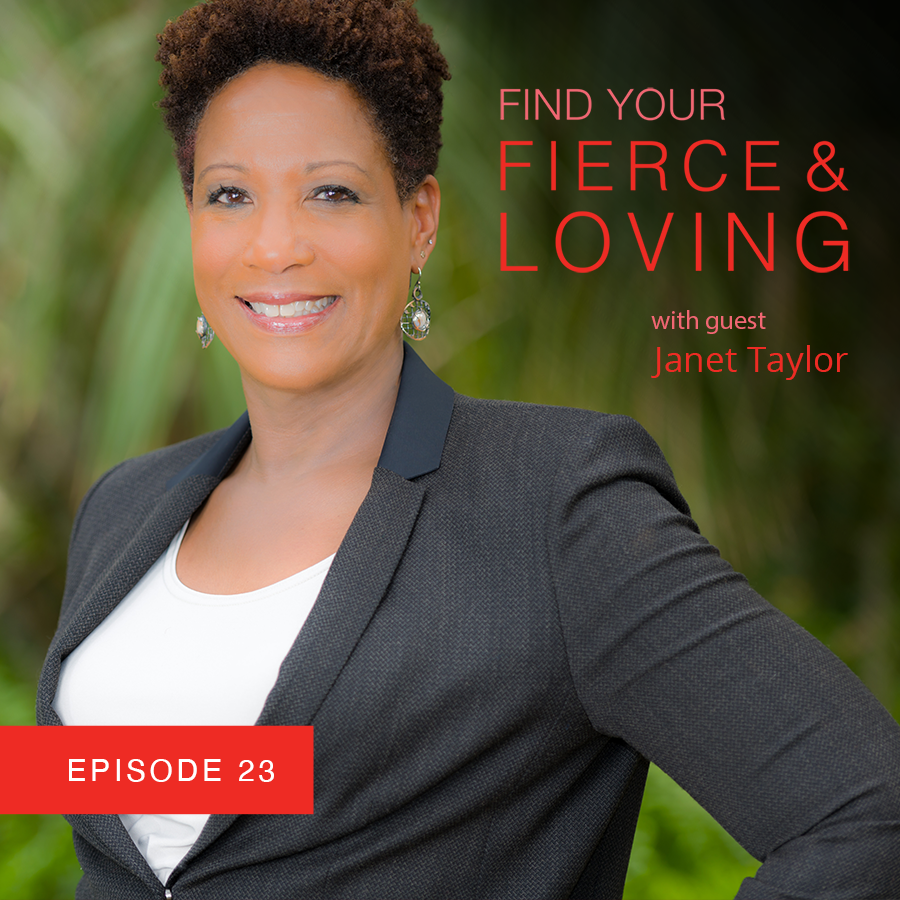
“When you move something from your unconscious to your conscious, it’s your responsibility to do something about it. Play in it, trudge through it, be uncomfortable in it, but try to come out with a more informed aspect of a belief that was false before.” – Dr. Janet Taylor
The idea of “self-care” is often seen as frivolous, selfish, or unnecessary. But self-care isn’t about manicures and bubble baths, it’s the ability to be aware of your own needs and prioritize your own well-being. For women, especially women of color, who are expected to care for those around them before themselves, self-care is a radical act and a tool for survival.
Show Notes
Dr. Janet Taylor is known as the “self-care doctor.” She knows the enormous benefits of modern medicine, but also sees the weaknesses of the modern medical model. When we have a model that doesn’t account for a holistic view of a person’s life and environment, we are missing so much of what they actually need to be well. Not only does the current model fail everyone through its narrowness, it fails Black people in particular with its entrenched racist ideas of Black bodies. The health of our communities demands a restructuring of how we think about care and health.
This week on Find Your Fierce & Loving, listen to the incredible insights on health and self-care from Dr. Taylor. She identifies the progress we’ve made in improving health, challenging conventions, and fighting racism, and lays out the path ahead.
- (03:32) – Resilience
- (09:45) – Self-care
- (15:34) – Medical racism
- (26:47) – Making the unconscious conscious
Dr. Janet Taylor is psychiatrist, self-care coach, entrepreneur, mother and lifestyle columnist, and has many coaching programs that are an integration of her years as a medical doctor, life coach, and mindfulness expert. She holds an M.D. from the University of Louisville, completed her psychiatric residency at New York Medical College and obtained an MPH from Columbia University’s Mailman School of Public Health in Health Promotion and Disease Prevention. Her book The Courageous Classroom: Creating a Culture of Safety for Students to Learn and Thrive, written with Jed Dearybury, will be released this July.
Do you want to unleash your inherent love and goodness, liberate yourself, and free humanity from the oppressive systems and structures we have created? We are here to support you in finding your fierce and loving life. Join us in Our Circle, a vibrant membership community rich in opportunities for engagement and transformation. Find out more at lolawright.com/our-circle.
You can follow Lola Wright, on Instagram, Facebook, LinkedIn, and Twitter and learn more about my work at lolawright.com.
Chicago born and built, Lola grew up in wealth and privilege, yet always sensed something was missing. She sought out aliveness and freedom in music, immersing herself in the hip hop and house music scenes of 90s Chicago. After finding herself on her own at 23, as the mother of two young children, she became determined to create a new experience.
Lola is an ordained minister with a gift for weaving together the mystical and material, she served for many years as the CEO of Bodhi Center, an organization committed to personal transformation, collective awakening, conscious activism, and community-building.
This podcast is produced by Quinn Rose with theme music by independent producer Trey Royal.
If you’d like to receive new episodes as they’re published, please subscribe to Find Your Fierce & Loving in Apple Podcasts, Google Podcasts, Spotify, or wherever you get your podcasts. If you enjoyed this episode, please consider leaving a review in Apple Podcasts. Your reviews help others find the show.
Transcript
Lola Wright (00:01): Personal transformation and collective awakening involve being the most alive, brilliant, inspired, creative, on fire version of yourself. A version that is not consistent with the status quo. My name is Lola Wright, and this is Find Your Fierce & Loving. This podcast is a wake up call, a roadmap back to your holy purpose, an invitation to set fire to the box you’ve been living in and watch it burn.
Lola Wright (00:40): I am so excited to have this incredible guest on Find Your Fierce & Loving today. Let me introduce you. Dr. Janet Taylor is a psychiatrist, self-care coach, entrepreneur, mother, and lifestyle columnist, and has many coaching programs that are an integration of her years as a medical doctor, life coach and mindfulness expert. Dr. Taylor holds an MD from the University of Louisville, completed her psychiatric residency at New York Medical College and obtained a master’s in Public Health in Health Promotion and Disease Prevention
Lola Wright (01:22): Dr. Janet Taylor has been seen on Good Morning America, CNN, The Dr. Oz Show, The Today Show, and many other spots. It is my great honor and privilege to welcome her to Find Your Fierce & Loving. Dr. Janet Taylor, I’m so happy you’re here.
Dr. Janet Taylor (01:39): I’m so happy to be here with you, Lola. How are you?
Lola Wright (01:43): Oh, I’m so good. So, one of the things you all should know about our relationship is that we’ve actually never… First of all, we’re legit friends. Lots of people on podcasts say they’re friends. We actually have cultivated a relationship, and we became pandemic friends, really through a brilliant woman that we share in common, Rhonda Brown. So, deep bow to Rhonda. And at the beginning of the pandemic, you and I facilitated a number of conversations around really being in relationship to crisis from a place of creativity.
Lola Wright (02:18): It’s like, how do we be brought to our knees and not have it take us out? And so, here we are 11 months later. And, I’m so curious. How is your world and how has that early conversation that we started, sort of from crisis to creativity, or from crisis to what are we living into, how has that unfolded for you?
Dr. Janet Taylor (02:41): Well, actually, meeting you and collaborating with you and just feeling your energy was a really pivotal point for me. And the sense of just knowing through all this pain and anguish and uncertainty, you can develop a friendship. You can become more creative. And, you can also learn how to accept where you are in a way that’s not Pollyanna, but really focus on… How do I keep learning the lesson I’m supposed to learn knowing that we can’t control so many factors outside of us, but just what do I have to do myself to deepen my resolve and to deepen my resiliency and to still have fun? That’s certainly been my mantra throughout.
Dr. Janet Taylor (03:19): I mean, we’ll get through this, but when the curtain lifts, when the heavens open up, we still need to be ready to attack whatever it is that we still want to attack. And, that’s kind of the mindset that I’ve maintained.
Lola Wright (03:32): One of the things I remember you saying the first time we spoke was in your work leading a Community Health Center in Florida, I said, “Well, how are your clients doing?” And you said very swiftly, “My clients are incredibly resilient. They have a lot of experience going through very challenging circumstances, and so there’s a way in which they’re actually prepared, perhaps better than those of us who are used to having significant degrees of comfort.” I’d love for you to riff on that for a minute. Because I think that’s like a big aha. I would say the vast majority of people listening to this podcast are likely enjoying significant degrees of comfort.
Dr. Janet Taylor (04:18): Yeah, and good for them, right? But, I think that the reality is, if you allow it, and certainly no one chooses to be under-resourced, or to be poor, or have to wonder where their next rent payments going to come from. But, there’s a certain grit that comes with that, and there’s also a certain thankfulness when things do happen. So, there always is this looking for the light at the end of the tunnel, and when you see the light, you have some gratitude. Everything I’ve learned, I shouldn’t say everything, but a lot of what I’ve learned in my life, I have learned from my patients who basically didn’t have anything, so to speak, but a kind word, but a how are you? Just observing them and their gratitude for whatever, their ability to make a dollar out of 10 cents.
Dr. Janet Taylor (05:09): Their knowing where to get what they need was something that I’ve certainly learned. During this pandemic… I mean, I have patients who are depressed or have a lot of anxiety who are like, “I’m good. I don’t need to go out and see anybody.” Or I have patients saying, “Now you all know what it’s like for us every day to feel this angst or whatever.” Then on the flip side, I work with patients who are addicted to drugs, to heroin and have had some overdoses. And because the jobs they had, which may have seemed menial to some in terms of washing dishes, sweeping floors, were gone. So, it really speaks to that need for structure, no matter what it is. I think the point, anxiety, stress, I mean, they don’t care what your zip code is.
Dr. Janet Taylor (05:53): But how you deal with it is… It definitely impacted by your own mindset, your own ability to certainly acknowledge and adapt and bounce back. That is an individual trait that can not be labeled by the color of somebody’s skin. It can’t be labeled by the neighborhood they come from, immigration status, gender identity, none of that matters. It’s how bad do you want it, and how tough, mentally tough can you be? Most of my patients are mentally tough. Do I wish more for them? Of course, I do. Do I wish they didn’t have to struggle? Of course, I do.
Dr. Janet Taylor (06:29): But at the same time, I mean, I’ve learned just so much about how to get up and keep staying up from many, many, many of my patients. I just have deep respect for them.
Lola Wright (06:39): One of the things that I think you and I really connected around was the notion of supporting people in their evolution, in their awakening, in their healing and holding a context of wholeness while doing so. As a trained medical doctor and psychiatrist, I think so much of the medical model is inside of people’s woundedness, brokenness, the sort of constant need to prescribe to a problem, which I’m like thank God for modern medicine, and there’s a context that we can hold around both ourselves and another, whereby, either I perceive you as fundamentally whole or fundamentally flawed. How has that informed your work?
Dr. Janet Taylor (07:32): There’s no question here. The medical model has really been one of a deficit if you think about it. We get reimbursed for identifying what’s wrong with you, for making a diagnosis. It’s not like, oh, you’re well, let’s check that box. You’re not going to get reimbursed for that or writing a prescription. That is needed. Certainly when people come to you, you need to be able to identify what is wrong with them, but at the same time, we have not been trained enough to help people identify their strengths and what is right with them. Or, identify it’s not that their Diabetes is out of control because they don’t care about themselves or whatever, but they can live in a neighborhood where you can’t find fresh food.
Dr. Janet Taylor (08:09): They could live in a neighborhood where you have to pay $10 for something organic or fresh vegetables. It’s understanding the whole determinants around how they came to you. Some of that has nothing to do with what you can prescribe, but you understanding what they need. What do I mean by that? So often, we’ll write a prescription and give it to people. They may not have health insurance, or if they do, their copays may be too big. That means we’re writing a prescription. They’re leaving. We don’t even know if they can afford it or not.
Dr. Janet Taylor (08:37): So, you have to ask, “Are you going to be able to pay this copay?” A lot of times we tell our patients, don’t take your medication unless you have food. Some people don’t have food. It’s really understanding all of that. That involves looking at somebody as a whole person, but it also means you have to take more time. And, dealing with the populations that I do and many poor under-resourced communities, if you don’t have the time to ask those questions, then you’re working with the wrong population. So, it’s not about checking them and labeling them, stereotyping them.
Dr. Janet Taylor (09:11): It’s about looking at our own biases, our own thoughts, our own assumptions, and understanding how that meets wherever the space is now, whether it’s telemedicine, or whether it’s in the space of an office, or in an emergency room, and saying, this may be your only opportunity to capture this individual, and to make sure that, when they leave here, they’re better off than when they came. And, it’s our duty to do that. For people who can’t or don’t care, or feel like it’s their will, or they have to pull themselves up by their own bootstraps, that’s wrong. I think it’s just wrong.
Lola Wright (09:45): You’re known as the self-care doctor. In some circles, you might hear, “Oh my gosh, the conversation of self-care is such a privileged conversation.” I always like to flip those assumptions also. As someone who was a young mother, spent a number of years on welfare, self-care was really a very radical act. And, it actually was sort of a tool for my own survival and enabled me to… Audre Lorde talks about self-care as an act of political warfare.
Lola Wright (10:21): I think what’s so interesting about the work that you do is you straddle so many spaces, right? You’ve lived or had proximity to so many extreme worlds. How did you arrive on self-care as a value and as something that you say I’m here to assert?
Dr. Janet Taylor (10:45): Well, I mean, certainly as women, we know that we often will put ourselves last. One of my passions is talking about mental health and wellness with women, in particular women of color. You can’t have that conversation without looking at our own self-sacrificing and understanding and helping women understand it’s okay to say no. One of my favorite sayings is no is a complete sentence. I love Audre Lorde and what she has said so much about identity but also about self-care and the importance of that.
Dr. Janet Taylor (11:22): It’s not self-indulgence. It’s self-preservative, and that’s an act of political warfare. Being able to get women, especially women of color, to take off their superwoman cape without guilt, without shame, show up for their mammograms, take care of themselves, getting their pap smears, talk to their doctors about their mood, tell their husbands partners, kids no, and creating that space for themselves is difficult.
Dr. Janet Taylor (11:48): In addition, being a woman of color in America, we’re so often, in particular Black women, if they do speak up for what they need, they’re considered loud or angry or just all this negative connotation. Like how do we take that back and change that narrative to one of, you need to take care of yourself? Even now, in this time we’re in, Lola. I mean, there has never been as crucial a time for individuals to know themselves and what they need and figure out how to do it so that they can shut out the external noise and really understand that thinking and being positive is an inside job.
Dr. Janet Taylor (12:25): It is strictly up to you because there are so many people right now who are worried about other things and not focused on taking care of themselves. Self-care, it’s a right. It’s necessary, and why do we have to wait until we’re 80 to realize all those things we should have done for ourselves? It’s not about being able to go to a spa. It is about being able to just relax wherever you are without guilt and do what you want to do. If it’s read a book. If it’s do nothing. If it’s have a glass of wine. Whatever it is, you need to take care of yourself and your soul because nobody else is going to do it.
Lola Wright (13:06): One of the things that you talked about is the importance of mental health and taking off the superwoman cape. I also think that there’s a lot of… I’ll just say for those of you who… I don’t even… I’m like, do I really want to go down this rabbit hole? But, for those of you who are familiar with the Enneagram, Lola Wright is an Enneagram 8, which you know is said that either we will be the CEO of a company, or we will be incarcerated because whatever we do, we go all the way. Very little is done in moderation.
Lola Wright (13:41): The core emotion for the Enneagram 8 is anger, and the body gesture looks like that of a Sumo wrestler. So, power, strength, control. I’m always scanning for that in a room. Who has the power? Who has the strength? Who has the control? Because that’s how I can sort of… It informs my sense of safety and security, right? All of this is inside of our self-awareness, whatever tools you use. For me, I have had to really unravel that exposing my vulnerability is not bad. It’s not a problem. It’s not like a sign of weakness.
Dr. Janet Taylor (14:25): It’s a sign of strength, because when you open… You know you’re strong, Lola, right? You know you can handle whatever comes your way, but when you allow yourself to be open to all of your emotions, including feeling vulnerable and including whatever it is, there’s a power there because it allows you to just wait in it and then make your own decision. So often, when people just come from this sense of anger or frustration, then it limits their ability to make a different decision.
Dr. Janet Taylor (15:00): That’s just the way our brain works. I mean, our brain functions in a different way when we’re constantly stressed or angry or focusing in one direction. The reality is there are many ways that you can go and being open and accountable to yourself, no matter what happens. Not saying that it’s always going to turn out the right way, but at least you looked at it from a different lens. Then, that is certainly, I think, a big lesson for where we are right now, in the sense of we can’t do things the way we always did.
Dr. Janet Taylor (15:29): Does that mean we do nothing? No, that means we adapt and do it another way. There’s a power in knowing how we always are, but there’s another power in challenging ourselves to say, “Well, what if I did it this?” Or, maybe I can look at it this way. And then, seeing how people react to you, seeing how the world reacts to you, and then using that as almost like a toolkit because there are times that we need to be angry. There are times we need to stand up for things, but there are also times when we can have our power in our silence which doesn’t make us any less, observant any less but really can help us as we really kind of galvanize and choose what we want to say or do. And then, just go from there.
Dr. Janet Taylor (16:15): I think, when you look at older people, a lot of them have found that they don’t have to react. They can listen. When you go back to them, like they have taken it all in, but then they are choosing how they want to be, and there’s power in that as well.
Lola Wright (16:30): Think about like our social conditioning around mental health. Can you talk about that a little bit? It’s like, it seems that there are communities that have been sort of given permission or access to mental health services in an empowering context, and then there are communities that have… I mean, we can talk about medical racism, for example. Just to put it out there, it’s like, if the history of your people or your family is such that a medical model has violated your personhood, then when I look to the medical model, I don’t feel encouraged. I mean, you identify as a Black woman. You also are a medical doctor. How do you navigate all those spaces?
Dr. Janet Taylor (17:20): Yeah. I mean, if you look at the history 400 years ago when Africans were brought here against their will to justify slavery, scientific racism started. To justify slavery, this erroneous notion that the color of your skin made you inferior to someone else and this myth of white supremacy evolved. We know that structural racism and structural racialization is at every level of every system, including medicine. For Black people, who we are has been used as pathology and continues. I mean, there’s racism and bias in medicine that continues, especially in mental health.
Dr. Janet Taylor (18:01): What do I mean? We know that there are Black boys who can do the same thing as white boys in a class and Black boys are suspended at seven times the rate.
Lola Wright (18:10): I can just be like, hey, as a mother of a mixed race Black son, I can tell you that is my experience. That is not just theory. I have literally seen that.
Dr. Janet Taylor (18:21): It’s true, and Black girls are suspended at six times the rate. If the behaviors are the same, then why do we say somebody gets a pass because they’re white, but somebody else gets suspended, is out of class, or maybe even get arrested or pepper sprayed. Like the little girl in Rochester, New York. Nine police officers for a nine-year-old, pepper sprayed, handcuffed. I mean, that is happening to our Black kids every single day, and that goes back to, rooted in slavery, where Black people were not as smart, as inferior, had a higher tolerance for pain, needed to be controlled.
Dr. Janet Taylor (19:00): Even now, if you look at who’s prescribed ADD or ADHD medication, or who’s more likely to be diagnosed as having ADD and ADHD, it’s Black boys. Not to say that ADHD and ADD aren’t real. I mean, my own daughter has ADD, but the fact is Black boys are more likely to get over-diagnosed when maybe they don’t have the right food. Maybe they’re drinking, eating too much sugar. Maybe they’re not getting sleep.
Lola Wright (19:27): Or maybe, there’s an assumption walking into the interaction about how they’re going to be. And then, as my oldest children’s father always said to me, “If you go looking for something, you will find it.”
Dr. Janet Taylor (19:39): The key is to find it, but sometimes finding it is not a diagnosis, a pathological diagnosis but understanding if you have, let’s say five people living in a one-bedroom apartment and Uncle Joe wants to stay up and watch TV. Meanwhile, little Johnny has to go to school, and little Johnny’s like, “Can you turn off the light?” And uncle Joe’s like, “F you, I’m not turning off the light.” Kids aren’t sleeping. Some kids are sleeping on chairs and don’t have beds. So, when they come to school, they’re tired or they haven’t eaten the right food so they may be acting out.
Dr. Janet Taylor (20:10): There’s all these other factors that don’t mean that there is something necessarily wrong with them, but we have to look at a system. When we talk about mental health, we know that if… Let’s say Dylan Roof kills nine, ten Black people in South Carolina, and he is taken to Burger King on the way home, I mean, on the way to jail. Then, we’ll be given the benefit of the doubt in terms of some psychiatric diagnosis. Whereas if a Black young man killed nine white people… A, he’s not going to Burger King. He’s going to be lucky if he made it alive out of the church, and certainly he’s not going to go get a psychological assessment. He’s just going straight to jail.
Dr. Janet Taylor (20:50): There definitely are disparities looking at how people are evaluated based on the color of their skin. Does that make people of color more resistant to going into a system that is inherently racist anyway and then wondering what they’re going to be diagnosed with? We know historically, Black people were more likely to be diagnosed with Schizophrenia, whereas they may have been depressed or Bipolar. We know today, a Black woman will go and see her primary care doctor 10 times before the doctor will ask about her mental health.
Dr. Janet Taylor (21:22): We know that there are Black women who have had sons or daughters who were murdered and been told by Black doctors, even like, you’re okay. You’re strong. Meanwhile, they’re depressed. I’m saying that to say that it’s not just that white doctors are assuming that we Black women, women of color, may not be depressed. But the fact is, all around, whether it’s implicit bias or just flat out racism, we have a system that is not geared towards looking towards strengths and certainly pathologizes what it means to be Black or Brown in America. Hopefully that is changing. We’re moving from cultural competence, where it’s, you know, you what the language, you have an interpreter to cultural humility, where you are aware of your own biases as a provider. You’re aware of your systems biases as a provider.
Dr. Janet Taylor (22:15): You actually talk about the interaction and what needs to happen in a way to improve an outcome and hopefully to lessen the dangerousness that happens when the bias and racist behavior and thoughts happen in medicine. That’s something that certainly is ongoing. The last thing I’ll mention is COVID-19, where Black and Brown people made up 13% to 14% of the population, but 30% to 40% more likely to die, and in some cases, 50% more likely to die.
Dr. Janet Taylor (22:51): Does that mean that there’s something wrong with us? No, we have to look at the system. You had Black people working and Brown people working in hospitals where they couldn’t even get a COVID test or get treatment. 70% of essential workers are women and people of color who were exposed, who couldn’t afford to work from home, couldn’t afford to take a day off and then exposed to COVID-19 and have to bring it home to their family. I mean, it’s really just, in broad daylight, just brought out the flaws inherent in how people live in these systems and hopefully is an opportunity to rebuild these systems and to look at exactly what has happened.
Lola Wright (23:30): There are a lot of people that listen to this podcast that may be coaches, that may be healers of some kind. I would say, there are a lot of listeners who are very plugged in to this conversation of inequity and injustice. How do you be with all that you just said and not lose your mind? I mean, how do you take care of yourself? You’re someone who worked at Rikers Island. You’ve been in like the bowels of injustice in this country. How do you hold the space of possibility in all of that?
Dr. Janet Taylor (24:14): Yeah. So, I read a lot about the history, our history for Black people, read a lot about biographies about Black women, especially, and really look at people like Fannie Lou Hamer, Harriet Tubman, Sojourner Truth, who had it a lot worse than I did but still were able to maintain that hope and not only maintain that hope, their goal was to make it better for other people. So, I think it really speaks to having your own individual purpose constantly. Again, knowing that I didn’t create racism. I didn’t create implicit bias, but I do my best to understand it, and wherever I can interject and make a difference, I do.
Dr. Janet Taylor (24:55): I have a lot of gratitude for where I am in life. I have gratitude for when I am successful, for when I fail, but really look at, especially now where it’s not just people of color who are kind of banging the drums about what the fundamental change that needs to happen here that other people are listening. So, I’ve made it my goal to at least, using evidence, not to blame, not to make people feel guilty, but to hopefully help people understand the dynamics of our history, the dynamics of where we are now, so that they can make a more informed decision about how to interact with the other.
Dr. Janet Taylor (25:32): Doing that from a lens of neuroscience, and certainly looking at the reality of the brain, but also, the reality of your own mindset and your own self determination to be different in this world. I think it’s a real opportunity to create a new humanity moving forward because post COVID, this world is going to be different in a lot of ways. How we work, how we live, how we love, how we play. Why can’t it also be different in how we relate to other people which means extend yourself. Say hello. A red MAGA hat may create a sense of threat in you, but if that person needs you to open the door for them or looks you in the eye and says, “How are you?” Respond.
Dr. Janet Taylor (26:18): The same thing. You see a young man in a hoodie, just because he’s wearing a hoodie doesn’t mean he’s a threat. Look in his eyes and say hello. It’s just a common kind of courtesy that I think can help as we really try to create a new paradigm which needs to happen because what’s happened the last 400 years is definitely not going to happen the next and unsustainable. I think we all, every single one of us, has been presented with an opportunity to make a fundamental shift, but it’s going to take all of us. I’m hopeful. I remain hopeful that things will be different.
Lola Wright (26:57): You want to be more alive. You want to unleash your inherent love and goodness, liberate yourself, and free humanity from the oppressive systems and structures we have created. We are here to support you in finding your fierce and loving life. Join us in Our Circle. This is an affirming and radical space that will gather weekly, on-demand or live, whatever works best for your life. For more information on how you can engage in Our Circle, visit lolawright.com/our-circle. I’d love to have you with us.
Lola Wright (27:41): You have decades of work under your belt. You’re not new.
Dr. Janet Taylor (27:47): If you’re saying I’m old. I’m old, yes.
Lola Wright (27:49): I’m just saying, you’re not new to the human condition. But, something has shifted in your work more recently. You have made a more explicit assertion around race and racism in your work. Why did that shift take place?
Dr. Janet Taylor (28:11): Ever since I was little. It goes back to when I was little. I was born in Chicago, but my grandparents were from Kentucky. I remember I was like an eight and nine year old being like my grandparents when they went to see their doctors, and these young white doctors would call my grandparents by their first names. I always, even today, I never call my patients by their first name, unless they insist. They could be homeless. They could be incarcerated, whatever. I have some respect for them. Out of that, certainly as I got into medicine, was noticing certainly just the balance of power, the balance of authority, especially when doctors are white, patients were Black, just how that was.
Dr. Janet Taylor (28:53): How to improve the doctor-patient relationship has been something I’ve always worked on which has led to certainly knowing more about racism. But frankly, like with what’s been going on in the past, in terms of anti-racism, definitely the past two years and just soaking it up in a way that now we can really look at knowing that racism is not really about race as much as it is about power and resources. But, more importantly, how can we change that? How to find an anti-racist approach? How to understand implicit bias is one I think that kind of ties in nicely with the brain and the work I’ve been doing.
Dr. Janet Taylor (29:34): With the murder of Ahmaud Arbery and Breonna Taylor, George Floyd, and we go back to Eric Garner, Sandra Bland. I mean, certainly working in… I’ve worked in many jails and look, in there, you definitely see just how skewed it is. But, it just all has come together with understanding the context of history, the reality of where we are, but more importantly, what can we do to help people understand how to mitigate bias, how to identify microaggressions, and this need for all of us to stand up and do something differently.
Dr. Janet Taylor (30:06): So, it’s kind of all culminated in a lot of work that I’ve been doing with corporations. I know in companies looking at systems on racism, anti-racism, and allyship and again, from an evidence-based lens. I still have work with my community-based mental health and then do that. So, it’s been full, to use your words but really, really, really rewarding. I am learning more and more every day because this is not new really in terms of our condition. But, I think it’s a real… There’s a different listening that’s happening and different action. White people are looking at and saying white privilege.
Dr. Janet Taylor (30:50): Looking and able to I think are able to wince and hear about white supremacy but really trying to do something different.
Lola Wright (30:59): I mean, it is fascinating. If I had said white supremacy five years ago, three years ago, people would have been… People were up in arms.
Dr. Janet Taylor (31:08): Even Black Lives Matter. You couldn’t say Black Lives Matter a year ago without people saying blue lives matter, all lives matter, which they do, but now we’re looking at 400 years when Black lives did not matter, the Black body did not matter. Even, I mean, if you look at today, Dr. Jennifer Eberhardt wrote the book Biased. Black and white police officers see Black skin as a weapon, as a threat. How can we change that? This really looking at the reality of, whether it’s racial inequities. If we look at how Black and Brown people die earlier, the wage gap, and really quantitating that, saying like, we have had a problem for 400 years, but what steps can we do to really change it?
Dr. Janet Taylor (31:56): So, it’s exciting, right? It’s still painful. But, I think there’s lots of opportunity just to educate and inform and really get people towards action.
Lola Wright (32:07): Yeah. There are many great scholars that have said something similar. We could say it’s a Jungian philosophy. James Baldwin wrote prolifically about it. This idea that like, if we’re unwilling to deal with our unconscious. If we’re unwilling to deal with the underbelly or the shadow, if you will, expect that, that will be pervasive. I, too, am optimistic about this moment in the evolution of humanity because I feel like that which we have collectively, certainly there have been segments of the population that have been very willing and ready to explore this, but there’s something that’s tipping, I think, in terms of collective consciousness that has come forward.
Lola Wright (32:56): Despite the discomfort, I just personally have never done any healing work that’s been like rainbows and unicorns. That has not been my experience. All the deep healing work that I have done has been fairly guttural, has required that I go through lots of shadow spaces in my psyche and my subconscious. I just want to encourage people that like… I consider myself a metaphysician, one who looks beyond the literal. So, there’s the condition that we’re seeing right now, which is really just the out-picturing of a world of unconscious agreements that have been woven together, and it’s being exposed at a global level. In spite of the discomfort, this is good news.
Dr. Janet Taylor (33:47): It is. It is. Not to sound too Pollyanna, I mean, we still have a lot of work to do. I mean, it’s because research shows, no matter how woke, and I don’t really like that word, how woke people are, 50% of white people feel, when you talk about equity, they still feel like you’re taking something away from them. So, there is still work to be done. But, I love what you said about really challenging these unconscious agreements because now hopefully they’re conscious. When you move something from your unconscious to your conscious, it’s your responsibility to do something about it. So, play in it. Trudge through it. Be uncomfortable in it. But, try to come out with at least a more informed aspect of something that…
Dr. Janet Taylor (34:27): A belief that was false before that you know not to be true well make it true in a way that benefits you. Make it true in a way that elevates it to something sacred because it’s right versus just going along with everybody else.
Lola Wright (34:41): This podcast is titled Find Your Fierce & Loving as really an invocation to call people into the discomfort of their bigness, their boldness, their aliveness. In my experience, when people say yes to their purpose, it’s not a straight path, and it is often not met with a party. I imagine that, that’s true for you, that there have been times on the journey of you saying yes to the most expansive version of you that you were met with ridicule, with cynicism, with criticism. Is that true? And how did you move through it?
Dr. Janet Taylor (35:23): Yeah, absolutely. I mean, the fact that as you’ve moved through and don’t believe your own hype. I think that there’s always someone who wants to pull you down. I don’t get into all that. I mean, I really don’t feel like… I mean, I reflect and I listen, but I don’t get into situations where I feel like I have to defend myself. The only way to do that is I’m not perfect by any stretch, but at least if I know I’m trying to move in authenticity and truth, that’s my truth. So, you’re either with me or against me, but I have lost trying to bring people along in terms of having to be on my train, because I know like what I’m doing.
Dr. Janet Taylor (36:07): I just, like Teflon, let things roll off, because there’s… Invariably, I mean, there will be someone who supports you. The fact is, you can disagree with me and still not tear me down. The people I surround myself with are people who are independent thinkers. We may not always agree on things, but I know they still have my back. And, that’s the opportunity that we have, I think, as individuals flowing through this, this life we have.
Dr. Janet Taylor (36:41): You mentioned the coaches and healers, and I just want to say thank you all for trying to elevate, whether it’s physically, whether it’s metaphysically, whatever interjection you can make in someone understanding themselves better. Thank you. We need you. But, I mean, again, I really feel like, Thich Nhat Hanh, said, “If we can inherit the color of our eyes, the way we walk, our hair, then we also inherit our trauma.” I think this is a time when the universe is really allowing us to heal our own trauma and our ancestors’ trauma.
Dr. Janet Taylor (37:22): It’s just a critical opportune time that we just create this shift about how we relate to the other in a way that you are more like me than not like me. That’s a conscious part of it. There are times, especially being in Florida, where you see it, and sometimes you could literally cross the street and have people who say hello, like literally everybody does, and cross the street and you see people who won’t even look you in the eye. I think that there’s just that opportunity to continuously, day after day, minute after minute, just try to achieve that connection.
Dr. Janet Taylor (37:59): Again, it’s not like you’re polar opposites and you have to come to where I am but at least let’s take some steps. I really think that, that’s there. We have to constantly teach our children to do that because I think they’re the ones who are really going to benefit. But, just be determined to look at the world, not just again, like, oh, everything’s great. I mean, there’s a reality, but just with what … How you see things is how they will be seen. Just this notion of, I want things to be better, and I’m going to look at things in a positive way.
Lola Wright (38:33): Janet Taylor, how best can people find you and connect with you these days? Because I know there will be those that are like, who is this woman? I can hear my mom in my ear. My mom has already met you, but I can hear her in my ear like, “I have to get Dr. Janet on my board.”
Dr. Janet Taylor (38:49): Yeah, no. I’m on Instagram @drjanet. My website is drjanettaylor.com. I have a new book that is available for pre-order on Amazon. It’s called The Courageous Classroom: Creating a Culture of Safety for Students to Learn and Thrive which really is for educators and acknowledging trauma, fear, their successes, what educators bring to the classroom, what our children bring to the classroom, and how we can create a landscape of calm in those spaces. So, The Courageous Classroom on Amazon. I have a great co-author Jed Dearybury who is phenomenal.
Lola Wright (39:22): How did the two of you hook up?
Dr. Janet Taylor (39:24): Through the publisher. I’m not an educator. Jed is. He’s gay, has had his own trauma, teacher of the year, a phenomenal teacher but is very open. So, it’s like my at portions of the book are kind of straight the research evidence, and Jed brings to life with amazing stories that will make you laugh and make you cry. So, it’s a nice combination.
Lola Wright (39:46): Awesome. Well, congratulations. Thank you for being with us. Yeah, I just look forward… I know we’ve set an intention like, we don’t know what we’re going to create together, but something will be created and so we just keep showing up, and I’m grateful for that.
Dr. Janet Taylor (40:05): Thank you for showing up because your words… You have a way.
Lola Wright (40:09): If you enjoyed this show and would like to receive new episodes as they’re published, subscribe wherever you get your podcasts, and consider leaving a review in Apple Podcasts. Your review helps others find this show. You can follow me at Lola P. Wright on Instagram, Facebook, LinkedIn, and Twitter, and learn more about my work at lolawright.com. This episode was produced by Quinn Rose with theme music from independent music producer, Trey Royal.
Lola Wright (40:58): I have the experience between the five other humans I live with and the two small dogs that demands are constantly being made. They’re not always like massive demands, but they’re just chronic or perpetual. I need this. I need that. I want that. And, I’m like aah.





Leave A Comment