
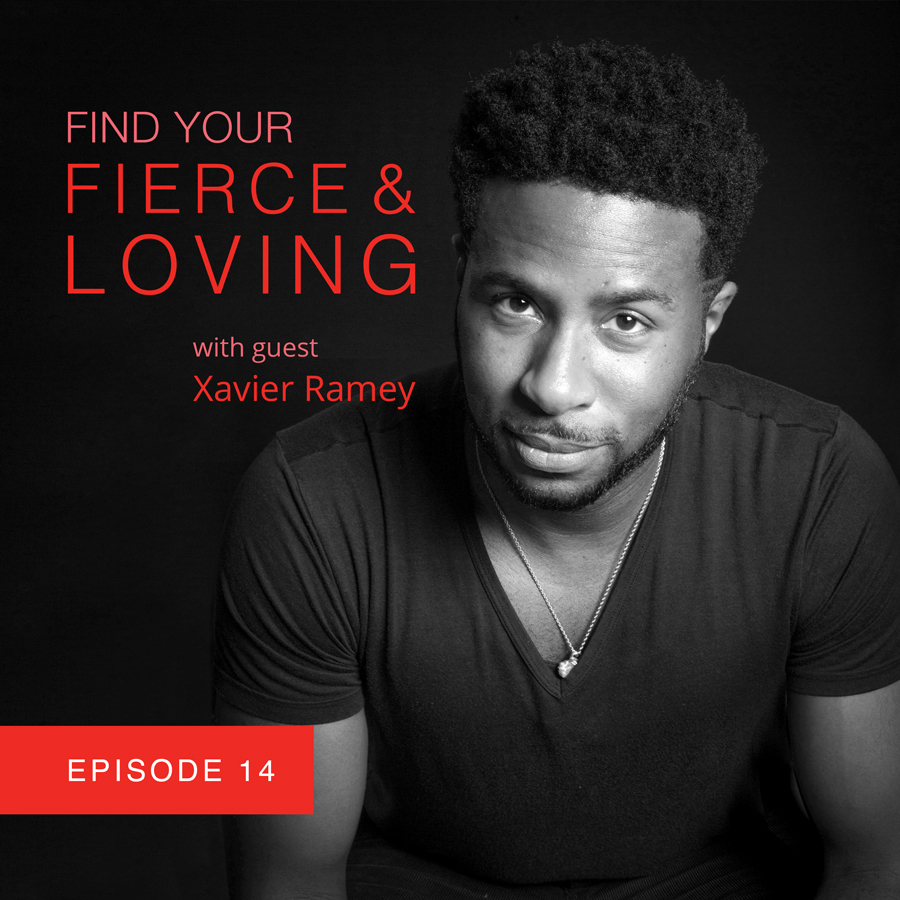
“Love is not simply a quiet acceptance and cherishing of one another. Love is strength.” – Xavier Ramey
The amount of pain that you want to fix in the world is very different than what is possible to do as a single human being. That’s an essential lesson that Xavier Ramey—speaker, social strategist, and the CEO of the social impact consulting firm Justice Informed—has seen people struggling with over and over again. As an activist leader whose work is rooted in his Christian faith, he knows the importance of a spiritual foundation in order to best serve yourself and your community.
Show Notes
We all have the desire to make a difference, whether that’s in ourselves, our communities, or in the world. However, the path to making that impact can seem insurmountable. How do we turn this want into an understanding and a willingness to do the required work, without hurting ourselves in the process?
On this week’s episode of Find Your Fierce & Loving, we take a dive into what a fierce and loving life looks like for a social consultant and community activist. There is a lot of passion in the social change space, but there is also a lot of burnout and idealism that becomes naivety. Xavier Ramey is dedicated to doing the work to pull his own life into alignment, and to teaching others how to do the same. We talk about his leadership philosophy, how to keep your life in alignment, and the bravery of loving without fear in this vital episode.
- (3:21) – Living life on purpose
- (11:27) – Spiritual grounding
- (21:06) – Wanting vs. willing
- (28:25) – Living a life aligned
- (31:35) – Leaving home
- (35:26) – Invocation from humanity
Xavier Ramey is the CEO of Justice Informed, a social impact consulting firm based in Chicago, IL. He is an award-winning social strategist, noted public speaker, & conflict mediator. Combining his background in economics, extensive management & social impact experience, & direct action campaigning in the Black Lives Matter movement, Xavier leads a company that brings a wealth of experience & network to clients seeking catalyzed strategies for inclusion, philanthropy, CSR, & community engagement. A native Chicagoan, he is a recognizable voice on the topics of community and economic development, policing & policy violence, & connecting the Christian faith to our lived experience. Through his leadership at Justice Informed, Xavier has consulted dozens of institutions on their DEI, community engagement, and philanthropic strategies, served as an advisor to Fortune 500 executives, provided strategic social impact guidance on multi-billion dollar business acquisitions and impact portfolios, led Masterclasses at top ranked graduate programs in business and executive communications, and has delivered keynotes across the world, including the TedX stage as well as before audiences of 20,000 people alongside world leaders on the topic of global equity and change.
Do you want to unleash your inherent love and goodness, liberate yourself, and free humanity from the oppressive systems and structures we have created? We are here to support you in finding your fierce and loving life. Join us in Our Circle, a vibrant membership community rich in opportunities for engagement and transformation. Find out more at lolawright.com/our-circle.
You can follow Lola Wright, on Instagram, Facebook, LinkedIn, and Twitter and learn more about my work at lolawright.com.
Chicago born and built, Lola grew up in wealth and privilege, yet always sensed something was missing. She sought out aliveness and freedom in music, immersing herself in the hip hop and house music scenes of 90s Chicago. After finding herself on her own at 23, as the mother of two young children, she became determined to create a new experience.
Lola is an ordained minister with a gift for weaving together the mystical and material, she served for many years as the CEO of Bodhi Center, an organization committed to personal transformation, collective awakening, conscious activism, and community-building.
This podcast is produced by Quinn Rose with theme music by independent producer Trey Royal.
If you’d like to receive new episodes as they’re published, please subscribe to Find Your Fierce & Loving in Apple Podcasts, Google Podcasts, Spotify, or wherever you get your podcasts. If you enjoyed this episode, please consider leaving a review in Apple Podcasts. Your reviews help others find the show.
Transcript
Lola Wright [00:00:01] Personal transformation and collective awakening involve being the most alive, brilliant, inspired, creative on-fire version of yourself. A version that is not consistent with the status quo. My name is Lola Wright and this is Find Your Fierce & Loving. This podcast is a wake up call, a roadmap back to your holy purpose, an invitation to set fire to the box you’ve been living in and watch it burn.
Lola Wright [00:00:40] All right, beautiful beings. I am so very excited to join you on today’s episode of Find Your Fierce & Loving. I have a brilliant human being with me today. I’m gonna share a little bit about him and then we’re going to jump in. Xavier Ramey is the CEO of Justice Informed, a social impact consulting firm based in Chicago. He is an award winning social strategist, noted public speaker, and conflict mediator. Combining his background in economics, extensive management and social impact experience and direct action campaigning and the Black Lives Matter movement, Xavier leads a company that brings a wealth of experience and network to clients seeking catalyzed strategies for inclusion, philanthropy, CSR, and community engagement. A native Chicagoan, Xavier is a recognizable voice on the topics of community and economic development, policing and policy violence, and connecting the Christian faith to our lived experience.
Lola Wright [00:01:50] I think one of the things I’m most drawn to about you is you have managed to live a really rich life on purpose. You know, like many of us sort of assimilate to society and organize ourselves around the accumulation of wealth, the accumulation of status, the, you know, like whatever the measuring sticks are of where we come from or what our society calls for. And certainly, you have accomplished many, many notable things but more than any of the accolades, it seems to me that the work you do in the world is highly aligned to your soul. Does that feel true?
Xavier Ramey [00:02:42] Yeah, it’s probably the only way I get through all of it.
Xavier Ramey [00:02:48] It’s impossible.
Xavier Ramey [00:02:50] Can you imagine if the planets weren’t in balance, but they were still spinning, I mean like who can manage all of the things of the world like that that we all individually manage?
Xavier Ramey [00:03:02] So balances keep alignment is key. But I’ll also say that that’s an intentional practice that took several years, one to even identify, two to organize, and three to actually engage in. So you came into my life and many people that I think that are seeing me now are seeing the product of a lot of deliberate internal work. And that’s dope, that’s awesome. But that’s also what allows me to, you know, float through a lot of these different worlds and spaces and different industries and sectors and such, while still maintaining my sense of personhood and a little bit of that West Side, North Lawndale swag too.
Lola Wright [00:03:35] You do that well.
Xavier Ramey [00:03:35] Absolutely. That’s the Leo in me coming out. Sorry about that.
Lola Wright [00:03:39] All is welcome here.
Xavier Ramey [00:03:42] Word.
Lola Wright [00:03:43] I’ve watched you as a real leader and as a, like a North Star, if you will, which I’m sure comes with a ton of pressure, because I’m certainly one of many doing that. And I’m curious, like, how have you managed to go through all the peaks and valleys of the last 10 months and maintain your well-being?
Xavier Ramey [00:04:10] When I think back to when I most fell off balance this year, it was shortly after the shelter in place was announced and before George Floyd was killed. And I felt off-balance because I knew I could…
Xavier Ramey [00:04:30] It’s weird, you know, something’s coming.
Xavier Ramey [00:04:33] Like, you just, you can feel it when you are in tune with the world and you know how people are, you know what they kick the can on and how you can’t, you can’t just keep postponing change.
Xavier Ramey [00:04:47] You also know the fragility of our alliances as people to one another, as communities, to one another, as ourselves, to ourselves. The promises we make to ourselves about how we’re going to change in the future that we don’t actually do and time, time comes up. I could feel something coming.
Xavier Ramey [00:05:07] And I shut everything down.
Xavier Ramey [00:05:10] I stopped doing business development. I stopped hiring. I faded off all of our existing clients and just was like, I’m about to go underground a little bit. I went into a space that I called the dark room because I knew that I could, I could just feel it. Something is coming. And it’s interesting when, you know, a wave is coming and you have to make that decision while you’re in the water. Do you know how to swim for that wave?
Xavier Ramey [00:05:37] It’s not like the waves back onshore but like, do you know how to swim the wave you see? Or do you know how to swim the waves of the body of water you’re in? And so I could also tell that I was not equipped.
Xavier Ramey [00:05:49] It was very, very clear to me I felt it in my heart, I felt it in my spirit. I started asking people questions about what you’re saying are very, very humbling, and congratulatory things, but I started asking very pointed questions to people around me who I trusted about my character, about my integrity, about my work, about who I was. And I was asking them about things that I knew I had not yet gotten aligned. And they were honest with me and that sent me into that dark room to get realigned.
Lola Wright [00:06:15] Wow. I want to just, like, pause there, because I think that is a practice that is of such great service to all human beings.
Lola Wright [00:06:24] And I would say far fewer human beings have a willingness to get sober around who we are, where we are. So I just have so much appreciation for your willingness to seek that out. Because most of us prefer to live in sort of like a delusional concoction of self.
Xavier Ramey [00:06:47] Yeah, well, you can’t react to a tsunami, you have to respond. When I feel something that’s like in my heart when I feel something spiritually that I feel is so great that it stops me it’s because I’m feeling a tsunami. There are a lot of waves that I just take to the face.
Xavier Ramey [00:07:05] I’m just just like, no, I’m not changing. I’m not stopping for this. I’m not going to reorient or I’m not getting sober or whatever.
Xavier Ramey [00:07:11] I’m not I’m not, you know, I’m not outside of the human gene pool on that one. But for things, and I do think preparation is key for continuity and sustainability and survival. I know that I’d had to learn this this year. I learned I got a big lesson in it this year, but I kind of had an inkling of it previously but now I know it is a part of who I am. People are watching me. People are watching me.
Xavier Ramey [00:07:36] Like I did not realize how many folks are watching me.
Lola Wright [00:07:41] Oh yeah. My mom now follows you on Facebook and cites you with some level of regularity.
Lola Wright [00:07:46] And I’m like, “How do you know Xavier?” She was like, “Well you shared his stuff!” and my mom will friend you in like a nanosecond.
Xavier Ramey [00:07:57] Yo, Lola it’s wild. It’s wild because you just like doing your thing and you don’t want, 1. you don’t know how much is resonating. 2. The value of and this is like more of a business kind of a business side of it, but like in this day and age, transparency, vulnerability is the measure of organic growth.
Lola Wright [00:08:15] Yes.
Xavier Ramey [00:08:15] And so for me, just like shooting the shit on Instagram, like people like, they watch. I’m like, what I’m just like talking about my frustrations with the intersection of white supremacy, heteronormativity, capitalism.
Xavier Ramey [00:08:28] Like y’all really in on this? Like I really want to do this for IG story for like ten stories in a row? Like y’all really sticking with me? Like this is going on in my brain or like, you know, these are some problems I’m having with some clients right now that I won’t name,
Xavier Ramey [00:08:43] but dang, I feel like this is symptomatic of a lot of situations. This… last year was the year I became Big Bro to a lot. I don’t even know how many young guys were watching me and they started just calling me Big Bro in the social impact sector. Like I didn’t even know I was laying track. I didn’t know I had footsteps. So I don’t know… maybe that’s just being 35 and 15 years into social impact work and you just realize, like you’ve you’ve… Like I said to you before we started, you know, it’s been, it’s been interesting to feel my flex this year. And it’s been really, really nice quite honestly. I don’t stop and really think about what I’ve accomplished.
Xavier Ramey [00:09:21] I think about where I’m trying to go.
Lola Wright [00:09:23] Yeah. One of the things that I’ve seen in my community organizing work is, you know, the nonprofit that I lead for many years became almost a rehabilitation center for activists.
Xavier Ramey [00:09:37] You say no more. I know what you mean.
Lola Wright [00:09:41] It became a space where, you know, people who are so committed to social change, evolution, disrupting systems and structures realized that the way they were doing it was unsustainable.
Lola Wright [00:09:55] And I fundamentally believe that, you know, and this is I mean, part of what interests me so much about who you are is the way that your faith intersects with your work and, you know, as an ordained minister and not one that identifies as Christian, but bows deeply to the Christian path, my fundamental belief is like human beings have a short run without some orientation of faith.
Lola Wright [00:10:25] You know like if I’m the biggest idea, you’re going to exhaust yourself. And if the source of your existence is in systemic change, you will be broken downtime and time again. And so there’s this great paradox between demanding and commanding and working towards systemic change,
Lola Wright [00:10:49] without expecting that to be your God.
Xavier Ramey [00:10:54] Yeah, there’s a naiveté in the social justice community, like in all communities, and part of it is that lack of, that real lack of spiritual grounding. I see it everywhere. You know, I’m not I’m not surprised. It’s the same thing when I go into like, I used to work in finance like my background is in economics and I was a commodities trader. And that space I remember that world in those workplaces at the Chicago Mercantile Exchange being severely, spiritually devoid of any power. It was people who had a job and they had a feeling about what they wanted the world to be.
Xavier Ramey [00:11:26] And that’s why they were at work and that’s why they were doing what they were doing. I find that quite often in the social justice community as well. The question of what you’re upset about in the world is very different from what is possible with humans.
Xavier Ramey [00:11:39] And as we think about the difference between being upset about injustice versus lamenting the reality of the sustainability of injustice. Like lamenting the fact that injustice is a sustainable modus operandi of this world, not because of just laws and principalities, these sorts of things, but because of the very nature of the confusion in the human heart.
Lola Wright [00:12:03] Yes.
Xavier Ramey [00:12:04] And as you were saying about that’s why I kind of laughed when you became this rehab center for activists. I can see when I first, I guess the Republicans would say I got radicalized. I was radicalized by the liberal media and the far left demagogues, I think I don’t know, maybe I have an Antifa pillow somewhere. George Soros gave me eight dollars. There’s always a boogie man instead of integrity.
Lola Wright [00:12:33] I was radicalized at this spot called Lit X at the corner of North Avenue, Milwaukee, and Damon.
Xavier Ramey [00:12:38] Yo what you know about Lit X?
Lola Wright [00:12:41] Come on. I was there in 1994.
Xavier Ramey [00:12:45] Oh yeah. So you should be asking, you’re asking me then like what do I know. I was a little later.
Lola Wright [00:12:50] With Mario and Tina and avery.
Xavier Ramey [00:12:54] Yeah I mean avery, avery was my writing teacher. avery r. young is, is uncle to me like a lot of folks in Chicago. You know Mario was my writing teacher as well when I was back in Chicago Authors. A lot of people be like “Yo X where’d the gift of gab come from?” And I’m like, “Invest in the arts.”
Lola Wright [00:13:08] Yes!
Xavier Ramey [00:13:08] Like what do you mean? Like, “Where’d your confidence come from?” “Invest in the arts.”
Lola Wright [00:13:13] That’s right.
Xavier Ramey [00:13:14] You know, do four hours of writing drills a day for three years and then see if you don’t boldly speak who you are to the world by the time you’re twenty.
Lola Wright [00:13:20] Well, actually, I believe that that is the liberation that I got in that space was access to myself, to my voice, to my truth, and unplugging from the systemic training that I had received. And for me, I was 16 and was told to read the book “Assata,” and it was like, wait a second, this is like a whole bunch of history that nobody has ever informed me of. And you can’t unknow things like that.
Xavier Ramey [00:13:50] Yeah. I mean, so you’re pointing to this the value of like you were saying with my darkroom, the value of reflection and intentional reflection. I think what’s interesting about what you’re talking about with Lit X and that community of creative writers, is the power of communal reflection. In that, I actually find, is where you find spiritual truths, even within the Bible, where it says, “forsake, not the blessings of the assembly.” Understanding that there are some truths that only come when we are together, which is why I always tell white folks “Y’all gotta stop learning in the closet.” There’s some things that you won’t learn on your own. There’s some experiences that you can’t have on your own. There’s some things that you can’t tuck away and listen to an Audible version of “White Fragility” and expect that you could contextualize that in such a way that you’ll understand what it means for you.
Xavier Ramey [00:14:35] And instead, you don’t do that and then you come to me and ask you, “But what do I do, Xavier?” It’s like, well, why don’t you start doing something publicly with us? And stop evaluating yourself as you’re thrashing into learning about the effects of the people you haven’t chosen yet?
Lola Wright [00:14:48] Yeah, we think, though, that, like, mental masturbation is safer. You know? I mean, we’re sort of raised, and by we, I say white people, you know, white culture, specifically, organized around data collection.
Lola Wright [00:15:04] And it’s, you know, um, unfortunately, we have proven time and time again that that does not actually produce transformation. Like, you can read every book on the New York Times bestseller list. I mean, the New York Times bestseller list, I don’t know this for sure, but it has never been populated with so many Black authors as it was in 2020, knowing doesn’t actually always make the difference.
Xavier Ramey [00:15:30] And that’s cause there’s no accountability attached to what is now known.
Xavier Ramey [00:15:32] I mean, that’s why learning is an unaccountable form of relationship to others. It is an accountable form of relationships yourself but has nothing to do with whether you’re actually now going to do something better for someone else.
Xavier Ramey [00:15:43] That’s why I also get frustrated with many people who insist on just reading about things or just listening to a pod- the number of people, just now, no offense we’re on a podcast now, but like, this is not the work. People who are listening, like, this is not the work. If you don’t if you don’t take what you have learned here and go and speak to the world and see who you are in the face of something that they doubt, that you now have to defend. You don’t actually believe in what you said you learned. You have to test it and people are not testing. And so they are untested. And then they get to points like I was saying this year, I could feel it coming. Knowing how people are, they don’t test themselves and so they they face a demon or they face a monster, they face a Goliath and all they think about is the fact that they’re just a child. And it’s like if you were actually in your faith, you would know to pick up a rock. Like this is why it’s not that you can’t face this thing. You can’t face this like you, because you don’t face things.
Xavier Ramey [00:16:41] When I started marching for my life, for Black Lives in 2014, I quickly was becoming one of those activists, that you are saying like, that needed the rehab. I was very quickly, I realized that I can’t sustain this level of public inertia and public exuberance and output without something filling my cup. I also learned that the world is vicious. They will just pick at you, just pick at you. Just take, take, take, take, take, take, take. Call it love, because they’re trying to survive. It’s the drowning thing. It’s a person whose lifeguard goes out there and you have to, in order to help a drowning person, you have to practice someone trying to kill you as you try to save them. While they don’t even realize they’re doing it. That’s what it’s like in the social sector a lot of times, to me, people are constantly hurting themselves, asking for help. I’m glad 1. I’m glad I was ready. I’m glad I was ready by the time June came because I was able to activate within that day. I remember the first thing when I was thinking, what do I… how can I serve my city? And I wrote this like, two-page How To on protesting. Because I knew a lot of these folks are new to it like these are just these are the folks who are going to be here in June and gone by November. But I’m glad you’re here. Miriam Coba talks about that all the time. We have to welcome people in, though they may not stay,
Xavier Ramey [00:18:07] we welcome them into the work on their time, and we introduce them and engage them in accountability for the time they’re here. But we also, as leaders of the work, we have to know that many times people are just dipping their toe into love. They’re going to go back to the currents, to the, you know, the world that provides them so much outside of love.
Xavier Ramey [00:18:28] So, it was interesting seeing the reception to just a list, of like, how to protest, like, here
Xavier Ramey [00:18:35] are the lawyers you should call, like write this on your arm. Like, here’s how you should think about battery power for your cell phone. Here’s what to do with, like, the white guy who’s like trashing a car because he’s not afraid of the police but you’re black and you’re next to them and they’ll arrest you. Like here’s how you deal with that. Like parents, here’s how you think about public transportation for your kids.
Xavier Ramey [00:18:54] That was interesting because it became a signal flare in the air that the spirit of diversity, equity, inclusion, that Justice Informed sits on as it relates at least to its leader, is a little different from the business case for diversity. Like, he’s giving you tactics for engaging in police demonstrations, around abolition. That’s not your run of the mill diversity training. And it would take a certain background and experiences and network to even have access to that type of information. Right? Like I was saying. Do not forsake the blessings of the assembly. The people who don’t sit with activists don’t know how to stay safe in the moment of activity.
Lola Wright [00:19:33] That’s right. You know, I’m a believer of, like, work with the willing. You know, lots of people want lots of things, but wanting does not actually make a difference.
Lola Wright [00:19:42] It’s the distinction between wanting something and then being willing to transform from the inside out such that your work can actually be meaningful.
Xavier Ramey [00:19:53] Yeah, I’m always looking for fear, like always, always, always. One of my life mantras is, listen, for fear, not to it. You have to listen for people’s fears because that’s their God. If they’re afraid, they are going to ask you to be afraid of it with them. If they’re ambitious about it, they’re going to ask you to go down that road, too.
Xavier Ramey [00:20:14] So you listen for people’s fears. I also listen for their ambition.
Xavier Ramey [00:20:18] So when I’m dealing with clients and potential clients, especially, I look to see whether they actually want justice to inform them. That’s that’s the first cut.
Xavier Ramey [00:20:27] Like, are you actually looking for something different to inform you? Meaning that you see through the lens of this thing? Are you still looking through the lens of the bottom line? I know your shareholders want answers about the recent dip in your stock price. Are you still, are you looking through the lens of what it means to be an equitable and accountable relationship with people and believe, truly believe that that will drive the results you need?
Xavier Ramey [00:20:50] Because if it’s not the case, then there is another firm for you.
Xavier Ramey [00:20:55] There is a different… I believe that the diversity of the chaos requires a diversity of the respondents. In the same way that there are many, many churches, there are many different pastors. That’s because everybody wants to hear the same thing differently. I mean, like, you don’t let certain people talk to you that doesn’t mean they’re not telling the truth.
Lola Wright [00:21:13] That’s right.
Xavier Ramey [00:21:14] And so, yeah, we need all types of pastors. We need all types of imams. We need all types of Sikhs. We need all types that, you know what I’m saying?
Xavier Ramey [00:21:20] Like, people are funky like that. They’re looking for a way to do the work without doing the work. Get the benefits of it, so to speak, without doing it. And there just simply aren’t any shortcuts. Spiritually, I know that many people want to change. They want growth.
Xavier Ramey [00:21:41] I see this a lot, like for myself, like I just joined the minister’s team at my church. And it’s been so interesting, I would say, when you take on a title, it changes your entire disposition. That’s why I be thrusting people, some people in the leadership, they’re not even ready but I’m like, no, you actually, you actually need the title before you become the thing. And then you have to preach patience to the other folks who are like, “why’d they get it,” you know, and it’s like there’s something in this person that I can see it. I can see it. They just need this type of a push. People are like that.
Lola Wright [00:22:17] Actually, when I hear you say that, I’m thinking and Howard Thurman’s “Jesus and the Disinherited,” he talks about, you know, holding the crown above one’s head and inviting them to rise into filling the crown, as opposed to speaking to someone at the state of consciousness that they find themselves in. It’s very powerful.
Xavier Ramey [00:22:39] But that’s what a lot of people reject. Like I usually come in with standards. Like I come in, I’m like, you know, you hear me say this a lot, like, come higher. Well, then I have to have some definition for what higher is. A lot of times folks who are rejecting the call to equity, these sorts of things are like, “Well you know… we should all be able to define what it is.” Like, there are standards bro. Like I love the opportunity and the notion of consensus but that’s not how integrity is made. You know I tell some of our for-profit clients, “I’m gonna talk about social equity the way you talk about profit. meaning that unless you’re making social profit I don’t care what your excuse is. I don’t care what you don’t know. Go get a certification in it, go back to school. Figure out your life lessons, whatever you got to do, but by the time you come here, you need to be profitable on the social side.” You know, Nipsey Hussle has this song, that I think it’s just really dope “Hustle and Motivate” and in it, he has this line:
Xavier Ramey [00:23:43] “F what they say and I’m saying this.”
Xavier Ramey [00:23:47] And it’s one of my all- I mean, I just love the way he says it! I just love the way he says it, because when you know the value of what you’re standing on, “Upon this rock, I will build this church and not… the gates of hell will not stand against it.”
Xavier Ramey [00:24:06] I don’t care what they’re saying, I don’t care what your offer is, this is what it is, respond. Meet me in the middle, but this is what it is. And I think that one of the challenges of the social justice community in the conversations around safe space or more so,
Xavier Ramey [00:24:27] I’ll say this also is an individual who identifies as cisgender heterosexual male: me showing up like that can confuse people in the social impact space because it can have the trappings of toxic masculinity and that machismo and these sorts of things. For me, I see it very much as the type of masculine energy that is rising up in me through a protector desire, because I’m not thinking about what I’m facing
Xavier Ramey [00:24:52] I’m thinking about who I’m trying to protect. I have a very soft heart, I’m a very sensitive man. I feel everything, and it is not a coping mechanism for me to take this posture, it is more of an, it is truly an empowered strength.
Xavier Ramey [00:25:12] It’s recognizing the value of what I have inside and knowing that the thing that’s trying to attack it, whether it be the fragilities of a client, whether it be the fears of a project manager, whether it be the legalities of a general counsel,
Xavier Ramey [00:25:25] Is that they don’t have a value for a heart this soft. And they don’t understand the power of what happens when we take our guards down, we put our guns down and we truly step into the freedom of what it means to love each other without fear of a lack of reciprocity, without fear of harm, without fear of abandonment. I think a lot of people out here don’t realize they have abandonment issues as they’re talking about DEI and social impact, and that’s why they’re blocking change in these companies. Without fear of imposter syndrome.
Xavier Ramey [00:26:03] I think a lot of people out here have imposter syndrome as they’re engaging. The white folks who are afraid that they’ll be seen because now they’re an executive, they’re responsible, and they know they don’t have the competencies, but still they’re visible. And it is one of the scariest things in the world to be seen and unprepared.
Xavier Ramey [00:26:22] And so they put these guards up rather than humbly saying, “Yeah, I don’t have it.”
Lola Wright [00:26:31] You want to be more alive, you want to unleash your inherent love and goodness, liberate yourself, and free humanity from the oppressive systems and structures we have created. We are here to support you in finding your fierce and loving life. Join us in Our Circle. This is an affirming and radical space that will gather weekly on-demand or live whatever works best for your life. For more information on how you can engage in our circle, visit lolawright.com/our-circle. I’d love to have you with us.
Lola Wright [00:27:15] So you have come for such a time as, it’s very clear, right? And presumably, we have all come for such a time as this, and yet we have not all identified what that is uniquely for each of us. If a friend were to come to you today and say, “Xavier, like you’re living your life on purpose, like this is clearly your dharma, as one might say like you’re living your life’s purpose, how do I do that? Or what guidance do you have for me?” Because I believe that, like, that is the greatest, greatest kind of freedom is to know that you’re living a life aligned and that you’re living your life in deep honor and reverence of the gifts you’ve been given while making a contribution to humanity. So, you know, if someone’s out here searching for like, you know, feels like maybe they’re circling the drain, like, “I just… what do I do?”
Xavier Ramey [00:28:21] Identify and be honest about your fears. That’s one. You know the second thing I’d say is understand your traumas. Understand that you have survived the world. You have not been the victor of the world, you have survived a thing that has attacked you and it had an effect on you.
Xavier Ramey [00:28:43] So for all your strength and all your endurance and all your degrees and all your platforms and all of your keynotes and all you, whatever you put up to say, you’re strong and you overcame and I’m about to secure the bag or we deserve this or don’t you tell me that or look at my garage or whatever, whatever you say,
Xavier Ramey [00:28:59] You still hurtin’ in there. If you’re asking that question. If you’ve gotten on in age and you’re asking that question, then I know there are questions you haven’t asked.
Xavier Ramey [00:29:10] And so I’m asking you about those things. The fears, the traumas, and then finally I would say stop teaching. Usually, by the time somebody is asking a question like that, it’s because they’ve already put some expectations out in the world that they already got it all together and now they’re seeing that they may be living up to others’ expectations that even they don’t respect. And so now they’re looking for true purpose. They’re looking for real. They’re looking for tangible. They want the real food, that good water that you don’t thirst anymore for. That sort of thing.
Xavier Ramey [00:29:41] Stop teaching. Stop teaching. A lot of people need to stop talking, stop teaching.
Xavier Ramey [00:29:47] Stop trying to be an expert. Stop. If your podcast is just about talking with your friends and let it be that but stop trying to be an influencer.
Xavier Ramey [00:30:00] If your class is about people waking up, then stop calling it “How to Get Woke in Three Sessions,” like stop claiming the finished-ness of life. And then you won’t find yourself crumbling under expectations you couldn’t live up to
Xavier Ramey [00:30:16] Because of a pace you wouldn’t take, because of questions you wouldn’t ask, because of statements you kept making in the world, that now you feel accountable to look like.
Lola Wright [00:30:24] You know, I’m struck about the story of your great grandfather moving to Chicago from Louisiana.
Xavier Ramey [00:30:30] Yeah.
Lola Wright [00:30:31] And the city that you and I were both raised in has a very complex existence. And so I wonder, as much as I know you love this city have you ever thought about maybe it’s time for me to leave the city?
Xavier Ramey [00:30:48] I used to think I’d never leave Chicago. You know, it’s that old Nelson Algren poem “A City on the Make” or “The Story of a City on the Make” right? “Chicago you may find lovelier lovelies but none quite so real.” That is my city. That’s my girl. I love her. What I also know is the power of diversity.
Xavier Ramey [00:31:08] The experiences I’ve had that make me more capable in Chicago come often from things from outside of Chicago. It was traveling that made me realize how extreme the city is. It was going outside of America that made me realize that way we live economically, the way we live communally, the way we live in terms of society, socially and educationally it is a choice. It is a culture. It is a practice. It is a tradition. It is not standard across the world.
Xavier Ramey [00:31:33] This is a choice. The violence is a choice. The love is a choice. The way in which we engage violence and love in America is a choice, as it is in Chicago, a choice. And so part of me thinks about leaving because, whoo I never said that declaratively, huh. I’ll have to meditate on that. Part of me thinks about leaving because there’s a certain wanderlust in me.
Xavier Ramey [00:32:04] I am Arita Ramey’s son. I am my mother’s son. Like she is what I call my butterfly because she just hops from flower to flower. She’s just such an explorer. She put that in me. That’s how she filled our house with books and toys and games and education and all types of stuff. Like I have a wanderlust heart because of it and I don’t have a desire to own any one thing I learned.
Xavier Ramey [00:32:26] I love hopping flower to flower. And so there’s that part of me. The other part of it is, you know, the longer you’re in a place, the more, the more you’re rooted. And there’s a lot that there’s power that comes with rooting. Anchoring comes with rooting. You know you move from dandelion to oak when you’re well-rooted. But you also, you take more of the hits, you feel the effects of aging in place.
Xavier Ramey [00:32:56] You have memories of how it fought you. And you have to forgive that of the place you’re in. And sometimes you want something else, something new. When I feel that my purpose has something to do with a different place then I will listen to that. And I will do the same thing I do with everything, I will meditate on it, let it marinate a little bit, I’mma pray on it. I’m going to seek out experiences in my life that test my thoughts and then I’m going to make a move. And that move may be to buy a home in Lawndale, in Chicago. That move may be to move to D.C. That move may be to, you know, go to North Carolina, maybe to go to Bangkok. I don’t know. But I trust, I truly do trust my process of growing and materializing my life.
Xavier Ramey [00:33:49] I trust it like you wouldn’t believe.
Lola Wright [00:33:51] And you know it, which is something that is of great value to know your process. If you know it, you can trust it, you know?
Xavier Ramey [00:34:03] Yeah. Yeah, it’s what gives the confidence and the posture, right, of confidence. It’s because I’m not doubting myself while I’m saying something to you. It’s how you can move powerfully, fiercely.
Lola Wright [00:34:16] What is the invocation, if you will, that you speak into humanity right now? Like given where we are as a species, given where we are in all of the shifts and changes, I feel like we’re in a threshold experience.
Lola Wright [00:34:33] What is the invocation like that you would speak into this moment for human beings?
Xavier Ramey [00:34:40] I’ve been really meditating this year on two things. One is Thomas the Saint and the Gospels and two, what it means to actually have a cross. I really think people just be out here chopping down wood, stringing up a cross, and mad that nobody watched their own self-crucifixion. I think that’s what it looks like out here. People are people are that I mean, how painful must it be for your pain not even to be a blessing to others? Like, how painful must that be? When pain doesn’t speak, some spiritual. Pain should always speak, pain should always be a light to those who seek to be stronger. So I’ve been thinking a lot about it. And when I think about the world, I think about those words of Christ, like, “Forgive them, Father, they know not what they do.” It truly does look, like, when I look at humanity, when I look at the parts of me, it really does look like a thrashing body that does not know its own weight.
Xavier Ramey [00:35:43] Just this, just a bull in a china shop. Just just breaking things, just wanting things. Viciously, going after things and justifying them for whatever reason that escapes from them because of their fears. Whether it be I got to protect my kids, I got to provide for my kids so that’s why I’m living viciously. I got to make $100,000. Like man forgive them. They don’t understand the effects of this. When we all, when we all listen to fear together. Do you understand what happens in the world when we all listen to fear together?
Xavier Ramey[00:36:15] So my invocation for the world is know that you know, not what you do as you listen to fear together. Be love. Be love and love is not simply a quiet acceptance and cherishing of one another, love is strength. Love is the ability to protect. Love is clarity and specificity. Love divides because it declares. It forces a choice for those who choose, who don’t choose love, it forces them to see that they don’t choose it. This is why, in many ways, Christ is… the pastors who choose not to talk about, “social issues” don’t understand that they’re choosing a very,
Xavier Ramey [00:37:00] Unbiblical stance on something.
Xavier Ramey [00:37:04] How can you call it a social issue when you’re when the people in your pews are poor? What are you talking about? Politics. Politics is what we made of it. I will say the poor will always be with you. Now, engage your congregation in a conversation about what of the human heart creates an eternal poverty. “They know not what they do.”
Lola Wright [00:37:23] Xavier Ramey, you are a gift to the city of Chicago. You are a gift to this planet. You really are. I, you know, whether you like it or not, my mom and I are over here just sort of like sweating you on Facebook.
Lola Wright [00:37:36] And, you know, you’re really like the one voice I actually listen to on Facebook. Thank you. Thank you. Thank you. I love you. I appreciate you.
Xavier Ramey [00:37:46] Love you too Lola.
Lola Wright [00:37:46] If you enjoyed this show and would like to receive new episodes as they’re published, subscribe wherever you get your podcasts and consider leaving a review in Apple Podcasts. Your review helps others find this show. You can follow me at Lola P. Wright on Instagram, Facebook, LinkedIn, and Twitter and learn more about my work at lolawright.com. This episode was produced by Quinn Rose with theme music from independent music producer Trey Royal.
Lola Wright [00:38:34] Oh, yeah, my mom now follows you on Facebook and cites you with some level of regularity and I’m like, “How do you know Xavier?”
Lola Wright [00:38:41] And she’s like, “Well, you shared his stuff,” and my mom will friend you in, like, a nanosecond.





Leave A Comment