
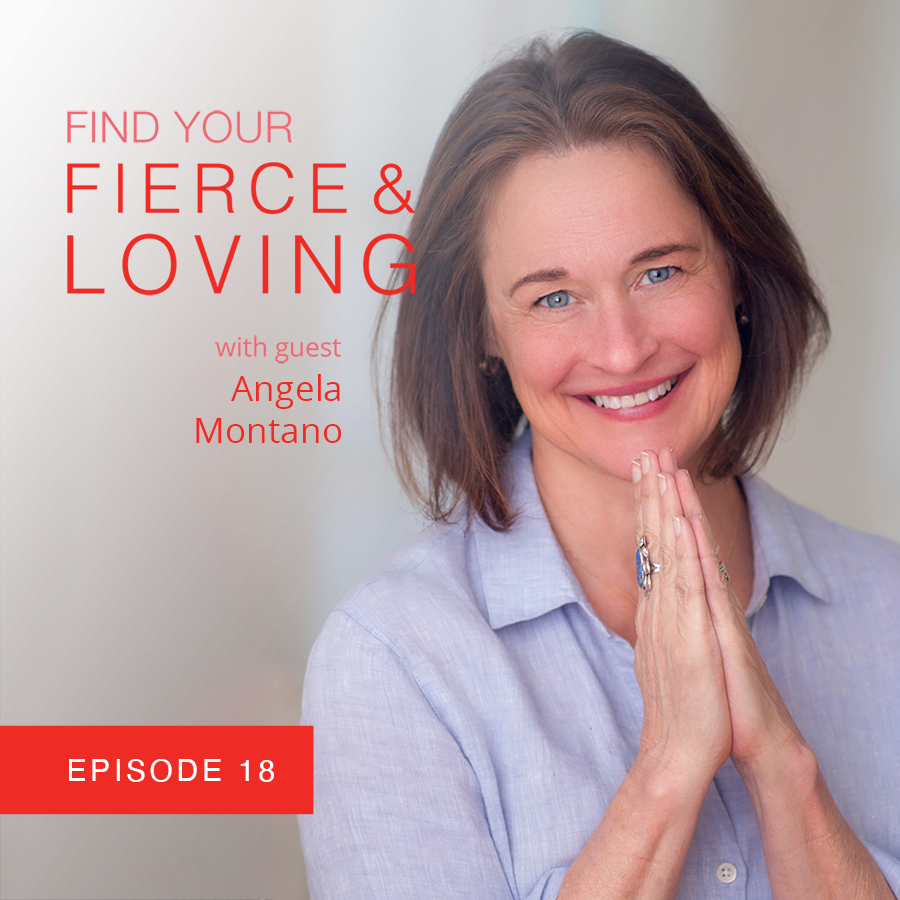
“If you’re loving you, then you’re going to have a holy no. You’re going to say no as easily as you say yes.” – Angela Montano
Wherever you are on your journey, you may sometimes find yourself constantly moving but not advancing. Spiritual coach and prayer counselor Angela Montano has devoted her life to helping thousands of clients open a whole new world of possibilities in their lives. If you feel lost or stagnate on your journey, join us this week to hear from Angela’s deep love and guidance.
Show Notes
Angela Montano has spent twenty years guiding people through trust and surrender. She sees the possibilities in life’s challenges and can help us re-align with the journeys that are right for us.
In this episode of Find Your Fierce & Loving, I invite you to join in a vital discussion of prayer, power, and the different forms that these concepts can take. Angela shares why prayer does not exclusively belong to religion, the power of prayer to change your existence, and the importance of integrating “fierce” and “loving.”
- (1:41) – Back of this moment
- (5:50) – Advancing in truth
- (18:46) – What is fierce and loving?
- (28:25) – Rethink prayer
Angela Montano prays a lot. Practicing and teaching what a ‘consciousness of prayerfulness’ is, she guides people to commune with the mystery of Love. This is a challenging practice, but worth it. Angela is both a prayer intuitive and a prayer advocate. As a prayer intuitive, Angela has facilitated more than 20,000 individual prayer sessions; through her classes, speaking engagements, interviews, workshops, and retreats, she has prayed for and with over 100,000 people. As a prayer advocate, Angela’s mission is to guide people to ‘rethink prayer,’ inspiring new conversations about prayer. She teaches ancient and new prayer technologies, encouraging people to cultivate a prayer practice which includes: praying for oneself, loved ones, situations, and really anything that calls one to ‘reach beyond,’ which is Angela’s most basic definition of prayer.
Angela is host of the weekly live interactive talk show, Prayer On The Air. She is also the author of the best-selling DailyOM course, 21 Days of Prayer to Change Your Life, which currently has over 27,000 students enrolled. You can join anytime to begin your 21 days. To learn more, go to angelamontano.com or linktr.ee/AngelaMontano.
Do you want to unleash your inherent love and goodness, liberate yourself, and free humanity from the oppressive systems and structures we have created? We are here to support you in finding your fierce and loving life. Join us in Our Circle, a vibrant membership community rich in opportunities for engagement and transformation. Find out more at lolawright.com/our-circle.
You can follow Lola Wright, on Instagram, Facebook, LinkedIn, and Twitter and learn more about my work at lolawright.com.
Chicago born and built, Lola grew up in wealth and privilege, yet always sensed something was missing. She sought out aliveness and freedom in music, immersing herself in the hip hop and house music scenes of 90s Chicago. After finding herself on her own at 23, as the mother of two young children, she became determined to create a new experience.
Lola is an ordained minister with a gift for weaving together the mystical and material, she served for many years as the CEO of Bodhi Center, an organization committed to personal transformation, collective awakening, conscious activism, and community-building.
This podcast is produced by Quinn Rose with theme music by independent producer Trey Royal.
If you’d like to receive new episodes as they’re published, please subscribe to Find Your Fierce & Loving in Apple Podcasts, Google Podcasts, Spotify, or wherever you get your podcasts. If you enjoyed this episode, please consider leaving a review in Apple Podcasts. Your reviews help others find the show.
Transcript
Lola Wright [00:00:01] Personal transformation and collective awakening involve being the most alive, brilliant, inspired, creative, on fire version of yourself. A version that is not consistent with the status quo. My name is Lola Wright and this is Find Your Fierce & Loving. This podcast is a wake-up call, a roadmap back to your holy purpose, an invitation to set fire to the box you’ve been living in and watch it burn.
Lola Wright [00:00:40] Angela Montano, I am so excited to have you on the podcast. For those of you that are listening, this extraordinary human being has been one of the most essential support structures for me in my life for the last nearly decade and it is my great honor to share her with you. I know that you will be absolutely moved by her presence, not by way of her efforting but just her very beingness. It is mystical. It is magical. So, Angela, thank you for saying yes to being here. I love you deeply. I am eternally grateful for you and it is my true, true pleasure to share your voice with my audience.
Angela Montano [00:01:22] Well, it is such a great honor and pleasure to be here. And I… I feel our decade. I feel our decade of work together. You know, just being with you here, you know, there’s a lot back of this moment. And I’m proud of you and grateful to be here with you.
Lola Wright [00:01:40] Thank you. You said there’s a lot back of this moment. Would you explain what you mean when you say that?
Angela Montano [00:01:47] You know, in interior design, you know, there’s a term, and I’m not an interior designer, somebody said this and it caught my ear. But it’s a term, artificially decorated.
Angela Montano [00:01:58] And it’s when someone decorates a room like all in a weekend, all in a day. And it’s not layered by like, “I love this. I love this. I got this here. I got this there. I’ve been in this room for months now. I know the light is good in this window. So a chair would go there.” It might at first impress you but it somehow isn’t like when you go into a home and you feel like all that is back of a room and how it’s decorated, like the soul of it. So being with you here, it’s like there’s no artificial decoration here. I think a lot of times when people come on to podcasts, people will say, my friend, so-and-so and I’ve been on podcast and I do feel like, who am I
Angela Montano [00:02:40] not a friend to? Sure. You know, I’m a friend, but, you know, but like, maybe they’re not my good friend. They’re, you know, like what I think of as a friend, right?
Angela Montano [00:02:48] So when I say there’s a lot back of this, you know, there’s, you know, just all that we’ve held hands together through. In the quantum leaps you’ve made, in the tears you’ve shed in the… in the how do I blast through this in the… you know, even in the way fear shows up so often, it’s like a righteous “I’ve got to escape this,” you know, and then to sit with that and then not escape this and then instead breathe through, move through, unpack what needs to be unpacked, deconstruct aspects of that fear.
Angela Montano [00:03:29] So when I meet with you today, you know, I think of all of that and then you inviting me to Bodhi in Chicago when Bodhi was there, like, I don’t know, there’s just lots of layers here and I feel it all and I’m grateful to be here.
Angela Montano [00:03:42] And I trust that will support us in letting this conversation flow in a way that’s best for those listening.
Lola Wright [00:03:51] Mm hmm. It’s interesting, you know, I think especially given the speed at which our existence moves these days. That’s so often especially in the space of personal transformation, you know, self-help, development, you know, spiritual seeking, whatever you want to call it. It is tempting to always look for the next best trick or hack.
Lola Wright [00:04:16] And I think there’s… I mean, I’ve done so many different programs and modalities and methods and all of those have informed me and I don’t regret one of them. I’m incredibly grateful. But there’s also something profoundly impactful of having a through thread. And I feel like you’ve been a through thread for me. You know, it’s like I could try this. I could try that. But you’ve been a constant and the constant that you’ve been for me is someone that has consistently reminded me of the truth.
Lola Wright [00:04:50] And I want to talk a little bit about that word “truth,” because I think it can get sort of confusing.
Lola Wright [00:04:57] Like, what does that mean? Your truth. My truth? Whose truth? What is the truth? Everybody thinks they know the truth.
Lola Wright [00:05:04] And when I talk about you knowing the truth for me, you have been a space holder that has reminded me when I forget that the circumstances and conditions before me may be ever-changing. You know, it’s like I think about my dad growing up.
Lola Wright [00:05:25] He would say, “Don’t get too high with the highs and don’t get too low with the lows.”
Lola Wright [00:05:29] You know? It’s sort of like there’s something eternal that can be leaned on, can be known, can be recalibrated to and that’s what you have always been in my ear in service of.
Angela Montano [00:05:46] I like your dad, “Don’t get too high with the highs and don’t get too low with the lows.”
Angela Montano [00:05:50] That’s pretty much Buddhism, you know? Have equanimity, have space around whatever is occurring. My dad used to say, “It takes all kinds to make a world.”
Angela Montano [00:06:01] And, you know, all these great dad sayings, you know, the wisdom comes where it comes from, you know? And I had… I worked with someone once who was a, you know, we’d call this person Type A. Head… One of the only women in a high, high position of a studio out here. And she had been diagnosed with breast cancer and she worked through it, got her treatment through it, like you would have barely known anything. And it… in that that included chemotherapy and and and the like. And she got through it like everybody thought she would get through it just: Boom, boom, boom. Go, go, go. And then the cancer recurred and that she was not counting on because she plowed through that like she plowed through everything else with this can-do attitude. And she decided to go to Ojai, California, and take some time off. She was always into all these different manifestations, spirituality, all these things, you know? She had it on the inside, on the outside. And she just… she got… she decided to work with this Native American Indian teacher and he asked her to go walk. Every day, that’s the only thing he would say, “But you have to walk as slowly as you can.” Well, nothing could have been a more painful suggestion to this woman because she knew she could book the miles. And she just, I mean, no book to read, no process, just walk as slowly as you can. So one day she’s doing this and, you know, it’s like, well, am I standing still and my moving like even that became Type A. Like if you tell her to walk slow, she’s going to walk slower than anybody has ever walked because she’s going to be the slowest walker. And so this became the battle…
Lola Wright [00:08:03] The best!
Angela Montano [00:08:04] The best slow walker there is! And so in, you know, trying to figure out what’s actually slow but still moving, she starts staring at this rock where there’s an ant and she’s walking so slowly she can watch the art because she’s as slow as the ant.
Angela Montano [00:08:22] And the ant is going like up this way and then back and then to the left and then back and then going down and keeps going back to this one spot.
Angela Montano [00:08:35] And she keeps watching this ant and she realizes that’s her. That in all of her flurry of movement, she didn’t really go anywhere. It looked like she was advancing, but she wasn’t really. And she realized I have to move forward with one thing. And that’s when she really made a deep surrender to work in this one way with this particular teacher. And she made that decision. She found herself crying.
Angela Montano [00:09:07] And then the ant went just in one way and went on and on and on.
Angela Montano [00:09:12] And to me, that’s our.. the conundrum we’re in. Are we like going all these different directions, but not really advancing in our, humanhood or our growth in our spirit? So what is truth, how does one advance in truth and what does that mean to me? It is… I have a sense that every spiritual path ultimately involves or leads to or we come to a point of surrender. I think what we are surrendering to and what I believe if I had to say what I think, you know what
Angela Montano [00:09:54] what like the finger pointing to the moon, what is truth? It is love. And when I say love, you know, I’ve always thought it’s interesting in our culture, we say “unconditional love.” Well, love isn’t love if it’s not unconditional, right?
Lola Wright [00:10:06] Exactly.
Angela Montano [00:10:06] Hey, baby, I got an agenda, you know.
Angela Montano [00:10:10] You know, you scratch my back, I’ll scratch yours or something, you know?
Lola Wright [00:10:13] Which doesn’t mean that we don’t have human boundaries and people get very confused about all of this.
Angela Montano [00:10:19] That is so true. So I think unconditional love, even in its unconditional nature, it, even, is well-bounded. You know, so somehow love to me is the answer. You know, just love and things will come right. And that, of course, includes you. Right? If you’re loving you, then you’re going to have a holy no. You’re going to say no as easily as you say yes. And it’s something about letting love be my greatest aim within and around me. And I… I have huge swaths through the day where I completely forget this. So I think this is what awakening is to me. It’s relaxing with the imperfection of life, relaxing with the imperfection of myself. It’s an embrace of, really, ordinariness. And at one point in my life, that would have been a real downer to me because I always want to be extraordinary, make a difference. But there’s something about letting go of trying to be someone, be something that feels like that to me might be the beginning of the hero’s journey if you will, that release of agenda.
Lola Wright [00:11:48] That feels very true for me. I think about, you know, I had you join my Our Circle membership community this past week. And one of the things that I’ve been sort of…
Lola Wright [00:11:59] grappling with myself is like, OK, so we have this community and like we have to get, you know, these people have an expectation, they’re participating in this. They want to know where is point A and where is point B? You know, like what’s the seven-point plan to purpose and aliveness and fierce and loving. And I’m like… I feel the pressure.
Lola Wright [00:12:24] By the way, no one has said that. That all lives in my mind and is sort of woven together with my own over-functioning. My own need to sort of over-perform and, you know, which has been really, sort of as a sidebar, very interesting to me, I’ve been studying this tendency, particularly among woman-identified people, you know? You know, this tendency for women to over-perform, to over-function. You know, there’s a fair amount of business research that even shows like the level of preparedness that a woman will have going into a presentation or a meeting is like so excessive and largely unnecessary. So anyway, I just can see that pattern within myself. And I si- I’m grappling with it because… I so… my path has not been that linear. My path has not been a seven-point plan to live your fierce and loving life. It hasn’t been that it’s been… I can see in retrospect that it has always been evolutionary. It’s always been forward moving, but it didn’t always feel that way at the time.
Lola Wright [00:13:42] And so it feels I just feel the sort of societal pressure to come up with the life hack that’s going to be the silver bullet for you, finding your thing and being like, yeah, I don’t want to do that. I don’t… I actually just want to sit together.
Angela Montano [00:14:00] Right. And I love that you’re bringing this forward and I think this is probably very useful for many of us. You know, and I… what I relate to or how I relate to what you’re saying is I sense it’s the way you’ve internalized the patriarch-y. The linear, you know, there’s a point B and you’ve got to get there. And no matter how much of a feminist or progressive or whatever we may think we are or aren’t, you know, that is something I think we’re deconstructing. I think we’re at a time where feminine power, feminine energy. I wonder even if it’s somehow like the new software on the planet that we’re getting accustomed to in.. and in the energy of this feminine power leading, to me it’s all about circles. It’s all about spheres. It’s all about circling and circling. And, you know, in the circling, each time you go around, there’s another aha. You know, I think about the way I clean my house.
Angela Montano [00:15:18] I love it when no one’s home and I clean my house. Like I guess I sound like I’m infatuated with myself, but I kind of wish there was an aerial view of me, like, I would love to like… and then I’d like to trace what I did. I literally, like, go from room to room to room to room to room. Like I, I pick up one thing I do something, I did… and I clean in a very circular way. You know, I’m very fortunate to have a husband who also cleans and he cleans very differently. He gets this done, this done, this done. And I go why should I even clean like,
Angela Montano [00:15:51] it just seems like he’s better at it. But when he cleans it, it never looks as good as when I clean. Because I’m just seeing things he doesn’t see.
Angela Montano [00:16:00] And I really do love for us, the masculine and the feminine. It’s always best when both of us do our thing. You know, he does his thing, I do my thing, and then it happens. So I don’t want to put down the linear, but there’s something about the circular that is the magic of life. And when I think about your circle, which I love and I, I really do plug as an extraordinary, wonderful thing for a person to join.
Angela Montano [00:16:25] You know, I think what you all are doing right now in the circle is deconstructing that patriarchal, you know, and you’re feeling it in… as the facilitator.
Angela Montano [00:16:39] Like, you’ve got to bring it right? And they’re feeling it and however they feel like, “I’ve got to achieve it.”
Angela Montano [00:16:45] And in truth, your circle is a laboratory where you’ve invited people in to really inquire and to really explore what is fierce, what is your fierceness? What is loving, what is your loving? And what happens if we open more to our fierce and our loving. And the growth for you and every teacher knows you learn when you lead, you know, your work is going to be the revelation that that’s enough.
Lola Wright [00:17:25] Yes.
Lola Wright [00:17:29] Oh, my gosh.
Angela Montano [00:17:30] And in a circle so many essential needs are met, connection. You know you know, when you talk about our work together, I have a friend, who has a friend, who’s a consultant and I think his name is Jeff Berkowitz, but he says, everybody needs three types of people or even friends in their life. One is people who, you know, are emotionally supportive, somebody you could call at 2:00 a.m. if you, you know, needed support that would pick up the phone.
Angela Montano [00:18:01] You know? You need someone who shares your interests. Maybe you’re into, you know, French films and, you know, that person will go with you the minute your, I know we’re in the pandemic now, but, you know, then then the minute your cool little movie theater like that has them. You know, you go there with that person, you know, they’re your buddy for that thing that you enjoy.
Angela Montano [00:18:25] And the third person, kind of person, is a person who knows your personal narrative. That we need someone to know us and know our arc. And a decade for you is a good chunk of your adult life. So it’s comforting to know someone knows.
Lola Wright [00:18:46] I feel like you have uniquely understood what I speak of when I speak of fierce and loving. And I wonder, like every time you reflect it back to me, I’m like, Yes, that’s it!
Lola Wright [00:19:00] Yes! Can you say… like, you know, obviously, I titled this podcast, Find Your Fierce & Loving. And, you know, at least the current title for my forthcoming book is Fierce & Loving. Can you articulate what you hear in that when you hear me speak of it? And I just want to sort of acknowledge for all of us, to your earlier point, a lot of times people who have been traveling with us in our personal narrative, their great resources for us because they’ve been tracking things and they’re not so like deep in the neuroses, like sort of any of the neurotic patterns of it. They really can hold what we might call the high watch of what you’re here for.
Angela Montano [00:19:44] Yes. When I hear fierce and loving, I hear what I want. I hear what I want. I want to be fierce and I want to be loving. And I want to have my fierceness and my loving, you know, what’s the word I want to use, like up and running or, you know, pistons firing on all cylinders working, you know, in my fierceness, in my loving.
Angela Montano [00:20:14] I want the “and” in both of that. And for me
Angela Montano [00:20:20] I sense for me that I could be imbalanced with my fierce and loving. I feel like I can be fierce and my loving isn’t quite there. Or I could be loving and I’m kind of Loosey Goosey, you know? And so for me, fierce and loving is really the “and” and “both” of the power to move in this world and the heart remaining open. And I don’t think that’s easy for any of us. And I think of parenting, you know, in parenting one of the things I practiced, you know, and of course, I don’t think I ever mastered it and I have a 20-year-old now, so, you know, I’m kind of done parenting, but I’m obviously, you know, a parent and a consultant and a guide for my daughter whenever she wants it, but, you know, I always wanted to be firm and loving, firm and loving. And I could be firm or loving, you know, it was like, you know… But to be firm and loving, you know, that’s to me fierce and loving, you know, calm and consequences. You know, like, you know that in the world, but not of the world. That for me is the fierce and the loving. And I think many of us, our professions or whatever circumstances we find ourselves in, even our personality has us have one culture versus the other, in different situations, you know. And so, you know, if you, if you are someone who tends to be very, very loving, you know, you might have to work more on your fierceness. If you’re someone that’s very fierce, you’re going to be working to: how do you bring in the soft- the softness? But I do think it’s what the world needs. It’s what I need for me and it’s I think it’s what our humanity needs as we move forward because I think we are moving beyond this survival of the fittest, Darwinian perspective of winners and losers. And we’re moving into not survival of the fittest, but survival of the wisest, survival of the wisest. And this fierce loving combo is necessary in wisdom. You can’t be wise without fierceness and lovingness working together, right? Wisdom isn’t like, “Oh, well, you know, have another chip, it’s, you know if it’s what you want, have it,” and it can’t be like “You may never have another salty carb again.” Right? It’s got to be the middle way, as the Buddhists say, the way is the middle way. And I think wisdom, the wisdom required of us, is calling us to sharpen our fierceness and to deepen our loving. And I think you hit it just right that like those words are… speak to what is being called forth in our culture today.
Lola Wright [00:23:52] I’m thinking about… I was… I went on a big, long walk through the woods this morning and I was thinking about, you know, Eckhart Tolle talks about this in Stillness Speaks, it’s really a scriptural reference. The idea of- and we may have even spoken about this recently in some of our sessions, but this idea of dying before you die. You know, and I feel very much like that is what we are in as a collective experience right now. You know, that’s… that some old way of being is dying, and, you know, when it’s scripturally referred to or, you know, even when Eckhart Tolle refers to it, it’s the dying or the righting of the ego. You know, it’s like we’ve lived in a particular era where we’ve held up and really sort of glorified the ego. And it’s not that the ego ever goes away, it’s that we are in right relationship with the ego. And so I think we are living in the midst of a recalibration. We are living in the midst of, you know, letting some version of existence die.
Lola Wright [00:25:07] And that is deeply uncomfortable because it does not promise that you know what is to come.
Angela Montano [00:25:14] For a long time, I’ve kind of rearranged my desk, but for a long time, I had this little piece of paper inside my, the thing I kept my, like, pens in. And it’s something I wrote and I got it. And it was and I got it as an inner guidance.
Angela Montano [00:25:33] It was: make peace with the hollowness inside. I’ve wanted to fix the hollowness. I’ve wanted to distract myself from the hollowness. I think approaching the infinite nature of the hollowness within, you know, at first, feels like a, I wonder if even… I mean, it just feels like it feels like death. And I wonder if the depth of loneliness, the epidemic of loneliness that is reported in our… in the United States of America, other places in the world. I wonder if in some ways the loneliness that we relate to as evidence of all the ills of our society might actually be that collectively we are entering the void. The hollowness. And everything real, everything truly transformational and you know this from your work with me, you know this from working with other people, everything of real consequence happens inside the void. You know, from a spiritual point of view, a mystical point of view, you are the light. And if you can be still in the void
Angela Montano [00:26:56] fertility happens. New life happens.
Angela Montano [00:27:00] And if we can, you know, we, you and I’ve talked recently or you’ve spoken recently about just the importance of context. You know, the void, we often have images of an abyss like I’m falling down in a well. I’ll never get out. I’ll die. But if we could see the void more like a womb. And this is the femininity, like the darkness of the womb. We don’t feel sorry for any little baby that’s getting nourishment in his/her/their mother’s womb. Right? We think, well, they’re getting everything they need.
Lola Wright [00:27:40] You want to be more alive, you want to unleash your inherent love and goodness, liberate yourself and free humanity from the oppressive systems and structures we have created, we are here to support you in finding your fearsome, loving life. Join us in Our Circle. This is an affirming and radical space that will gather weekly on-demand or live whatever works best for your life. For more information on how you can engage in Our Circle, lolawright.com/our-circle. I’d love to have you with us.
Lola Wright [00:28:24] So you have a body of work called “Rethink Prayer,” and I’d love for you to talk a little bit about this because it actually came up when you were with us the other evening in Our Circle. There was someone who identified as atheist and I asked her like, “Hey, when you hear Angela speak, does her language feel prickly to you or can you translate it? Does it make sense for you?” And it ended up yielding a really interesting conversation. We had a community member in Japan who said, “I love that the word prayer here is secular. It’s not actually religiously associated.” So I’ve been thinking a lot about that. You are committed to almost like a reclamation of the word prayer and have created a whole body of work around it. What is prayer from your perspective and why do you see it as valuable now, particularly as we become decreasingly religious?
Angela Montano [00:29:20] You know, I was a television news reporter. I went through my own deep soul-searching time, and through that extraordinary time in my life, I ended up becoming a licensed spiritual practitioner, which means I work like a therapist. I have clients hour after hour, but instead of working from a psychoanalytic perspective, I’m working from a spiritual perspective, which is each person who sees me is whole and it’s about realizing that wholeness. So I’m not diagnosing, but I’m looking for ways that I work with each client to be a clearing for that wholeness. And so through that, the healing modality that I work with is prayer, and I do an opening prayer, as you know, and then the closing prayer of the session is to really put the contents of the session, that’s whatever the client brings forward, which has to do with their own suffering into prayer. And so after doing that for, you know, many, many years, you know, I’d done it 10 years and I really thought I would do many other things. I thought I would write books and speak. And I was amazed that I just kept doing sessions. I mean, well over 20,000 at this point. And I learned so much about prayer because I never left the laboratory. I’m tracking it in person’s life after person’s life after person’s life. And, you know, I’m seeing what happens. And I had this revelation and it was kind of dawning on me for a long time but it really hit in 2008 when my mother passed away. My mother was an artist. And in.. at her memorial service, we invited all of her artist friends to bring their work. And we said all their work up on easels and her work up on easels. It was in an old, I’m from Virginia, so it’s like this… It wasn’t a memorial service, I don’t know, I guess you call it a funeral home, but it was an old Virginia house, you know. So it was just- you would walk into these rooms, look at this art, talk to friends. And as I walk through this, these rooms and, you know, I’m seeing relatives and friends, you know, people who love me, love my family, I got this, like, deep down voice, you know, from me not audible out there, but it was like, “You must bring forth your body of work.” And I said, “but I am,” you know like my work is like the sand mandala, every client come in and then I clear the sand and, you know, it doesn’t have to be a physical thing in the world. I- you know, the work I do was kind of invisible and I’m good with that. And then it was like, “No, you must bring forth your body of work. What you’ve learned about prayer, what you know about prayer cannot die with you. You must share it.”
Angela Montano [00:32:29] And I realize I’ve had an incredible seat at the table. I’ve had an incredible view
Angela Montano [00:32:37] watching the power of prayer. It doesn’t work the way we want it to work as children, you know, I want the chocolate ice cream, the chocolate ice cream comes, you know? Sometimes those things happen. But what I witnessed about prayer was
Angela Montano [00:32:54] so much more… I want to say multidimensional than that. And I saw person after person who stayed with the work and worked with me,
Angela Montano [00:33:05] things got better and better and better. Often not at all the way they thought it should be or how I might have even hoped. But I just saw that somehow more and more buoyancy, lightness, and possibilities occurring. Now, there’s a constant ebb and flow in life. I’m not saying you pray and it just flows, flows, flows. It’s ebb and flow, ebb and flow and so “Rethink Prayer” is my offering to have people rethink prayer. I so appreciate what your circle member said, it was from Japan, the word prayer is not associated with religious religion there. That’s like a shock to an American. You know, prayer is loaded. It’s even offensive to people. You know, it can even be, you know, an underhanded insult, you know.
Angela Montano [00:33:59] Oh, you know, “You look like you could use a prayer today.” You know, it could be like an insult for people, you know. So it’s… so I want to see if I can shift that.
Angela Montano [00:34:12] I want to see if I can help change that. But to your question, what is prayer? My basic definition prayer is simply the instinct to reach beyond. It’s just reaching beyond a current state of thought out of which suffering arises. It’s reaching beyond. And man, woman, humans have been doing that before the first religion was ever even created. There’s evidence of that even in the Neanderthals.
Lola Wright [00:34:44] So and I think it’s it’s implicit in what you’re saying, but I want to be explicit about it, which is that the practice of prayer that you study, teach, officiate, is not praying to an externalized anthropomorphic presence, but really a praying from. Can you talk about that distinction?
Angela Montano [00:35:11] Yes, yes. Yes. So one of my go-to definitions for God that has resonated for me and been close for me all these years is: God is that which is too vast to be named. That which is too fast to be named. So if we’re praying to anything, we’re praying to the vast, infinite possibility. And that does require faith because in my suffering
Angela Montano [00:35:47] I don’t see any other possibility. I’m stuck between a rock and a hard place, right? Like that’s why I need prayer to, if we reference scripture, “to look to the hills from whence help comes.” That interpreted metaphysically is to look to a possibility beyond my current purview. And that requires me to consider I might not know everything, you know, like maybe there is a… you know? And so when I say something spiffy, like, you know, “God makes a way out of no way in God there is a way.” I mean, in the infinite possibility of vast realms beyond my knowledge something is available that is good.” And so, no, it’s not a praying to a specific presence, but it is an opening to a space. You know, in a way, I guess I could also say God is a space, a vastness. Now, I trust and this is the great leap of faith,
Angela Montano [00:37:01] I trust that vastness to be love, to be love. To be eternal, to be
Angela Montano [00:37:11] good and good beyond good and bad, but merciful grace. I suppose maybe we each come to that in our own way.
Lola Wright [00:37:20] And so presently you have an offering that you do on Monday mornings that is a gathering, really for people to experience that practice. What does that look like?
Angela Montano [00:37:35] Well, I do a… it’s right now or I’m kind of under construction in my website, in my work and everything right now. So do pray for me. But right now, my… I always thought I’d have a radio show called “Prayer on the Air.” And so I always thought of that person, Dr. Laura, you know, and you call in and I find her just, God bless her soul, but she seems very judgmental to me. And I feel like she kind of judges you and advises you and kind of puts you in your place. I know people love her. OK, so I know, you know… And I was like going to be the antithesis of her, you know, like, you call me and you get nonjudgmental, loving attention and prayer. You know, you know, and I, I still want to do that. So I don’t know how I’m going to do that. But right now, my morning Monday call is kind of that live radio show. It’s even called “Prayer on the Air.” And people call me from all over the world. Everybody has a number. I’ve got people in just everywhere, Australia, France, Italy, you just name it like… And it’s strange because I’ll have like three people in Australia, one person in France. It’s… maybe 300 or so people gather. It’s not a gigantic amount, but it’s shocking because it’s like one person in Arkansas.
Angela Montano [00:38:56] I don’t understand it, but, you know, it’s just so strange.
Angela Montano [00:39:00] But basically, you know, I speak a few words and people give their prayer requests and I pray for them and I get to talk to them, give them a little prayer, you know, inside and then everybody prays. And I mean, this group that has come forward, they so many of them, I mean, they’ve got prayer in their bones. And I mean, what stuns me is the number of people that never ask for prayer. They and they never raise their hand. Like, if it were me, I would raise my hand every single week. You know, I’ve always got something, please put this in prayer for me. But so many people show up and they are praying. They just want to be in the prayer field and pray and contribute. And so there’s a great feeling of intimacy. I feel like prayer is a language of intimacy because, you know, you kind of get together to pray for people and you feel such connected- connection because, you know, people aren’t small-talking when they are asking for what they need prayer for. And they’re trusting. They’re trusting me and they’re trusting the group. You know, these are things people ask for prayer about what they really care about me, you know?
Angela Montano [00:40:14] And so I want everybody in the whole wide world to have the experience of prayer support because I see the value of it. And it’s like you’re reaching beyond and someone’s holding you space for in the vastness of possibility there’s a way and I’m going to just trust that for you.
Angela Montano [00:40:34] And it might be hard for me to trust for myself because I’m so emotionally invested in my stuff, but I might be a clear space to hold it for you. So that’s my morning thing. And then my other thing is just my dailyom.com. I have “21 Days of Prayer to Change your Life,” and that’s where I really teach how you can construct your own prayer practice. And I think that’s a valuable course that’s very inexpensive if you want to buy it.
Lola Wright [00:41:03] What’s your sense of there was, like, a collective prayer request that humanity is calling forward without perhaps specifically or explicitly naming it? Like when you sense in to the soul of humanity, what’s your sense of the collective prayer that the moment is calling for?
Angela Montano [00:41:23] You know, I want to answer that two ways. I guess the first one is I feel like collectively people are really wanting reassurance and “I’m safe. I’m secure. Everything’s going to be OK.” I don’t think this just arose with the pandemic. I felt it coming before. Just the harshness of the things that have unfolded, being, you know, multiple school shootings in the United States or just like these things that just aren’t supposed to happen. I feel the prayer request is like for people to really accept this is all coming up for help and healing, for transformation. You know, it’s darkest before the dawn, “there’s weeping for a night, but joy cometh in the morning.” That to me is the collective reach that I feel happening. In the individual, you know, I think about my individual practice, and my individual practice is probably pretty rarefied, I don’t know if it is… any way speaks to the whole population, but I do see a theme there, too. And it’s what we talked about earlier. I see people moving beyond “I’m a winner. I’m a loser. I’m enough. I’m not enough,” to “I am. I have permission to be and I can trust an internal guidance system that is directing me, you know, I’m following the golden breadcrumbs and it’s not about it’s not a ascension descension world,” you know, I’m going up or I’m going down. You know, it’s… that Ascencion model is being deconstructed. And we have to grow deep. We have to grow down. That’s where we find our compassion, our humility. We have to grow up. That’s where we get our empowerment and our confidence. And we have to grow out with… that’s where we get our frustration, tolerance, and our tolerance of any kind. So the soul of my point is, as James Hillman talks about in one of his books, The Soul’s Code, the soul grows omnidirectionally. Right? But my ego says up is good, down is bad. But if you can’t grow down, you miss so much. Your soul is shaped by your trauma. You know, you’ve got to grow down. You’ve got to grow out and you’ve got to grow up.
Angela Montano [00:44:02] And that’s what I sensed in the individual work I do that I’m serving that allowing.
Lola Wright [00:44:13] I love that. Anything else that is on your heart or mind that you feel like you want to add as a reminder for those listening?
Angela Montano [00:44:22] I just want to bless everyone listening. You know, I do believe that a blessing. You know, I believe in the power of words. You know, referencing scripture, the power of life and death is in the tongue. The power of our words to… for me to say, I bless you, it means I’m aware that there’s an invisible light and I can direct and give that light indiscriminately. I want to bless listeners, bless you. And I want to receive blessings myself, because the more blessed I am, the more clearly I’m going to see. The more blessed you are, the more clearly you’re going to see the love that you are and the love that is. And I think that’s what the world is opening to.
Lola Wright [00:45:13] Thank you for being a reminder for me when I forget. Thank you for seeing the bigness of me, the tenderness of me. I feel like you are available to see the vastness of me.
Lola Wright [00:45:29] I am not a fixed entity in your perception and you have an incredible ability to bring grace, to bring humor, to bring certainty, to bring surrender. Like I think that idea of growing omnidirectionally is so appropriate for how you show up and it’s a great gift.
Angela Montano [00:45:55] Thank you and I thank you and I just sent you profound blessings with all that you’re doing. And I feel what you’re doing in Fierce & Loving is serving the omnidirectional expansion that is happening in the human spirit, in the collective human heart. So I thank you. I love you.
Lola Wright [00:46:17] I love you too. I love you too.
Lola Wright [00:46:21] If you enjoyed this show and would like to receive new episodes as they’re published, subscribe wherever you get your podcasts and consider leaving a review in Apple Podcasts. Your review helps others find this show. You can follow me at Lola P Wright on Instagram, Facebook, LinkedIn, and Twitter and learn more about my work at lolawright.com. This episode was produced by Quinn Rose with theme music from independent music producer Trey Royal.
Angela Montano [00:47:06] I got pregnant, I got married at 35, I had a baby at 38, I got pregnant at 37 and I never really thought I would have kids. I got so scared. And, you know, I called my… one of my very best friends, Rachel, who went to college with me.
Angela Montano [00:47:20] And, you know, and I’m like, oh, my God, why did I can’t believe I did this? Like, what was I thinking? I…you know, like I can’t do this and what am I going to do now?
Angela Montano [00:47:30] And she’s like, “Angie, you’ve actually always talked about having a kid, you know. Do you remember?” I was like, “Are you sure, Rachel?”
Angela Montano [00:47:42] Rachel’s like, “Yes, Angie yes.”




Leave A Comment