
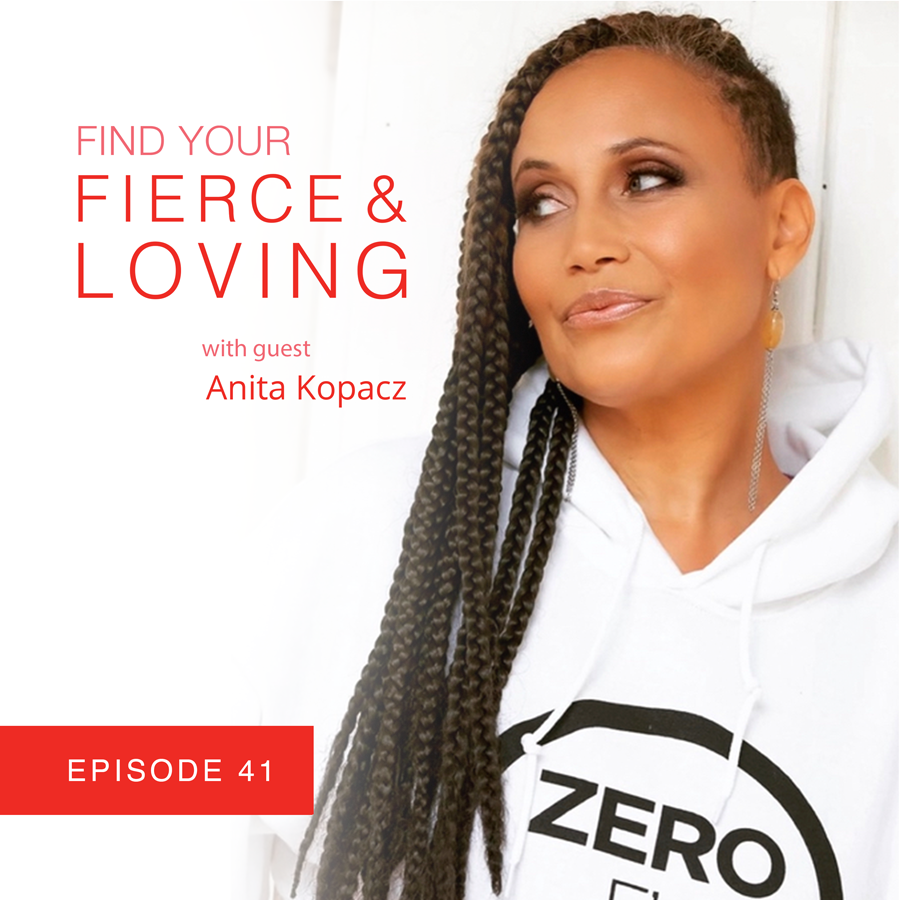
“It’s like, oh yeah, I believe we’re all one, but before we even get there… How do you feel about Black people? We have to do some work before we can really feel what that oneness is.” – Anita Kopacz
Anita Kopacz is bringing an ancient and new narrative to wellness and spirituality. The spiritual psychologist and author of Shallow Waters is irreverent and insightful. She’s taking people past the toxic positivity of spiritual bypass and into actual healing.
Show Notes
Yemaya is the Yoruba deity of the sea, the original Black mermaid, and the heroine of Anita Kopacz’s new novel Shallow Waters. In her stunning novel, Yemaya intersects with 1800s history as she seeks her love, who has been kidnapped and brought across the Middle Passage to the Americas. Through years of work, rejection, and uncertainty, Anita felt called to tell this amazing story.
Tune into this week on Find Your Fierce & Loving to hear about getting a book deal during a pandemic and how Charlamagne tha God fell in love with Anita’s work. With every step of this conversation, Anita brings her wisdom and curiosity to help you break apart your own limitations and rediscover who you really are.
- (02:45) – Spiritual leadership
- (08:12) – Creating this book
- (24:48) – Finding Charlamagne
- (32:19) – Raising children
Anita Kopacz is the author of the Simon & Schuster fiction novel, Shallow Waters. It is the second title that Charlemagne tha God will release on his imprint, Black Privilege Publishing on August 3, 2021. Anita is the former Editor-in-Chief of Heart & Soul Magazine and Managing Editor of BeautyCents Magazine. She is an award winning writer, a Spiritual Psychologist and a certified Tantra coach with a passion to see people thrive. Anita created the Zero F’s Given campaign to raise awareness and help victimized and disenfranchised populations heal from sexual trauma, find their voice, and reclaim their power. She has helped thousands of victims through her work with Zero F’s Given and being on the board for the Center for Safety and Change. Through leading retreats around the world, working with private clients and storytelling, Anita fulfills her intention to awaken the divine simplicity, pleasure and joy in her life and others.
Do you want to unleash your inherent love and goodness, liberate yourself, and free humanity from the oppressive systems and structures we have created? We are here to support you in finding your fierce and loving life. Join us in Our Circle, a vibrant membership community rich in opportunities for engagement and transformation. Find out more at lolawright.com/our-circle.
You can follow Lola Wright, on Instagram, Facebook, LinkedIn, and Twitter and learn more about my work at lolawright.com.
Chicago born and built, Lola grew up in wealth and privilege, yet always sensed something was missing. She sought out aliveness and freedom in music, immersing herself in the hip hop and house music scenes of 90s Chicago. After finding herself on her own at 23, as the mother of two young children, she became determined to create a new experience.
Lola is an ordained minister with a gift for weaving together the mystical and material, she served for many years as the CEO of Bodhi Center, an organization committed to personal transformation, collective awakening, conscious activism, and community-building.
This podcast is produced by Quinn Rose with theme music by independent producer Trey Royal.
If you’d like to receive new episodes as they’re published, please subscribe to Find Your Fierce & Loving in Apple Podcasts, Google Podcasts, Spotify, or wherever you get your podcasts. If you enjoyed this episode, please consider leaving a review in Apple Podcasts. Your reviews help others find the show.
Transcript
Lola Wright (00:01): Something is stirring. Maybe you’ve felt it. We are reckoning with the reality of injustice and binary thinking that feeds the political machine. Humanity is in the midst of a heartbreaking and painful paradigm shift. That is a good thing. My name is Lola Wright, and this is Find Your Fierce & Loving. This podcast is intended to help you disrupt, untangle, and free your mind of personal and collective agreements, patterns and beliefs that are holding you back and weighing you down. We desperately need your fierce and loving purpose, now more than ever.
Lola Wright (00:53): I am so excited to have this brilliant being on the podcast today. Anita Kopacz is the author of the Simon & Schuster fiction novel, Shallow Waters. It is the second title that Charlemagne tha God will release on his imprint, Black Privilege Publishing and has been released today August 3, 2021. Anita is the former Editor-in-Chief of Heart & Soul Magazine and Managing Editor of BeautyCents Magazine. She is an award winning writer, a Spiritual Psychologist and a certified Tantra coach with a passion to see people thrive. Anita created the Zero F’s Given campaign to raise awareness and help victimized and disenfranchised populations heal from sexual trauma, find their voice, and reclaim their power. She has helped thousands of victims through her work with Zero F’s Given and being on the board for the Center for Safety and Change. Through leading retreats around the world, working with private clients and storytelling, Anita fulfills her intention to awaken the divine simplicity, pleasure and joy in her life and others.
Lola Wright (02:11): So, welcome, Anita, to Find Your Fierce & Loving. It is important for people to understand that we have never actually met in the flesh. We have like a many years-long relationship now via Instagram DMs.
Anita Kopacz (02:27): That is absolutely true and amazing. I’m like, wow, it’s such an honor for me to be here and to just see your smiling face in front of me. And, I can’t wait to actually, finally meet in person one day. I’m sure it will happen.
Lola Wright (02:44): Yes! I think I first came across you through Michael Beckwith. I think that’s how… I think he may have shared something of yours, and I’m like, “Oh my goodness, who is that?” And so, I’m curious, how do you and Michael know each other?
Anita Kopacz (03:00): Yes. I met Michael when I started going to Agape, a long time ago. This was when my daughter, my first daughter was born, so 17 years ago. One of my friends, she was just like, “I want you to come with me to church.” And, I was like, “Eh, I don’t want to go to church.” I’m like, “I’m sorry. I don’t really do church anymore.” And, she was like, “No. No. I want you to come with me.” And, I was like, “All right, fine.”
Anita Kopacz (03:32): Oh my gosh, I was a hot mess, like on the floor bawling. I’m like, “What is this place? This is amazing.” And, I went for years. I was actually too scared to introduce myself to Michael. I was so in awe, just the way he channeled and everything. I was like, “Oh, my gosh.” Super intimidated to introduce myself. And, I finally did, years and years later, and I had given him one of my books. And, it wasn’t the book that’s coming out now. It’s the first book that I wrote, and it’s called Finding Your Way. He ended up using it in some of his sermons, and it was just… We became close friends, and it just was, I’m like, “I’m glad I got my nerve up to finally introduce myself.”
Lola Wright (04:30): That’s so sweet. I think one of the things I appreciate about you so much, especially on Instagram… I think it’s really what drew me to you is… You’re pretty irreverent, and I very deeply resonate with that. I think it’s… Part of it is sort of this, in the health and wellness space, or in the spiritual space, there are all these personas that sort of say, “This is acceptable, and this is not acceptable.” And, someone like you, and I think it’s true for me, too, we sort of bust that up and invite people to go beyond their simplistic understanding of what it means to be spiritual, or what it means to be powerful, or what it means to be in a health and wellness space. And, that doesn’t mean just rolling over and accepting things that don’t work.
Anita Kopacz (05:26): Exactly, exactly. I have chills because that’s exactly right.
Lola Wright (05:31): And, don’t you think we’re in a time where people are more and more hungry for that? You started out by saying, “I don’t want church,” and then you were exposed to Agape, and it was like, “Oh, this is something different.” So, there’s a way that things have been that don’t work, maybe never worked, but there are those of us who are like, “I’m definitely not here for that.” Right? And so, what does that look like for you today? What does that look like as a spiritual psychologist, as someone who I imagine encounters spiritual bypass a fair amount, how do you navigate that?
Anita Kopacz (06:09): I do encounter spiritual bypassing a lot, but for me, sometimes with my clients, if I have time, I don’t like to just call it out, like, “You’re fucking spiritually bypassing right now.” And, I don’t know if I can say that word on here.
Lola Wright (06:28): You can totally say that word. And, from your perspective, would you just, for those of us, our listeners who may not know what that terminology means, how would you define spiritual bypass?
Anita Kopacz (06:39): Spiritual bypassing is basically not dealing with something that might be either a traumatic experience for you and just going into, “It’s all love and light. Everything is okay. Can we all be one? Let’s not talk about racism. Can we just all be one?” Things like that. Kind of staying in this fake positivity.
Lola Wright (07:10): Yes, yes. Which is really toxic and really not of service to evolution, growth, transformation. It is, in fact, sort of the exact opposite of that.
Anita Kopacz (07:23): Yes, yes, and I would say in the beginning of the kind of spiritual wave that happened, there was a lot of spiritual bypassing at first. But, it feels to me that people are kind of waking up to that as well, now, or I’m hoping.
Lola Wright (07:44): Yeah, and I actually think, I mean this is, I feel like a lot of Black influencers and leaders are really the ones that are leading that. Which is not to say that there aren’t white influencers and leaders and whatever. But, I think that the racism that can be so imbued in spiritual bypass, there’s like, no. And, it sort of leads me to the topic of your book. A lot of what we understand in the Western world, in terms of ancient wisdom and spirituality beyond religious contexts, comes from African spirituality, which is not given a whole lot of props in mainstream media, and people do not understand its origins.
Lola Wright (08:39): I think it’s really, really important, and in your book, Shallow Waters, which I’d love for you to tell us about, you are making reference to the Yoruba tradition of spirituality. Tell me about that. I was introduced to Yoruba through Afro-Cuban culture. I dated an Afro-Cuban man who practiced Yoruba, and his aunt, and I’ll probably put this in the show notes, I’ll send it to you, this beautiful song that she… His father wrote it, Chucho Valdés wrote it, and it’s called Yemaya, and Mayra Caridad Valdés sings the song, and Yemaya is a prominent character in your book, right?
Anita Kopacz (09:23): Yes. She’s the main character.
Lola Wright (09:24): Yeah, so tell us. Tell us, how did you get to that?
Anita Kopacz (09:29): I mean, “How did she get to me?” I feel like is the question because she was not even knocking on the door, like breaking down the door, sitting on my bed, saying, “You’re going to write this story. You’re going to write this story. You’re going to write this story. I don’t care what you’re doing with the rest of your life. This is coming through.” I’m like, “Okay!”
Anita Kopacz (09:50): She is, like you said, an Orisha from the Yoruba Ifa tradition, and through the African diaspora, she has traveled to, or people believe in her in Cuba, in Brazil, different versions of her in Haiti and parts of the Caribbean, and in the US, and now all over, in Europe, all different places. But, she is a Black mermaid, and she is considered to be the mother of us all. She is the mother Orisha.
Anita Kopacz (10:25): My friend, a long time ago… I’ve always felt a connection to Yemaya, and my friend was a priest of Oshun, which is another Orisha in the tradition. And, he told me that Yemaya was said to protect us as we went over the middle passage, our ancestors. And, I was like, “What?” And also, protect the souls that decided to jump overboard. And so, I was like, “There was a Black mermaid that was with us?” My whole body was just like, “What powerful shit is that, and what does that mean for us today, and what does it mean?” There were just so many things that were coming up.
Anita Kopacz (11:19): And so, what I wanted to do was write a story about before Yemaya knew she was a goddess, so like a coming of age story. So, it takes place in the early 1800s and starts on the west coast of Africa. She’s a Black mermaid. She falls in love with a fisherman. You know, the mermaid story. But, it changes because this fisherman is taken on the slave ships to America, to the New World. She has to have her own middle passage underwater, and when she gets there, she has to cocoon herself for 40 days and 40 nights to become human.
Anita Kopacz (11:59): So basically, the whole book is about her trying to find her love in a place that makes her a slave because of her color. Right? And so, she has to navigate all of these different things. She meets historical figures throughout it. And, it was a healing piece for me. It was a healing piece for me because I know a lot of people now are doing ancestral healing, looking for ancestral wounds, what are some ancestral gifts? And, this book is all of that personified for me because when I was writing about the middle passage, I felt it. I felt what my ancestors went through, like it was emotional. It just… The whole thing was so deep, like my blood, sweat and tears coming out to, I don’t even want to just say write. It feels like to record the stories.
Lola Wright (13:09): Yeah, I mean, I’m appreciating… I think for me already, the thread in this conversation is range, like the range of the origins of that spirituality that you make reference to. The range of your own work in the world as being… I mean, I make up in service of this idea of oneness, but that doesn’t mean we deny what has happened and giving yourself full permission to just feel the heartbreak, the terror, the inspiration. I hear all of that in what you’re saying.
Anita Kopacz (13:50): Yeah. It’s absolutely true. Absolutely true. And, it’s interesting when you say the oneness because that’s one of the things with the spiritual bypassing, right?
Lola Wright (14:00): Yes.
Anita Kopacz (14:00): It’s like, “Oh yeah, I believe we’re all one, but before you even get there, how do you feel about Black people? Right? So it’s like, we have to do some work before we can really feel what that oneness is.
Lola Wright (14:22): Yes.
Anita Kopacz (14:23): We’ve probably felt… It’s not something that we haven’t felt because most children just feel it naturally. It’s just there. So, it’s kind of returning to that place.
Lola Wright (14:35): So, what was it like to do this in the past year of the pandemic? I mean, writing a book under any circumstance is a labor of love, and from what I can tell in my own experience, it is guttural. It is a guttural experience.
Anita Kopacz (14:51): That’s exactly what it is. It is a guttural experience. And, this book actually has been in the process for about seven years. One of those years was absolutely nothing happening. I would open the computer, and I’d feel nauseous and I would just close it. Nothing. Literally nothing. So, to write the book, it only took about four months for it to come out, and then all of the rest of the time has been honing it, editing it, getting it to exactly how I want it to be, right? It has been a process.
Lola Wright (15:35): I think that’s important to point out because in a world that appears to produce things so quickly, I think we can… I’ll just speak for myself, grow impatient when things don’t come to form as swiftly as we think they should. But, it’s like, seven years is a long time.
Anita Kopacz (15:57): Yeah. Diving timing. Yemaya had her timing with this. She had her timing. It was… I started writing it before all of this racial… well, not before. It’s been happening this whole time. But, before it was right in the forefront of everybody. So, during the pandemic, that’s when I did get the deal, so the book was already finished by then. So, I guess that’s still considered… I would say maybe the actual process of writing was five years, but one year I couldn’t open it, and the other year, it was already in the process of being finished and put out there.
Lola Wright (16:44): One of the things that I watch human beings struggle with so much is this very literal interpretation of reality. And so, when we are interpreting reality from a very literal perspective, there’s almost no access to imagination and creativity and mythology and other dimensions of reality. And so, when I hear you feel so moved by the presence of this goddess, this Black mermaid that was a healing presence in the middle passage, I just wonder if you come up against that with people yourself, where part of what keeps us trapped and stuck is an inability to go beyond the material. And so, you’re allowing yourself to be moved by what we might call the spirit realm, the unseen realm. I would love to hear about that for you.
Anita Kopacz (17:48): Yeah. It’s funny. I was just talking about this with one of my friends that I have felt extremely blessed that all my life, I have been supported in who I am because I could have been… It could have not been that, right? Just put it that way. So basically, all my life, I’ve been really, really connected to the spirit realm. I saw ghosts. I would run away from them. I would talk to them if I had to, right? But mostly, I was running away from them.
Anita Kopacz (18:27): And, I actually began giving readings when I was about 18, and this was a long time ago, before this was something that, I know people just give readings on Instagram now. It’s kind of normal. This was before it was normal, and so I had people calling me a demon when I was 18because I would know things about their life that they just… “How do you know these things? You must be a demon.”
Anita Kopacz (18:53): So, I would go to my mom, who’s deep in the church. I was raised in the church. And, she just told me, “Anita, don’t worry. Anything that comes out of you is God.” That’s all I had to hear. Which, she could have not said that, right?
Lola Wright (19:10): Right!
Anita Kopacz (19:11): She could have said something else. And so, I’ve always been supported in keeping that communication open. That’s why eventually I did get my masters in spiritual psychology, because I felt like I wanted basically a way to serve people without them feeling as if they need me. Because what was happening with the readings is that people would have these epiphanies, and then come back next week, and I’m like, “Didn’t you figure it out? What’s happening?” And so, I didn’t have the tools to help people move through. I just would tell them what’s happening, what’s going to happen, what they could do which doesn’t work. People really need to find those things themselves and heal themselves. To me it was almost like it was just that sense of awe that they were addicted to.
Lola Wright (20:12): Totally. I think that happens at places like Agape. It happened at Bodhi. People get a hit of the experience, but it’s not… I mean, that’s really just a portal into the work that we each have to do. And, I think it also really points to our orientation around consumption. Just give it to me! I want to eat it! I want to eat it! I want to eat it! And it’s like, “Well, wait a second. Do you know how the food is made? Do you know how it’s prepared? Do you know where it comes from?” And honestly, not that we’re here to talk about this, but that is one of my critiques of this sort of social media spirituality is that it can be very thin. And, this stuff that we’re talking about is quite layered and nuanced and deep. It requires an embodied approach, and I know that the work that you do also is in the realm of trauma, and specifically sexual trauma. Did that influence the book? Do those things work together? Why is that so important to you?
Anita Kopacz (21:22): Yes, it all works together. It all works together. And, one of the intentions that I have put into this book, while I don’t speak about sexual trauma or anything like this in this book, one of the things that I do like to do with my work is infuse it with what lessons I do want people to get out of it, whether the words are there or not. So, it’s the intention, setting the intention. And so, there is the intention of people remembering who they really are and healed from their traumas, right? That is the intention within this book.
Anita Kopacz (22:00): And, how that overlaps for me is, a lot of the work that I do do with people in healing their traumas. It’s not just about talking about what happened to them and seeing what that is. It’s them remembering who they really are because once they remember who they really are, it’s like I can feel it on the inside. It just grows and grows on the inside, and this open gash now becomes… Even if it just becomes a scar, it’s no longer going to hurt in the same way. Yes, if you look at it, “Yes. Okay. Yeah, I was molested when I was seven.” But, I can say that. Whereas in my 20s, I wasn’t going to tell that to anybody because I had so much pain and so much guilt. I was so ashamed. And, now I can just say it. Now, it’s just like, “Yes, I know that it happened. I see it.” But it’s not… To me, honestly, it’s a blessing at this point.
Lola Wright (23:10): And, that’s a big idea for people to get. So, I experienced sexual trauma. I was molested at the age of seven. In my 20s, it was absorbing me. I was consumed by the pain, the shame of it. And now, I’ve come to understand that that incident, which by the way, we would not want for anyone, that incident does not define me. It’s not the truth of who I am, and I’ve come to acquaint myself with my essence, my truth. Ernest Holmes says, “There is an aspect of your being that has never been hurt, harmed or hindered.” And, if you can connect to that one, then all things are possible.
Anita Kopacz (24:00): Ashe. Exactly.
Lola Wright (24:04): You want to be more alive. You want to unleash your inherent love and goodness, liberate yourself, and free humanity from the oppressive systems and structures we have created. We are here to support you in finding your fierce and loving life. Join us in Our Circle. This is an affirming and radical space that will gather weekly, on-demand or live, whatever works best for your life. For more information on how you can engage in Our Circle, visit lolawright.com/our-circle. I’d love to have you with us.
Lola Wright (24:48): I want to ask you, how do you get to be the second book on the imprint of Charlemagne tha God? I mean, how does that happen?
Anita Kopacz (24:56): That’s straight up divine intervention. God, Goddess, Universe, whatever we want to say. One of my best friends, Yadi Alba… She went to the ocean in Miami, and I didn’t even know she was doing this. She asked Yemaya, she’s like, “What does Anita need to do for this book to come out?” Right?
Lola Wright (25:23): May we all be so blessed to have friends that make prayer requests on our behalf that we don’t even have to make ourselves!
Anita Kopacz (25:34): Right? So, at that point, I had already… She knew I had already told her because there was another publisher that I was kind of thinking about, but I wasn’t in love with the contract. I was just not really there. And basically, what I decided is because I was like, it is time because it was the beginning of 2020, and all these things were just happening, pandemic, racial craziness happening. And, I was like it is time right now. Right now is the time. I’m going to self-publish. If nobody else could see it, I’m going to self-publish.
Anita Kopacz (26:14): And so, I started on that journey. I bought my ISBN number. I started the journey of that. But Yadi, thank goodness, she just felt that there was something else, and so she asked Yemaya, and Yemaya told her to give it to Charlemagne, right? Which she knew him. I didn’t know him. She texted him. She’s like, “Hey, my friend wrote this book.” Told him what it was about. She was like, “Do you want to read it?” And he was like, “Yeah, yeah, sure. Send it to me.” Basically, within a day, he’s texting me, and he’s like, “Do not sign your other thing.”
Lola Wright (26:56): Wow. I have chills.
Anita Kopacz (26:59): He just got the book on so many… Literally, I don’t know if you’ve ever done this, where you’ve written down what it is that you want people to get from something, right? Whether it’s one of your sermons, or the podcast, have a list of things. He calls me, and he hit every single thing that I wanted people to get from this book. And, this is a man because I wasn’t even thinking about men. I’m thinking about women healing from this, right? I wasn’t even… He hit every single note. And, I was just like, “Okay, he understands what I want to do with this book.” He was just in the beginning of figuring out this imprint with Simon & Schuster. So basically, the divine timing was on point.
Lola Wright (27:55): So, I just want to… You’ve now given us two references to the power of intention and specificity, and so what I’m taking from this is there is a desire, an intention, a soul’s appointment placed on and in every being on this planet, and for many of us, there are many, if we’re available to them. And, our responsibility as the steward of that calling, of that appointment, is to get very clear. What is it that I want this to contribute? What is it that I want it to awaken, to stir, to incite? And, you were loyal to that. You were a listener of that, and as such, you know I say the law always returns back to you that which you intend. That’s not some crazy thing. That’s like, universal law is always reflecting back to you the nature of your song, as we might say. And that’s what you had validated.
Lola Wright (28:58): Which actually, the other powerful thing about that is, I imagine, that just grows your confidence and your self-esteem. It’s like, I’m not crazy!
Anita Kopacz (29:07): I know, right? Well, maybe a little. But, that has nothing to do with this here. But yeah, absolutely. Absolutely. It’s a whole different industry to the magazine, as well, magazine publishing. Completely different industry. Completely different people. I was thinking there would be some… I reached out to so many people, “Hey, are you connected to Simon & Schuster?” Or, wherever else I wanted to be published. And, there was no connections. It was really interesting. The process was really interesting in that way because it felt like I didn’t have anyone to call upon.
Lola Wright (29:53): I was just about to ask, what was it like to move through having to make requests of people and advocate for yourself? I have navigated that myself. I’m in the process of writing a book, and I have an agent who’s basically told me, unless you have 100,000 followers on Instagram, we can’t do anything with this. And I’m like, “Oh, that’s so sad.” And, it requires me to go beyond this literal interpretation of reality and to advocate for my wants and my desires and my intentions which has us out on the skinny branches of life. It can be very uncomfortable, especially, I think, as women. We’re not often encouraged to be loud and proud about what you desire.
Anita Kopacz (30:39): Yeah. That’s very true. And, I’m just like, fuck them. Fuck what they think. Really because the call was so strong, I really was not allowed to be like, “Well, I’m just not going to do it if I don’t have any connections.”
Lola Wright (30:57): I’m scared…
Anita Kopacz (30:59): That wasn’t really… It wasn’t an option. The amount of times that I was said no… People said no to me so many times. Agents, publishing houses. But, what made me feel better because one of the books I love is Children of Blood and Bone, and she said she had, I think it might be even more, but it was like over 200 rejection letters from publishing houses for her book. And her book did ridiculously good. I think it was the number one sold fiction book in 2019, maybe?
Lola Wright (31:43): Wow.
Anita Kopacz (31:44): So, when I saw that, I was like, “Oh, I only have like six!”
Lola Wright (31:50): Totally.
Anita Kopacz (31:51): It’s like, “Okay, if she can go through 200.” Can you imagine that and still get up the next morning and write?
Lola Wright (32:00): Yeah, so it’s like, find the thing you’re willing to do that for because there are plenty of things that come through us that it’s like, “Would I be willing to go through all of that for that inspiration? Yeah, no, probably not.” Then, it’s like, “Okay, great!” It’s like, “Good to know!”
Anita Kopacz (32:20): Find what that is because my daughter, she always brings this up to me, and I know it’s an old adage, but it’s just like, “If it came easy, then everyone would be doing it.” And, she’s always… She says that to me, and I’m like, “Yeah!” I love when she repeats the things I say to her because I’m like, “Oh, thank you because sometimes I need it.”
Lola Wright (32:41): Totally. I think that’s one of the great gifts of raising your kids in this conversation, of possibility, of the infinite realms of existence. It’s like, if they are raised in that consciousness, in that conversation, they will throw that right back at you when you forget.
Anita Kopacz (33:06): Yes, they will. For sure, for sure. Which actually really helps.
Lola Wright (33:09): Totally. So, as you’ve said, the racial disease that we are living in at this time in humanity is not new, and yet, there’s something that does appear to have come to the foreground as a receptivity, a willingness. I can be cynical at times, probably my own self-protection, having been someone in this conversation a very long time, being met with resistance, specifically from white-identified people for a very long time. I’m reticent, or perhaps cautiously optimistic, and I also have to watch that cynicism that says, “Are you sure?” Or whatever. So, I’m curious for you, what… Are you optimistic? How do you be with both your optimism and your knowing of reality, and by that I mean capital-R Reality? So, there’s your optimism, there’s the knowing of evolution that we are amidst an evolutionary leap, and the devastation and heartbreak of the headlines. Not even the day to day that we know people are experiencing, but the headlines of Adam Toledo, of Daunte Wright, on and on and on. How do you be with all of that?
Anita Kopacz (34:43): Well, it’s a great question. The headlines, the reality, all of that is heartbreaking for me, and I’m super sensitive so literally my kids will see me crying on the floor, like, “What happened?” And, they are also on social media, so they see some things, they know what’s happening. And so, while all of that is happening, it is also very clear to me and has always been very clear to me, the divinity of Black people, and how fucking amazing we are, and I was raised with that. That’s what my reality is, right? My mother is a goddess, and that’s who I came from. I came out of her, and she is a goddess, and I’ve never seen anyone else in this world that’s as… I could be… She is my mom, but she’s just amazing and has always taught us Black is beautiful… Was always telling us these things. And, while I do have a white father, they were very clear they were having Black children. That’s, when you go out into the world, you’re going to be a Black woman. No one’s going to be like, you’re a white woman, you know? It’s not going to be my reality.
Anita Kopacz (36:10): And so, there is this part of me that is so in awe and in love. Just look at our art, our food, our stories, our music. There’s just so, so much richness, that that’s what we in my family, there’s seven girls…
Lola Wright (36:36): I am always, every time, I’m like, there’s another sister emerging in her feed. I’m like, “Amazing!”
Anita Kopacz (36:45): Yeah, there’s a lot of us. And so, it’s just like, that’s what we feed our children is this amazingness. Look at how amazing we are. And so, they have these two realities coming up against them, and luckily it seems to be that they’re going with the we are amazing. But, I know for sure, there are some things forming in their heads, some insecurities, some things that could be happening from a lot of the news that’s out there, and experiences that they have. I know that for my older daughter, one of her friends said the N-word, and her friend is white, and Sadie just straight up was like, “No, that’s inappropriate for you to use, and you are not allowed to do that. I don’t care if you’re…” Just straight up told her. And, I was like, “All right, okay.”
Anita Kopacz (37:48): This next generation, I feel like they’re going to be saving us. They’re absolutely amazing. I love them, and I love speaking to young people about these things because they are just… They’re not scared to tell off their parents if their parents are… Not disrespect.
Lola Wright (38:07): Totally.
Anita Kopacz (38:08): You know, I’m not into disrespect, but if your parents need…
Lola Wright (38:13): But, they’re free. They’re free.
Anita Kopacz (38:14): Yes, yeah. They’re free. They’re smart, intelligent. It’s just so many different things. I’m loving what they’re doing.
Lola Wright (38:26): So, if people pick up the book, it comes out in August, right?
Anita Kopacz (38:29): August 3rd.
Lola Wright (38:31): And, what is it, as a teaser? It’s like, I’m thinking about ordering this book, I love this book, blah, blah, blah. What is it, what’s the prayer that you have for your readers?
Anita Kopacz (38:42): Well, my prayer is that we all remember who we really are, and that is infused inside of the book for all of us. The book is really for everyone. All different kinds of people have read it so far, and they have found their favorite characters, or people that they could relate to. There’s a lot of historical figures in there. I don’t want to say all of them, but it’s just fun to see because then you’ll be like, “Oh, that’s so and so!” Right?
Lola Wright (39:18): I just want to bow very deeply to your willingness to listen to the call that was placed in and on you. I’m grateful for your tenacity, your fortitude, your stamina, your resilience, your commitment. It’s inspiring to me. Thank you for being one of my first inspirations every morning as I lay in bed, and I pull out my phone, and I see you there bright and early. I’m like, “Oh yeah, she’s saying it again. Give me something good! I love it!” I feel sometimes like I’m out there by myself, trying to pull together all these disparate ideas that make sense for me, but because we’ve gotten so siloed in our thinking, we don’t have the capacity… And, social media, sadly, largely just doesn’t do well with nuance. But, you bring the complexity of life to that space, so thank you. I just, I love you. I appreciate you. I am so ready for an in-person experience, seriously.
Anita Kopacz (40:26): Ashe. Thank you so much. I love you.
Lola Wright (40:30): If you enjoyed this show and would like to receive new episodes as they’re published, subscribe wherever you get your podcasts, and consider leaving a review in Apple Podcasts. Your review helps others find this show. You can follow me at Lola P. Wright on Instagram, Facebook, LinkedIn, and Twitter, and learn more about my work at lolawright.com. This episode was produced by Quinn Rose with theme music from independent music producer, Trey Royal.
Anita Kopacz (41:17): Disney announced that they were making The Little Mermaid Black. And I was like, “Oh, really?” Well, this reminds me of my coloring books when I was little, and I would take a coloring book and color my white mermaids Brown and Black, right? And I’m like, “We have the original Black mermaid story. Why would we not tell that instead of take a coloring book and color her Brown?”




Leave A Comment